A washing machine transmission is one of the most important mechanical components in a semi-automatic agitator washing machine. Although it is installed inside the appliance and is not visible during normal operation, the transmission determines how effectively motor power is delivered to the agitator, how smoothly the washer operates, and how reliably the appliance performs over time.
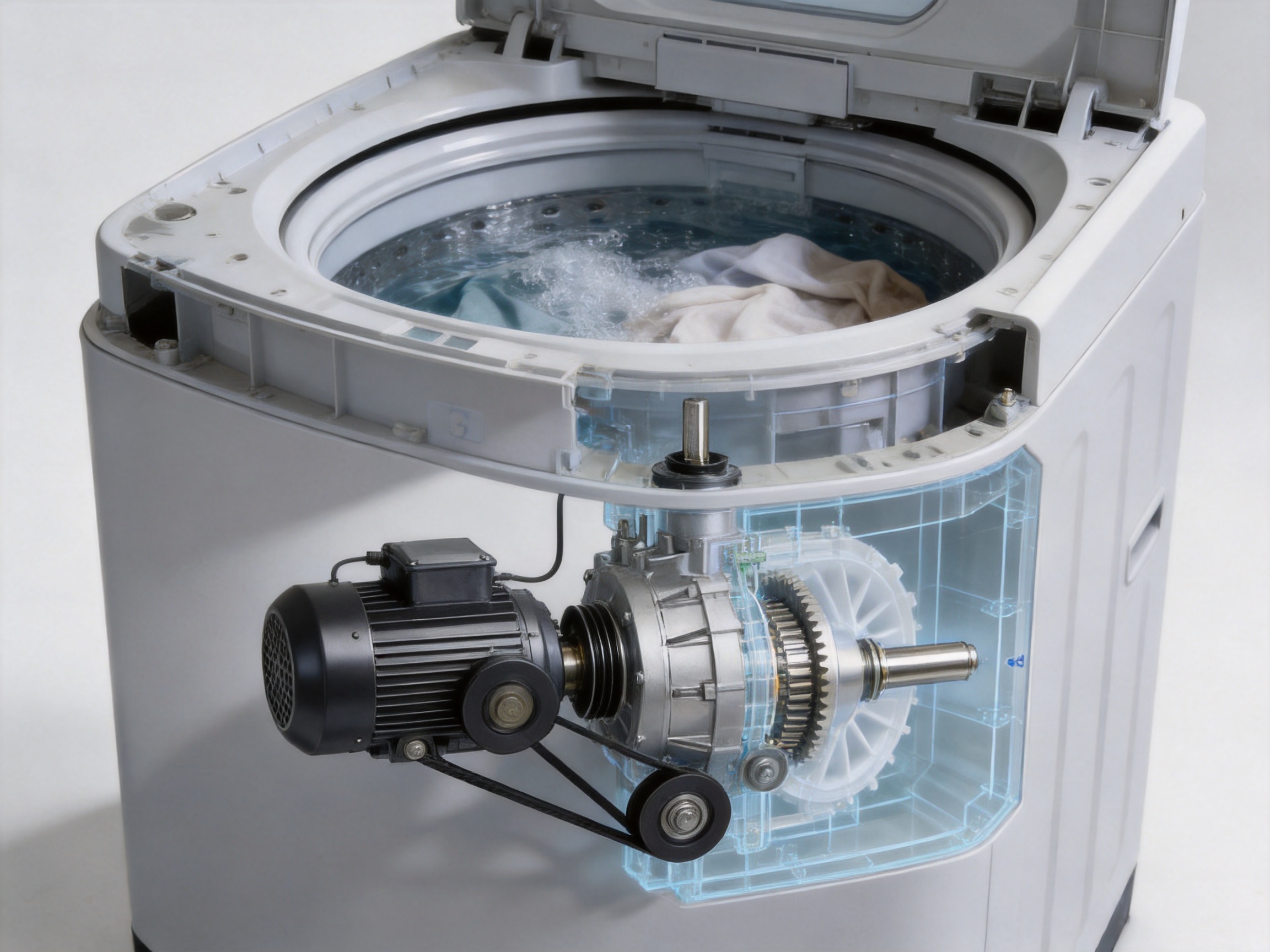
The transmission converts the motor’s high-speed rotation into low-speed, high-torque output. This conversion is essential because an electric motor typically rotates much faster than an agitator should operate. Without suitable speed reduction and torque multiplication, the agitator would turn too quickly, washing performance would become unstable, and the motor could be exposed to excessive mechanical stress.
Designed for semi-automatic agitator washing machines, this washing machine transmission provides a practical balance between operating performance, durability, manufacturing efficiency, and cost. It is particularly suitable for appliance manufacturers, aftermarket distributors, repair businesses, and washing machine brands serving price-sensitive markets.
With a durable mechanical structure, stable operation in humid environments, and compatibility with customized OEM and ODM development, the transmission provides a dependable power solution for a wide range of washing machine applications.
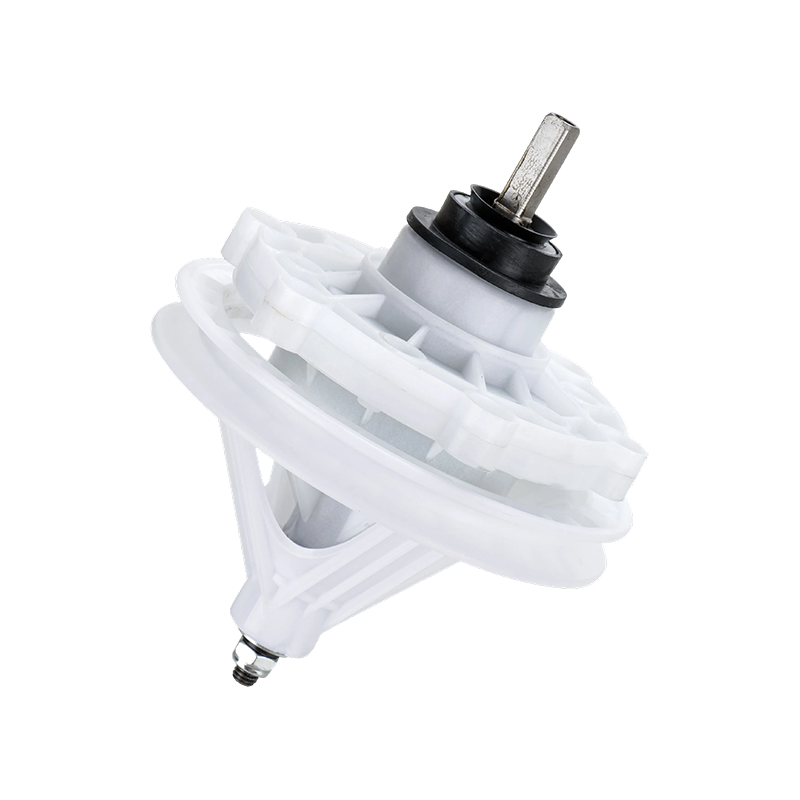
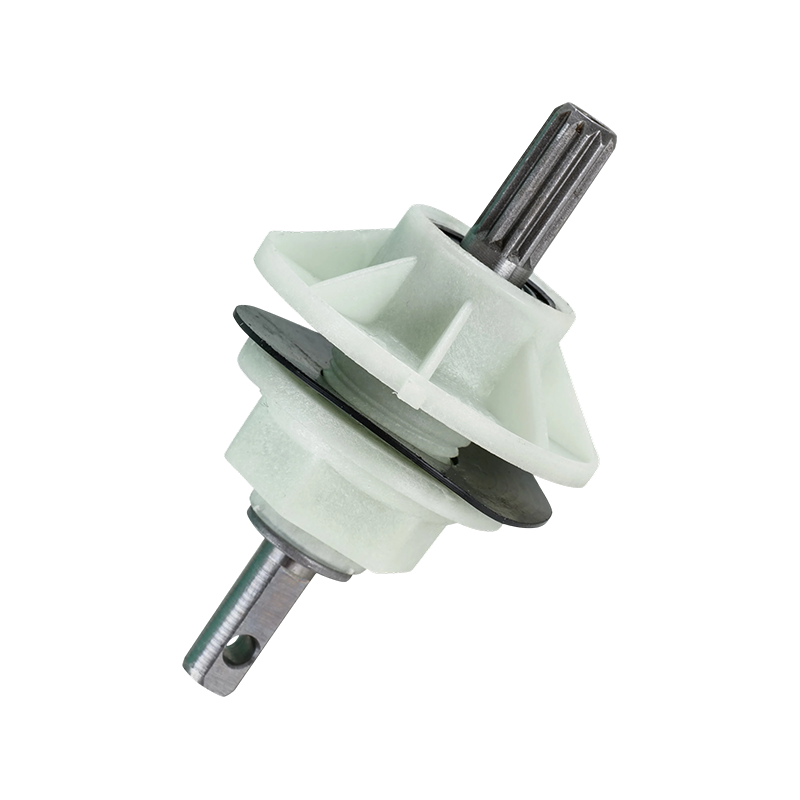
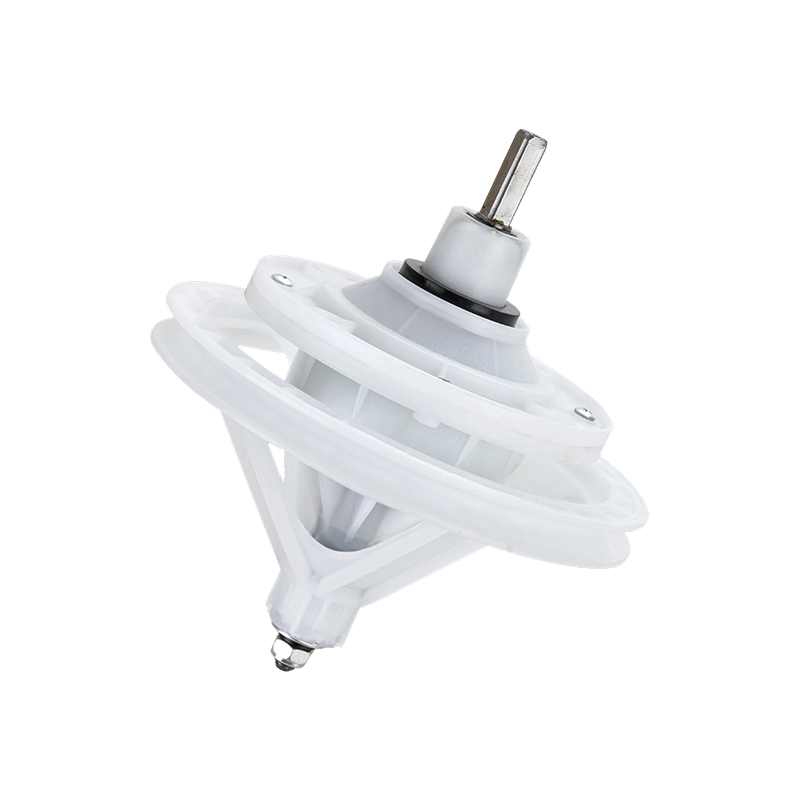
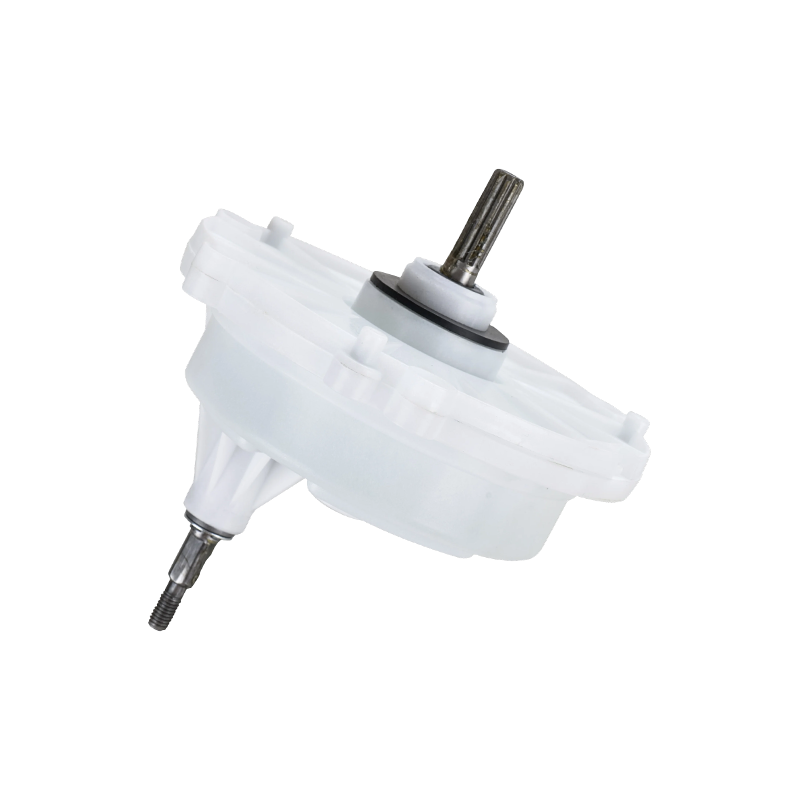
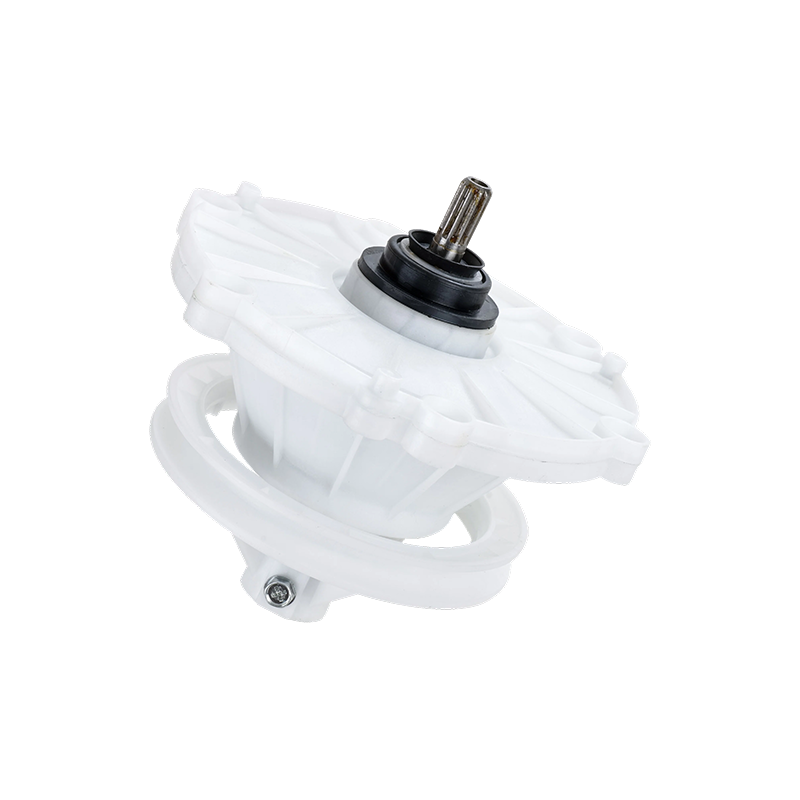
Washing Machine Transmission
1. The Role of a Transmission in a Washing Machine
The transmission acts as the mechanical connection between the washing machine motor and the agitator system. Its main task is to receive high-speed rotational input from the motor and transform it into controlled output that is appropriate for washing clothes.
During operation, the motor produces rotational energy at a speed that is generally unsuitable for direct agitator use. The agitator requires a slower movement with stronger turning force so that it can circulate water, detergent, and garments effectively inside the wash tub. The transmission performs this speed and torque conversion through its internal gearing and rotating components.
In a semi-automatic washing machine, the agitator must generate enough mechanical force to move a load of wet clothing through water. Wet garments are considerably heavier than dry garments, and the water inside the tub creates additional resistance. The transmission must therefore provide sufficient torque during startup, direction changes, and continuous agitation.
A well-designed transmission also helps maintain stable movement. If the output speed changes excessively under load, the washing process may become inconsistent. If the internal gears are poorly aligned, the appliance may produce abnormal noise, vibration, or premature wear. For this reason, the transmission is not simply a speed-reduction device; it is a precision power-transfer assembly that directly influences appliance quality.
The component can also help protect the motor and other drive elements. By controlling the relationship between motor speed and agitator speed, it reduces the possibility of excessive mechanical shock. A suitable transmission distributes operating forces across its gears, shafts, bearings, seals, and housing, allowing the entire drive system to work more efficiently.
1.1 High-Speed Motor Input
Electric motors are designed to rotate rapidly and efficiently. However, direct motor output is generally too fast for an agitator. Direct connection could cause excessive water turbulence, inefficient clothing movement, unnecessary noise, and a greater risk of mechanical damage.
The transmission accepts this high-speed input through its input shaft or related drive connection. The internal gear arrangement then reduces the rotational speed while increasing the available torque at the output shaft.
1.2 Low-Speed, High-Torque Output
The output shaft is connected to the agitator or the relevant washing mechanism. At this point, the rotation is slower and stronger, which is better suited to moving clothing through the wash water.
The low-speed output supports controlled agitation and helps the machine maintain washing action when the tub contains a heavy load. This characteristic is particularly important for household washing machines that must operate reliably with different fabric types, load sizes, and water levels.
1.3 Mechanical Stability
The transmission must maintain its operating position while absorbing torque, vibration, and repeated load changes. Its housing, shafts, bearings, and internal gears work together to preserve alignment.
Mechanical stability helps reduce noise and vibration, supports longer component life, and improves the user’s perception of appliance quality. A stable transmission also makes the washing machine easier to service because the drive system is less likely to experience abnormal wear caused by misalignment.
2. Product Overview
The washing machine transmission is developed for semi-automatic agitator washing machines and washing machine systems that require a compact, economical, and reliable drive component.
Its primary product characteristics include a speed-reduction function, high-torque output, durable internal components, suitability for humid operating conditions, and compatibility with OEM and ODM requirements. The transmission is intended to provide consistent mechanical performance while supporting practical production costs.
Because washing machines operate with water, detergent, moisture, and changing temperatures, their internal mechanical components must be designed with environmental conditions in mind. The transmission therefore needs suitable housing protection, reliable sealing arrangements, appropriate material selection, and manufacturing accuracy.
The product is also suitable for markets where affordability is an important purchasing factor. A transmission that combines reliable performance with controlled manufacturing costs can help washing machine manufacturers develop competitive products without unnecessarily increasing the final appliance price.
For distributors and aftermarket customers, the value of the product includes stable supply, repeatable specifications, and the possibility of sourcing a component that can be integrated into different appliance programs. For original equipment manufacturers, the product can serve as a standard component or as the basis for a customized drive solution.
3. Main Advantages of the Washing Machine Transmission
3.1 Efficient Speed Reduction
The transmission efficiently changes the motor’s high-speed rotation into a slower output suitable for agitation. This is the core function of the component and the foundation of reliable washing performance.
Effective speed reduction allows the agitator to move at a controlled rate rather than simply following the much faster motor speed. This improves the relationship between water movement and garment movement, helping the washing machine clean clothes more consistently.
Controlled output speed can also contribute to lower mechanical stress. When the agitator operates at an appropriate speed, the gears, shaft, tub, and connected parts do not need to withstand unnecessary rotational forces. This supports longer service life and helps reduce the risk of premature failure.
3.2 Strong Torque Performance
A washing machine must produce sufficient torque when starting, changing movement, and handling heavy wet clothing. The transmission increases the usable torque available at the output shaft, allowing the agitator to maintain its movement under load.
Strong torque performance is especially valuable in semi-automatic washing machines because users may place different quantities and types of clothing into the tub. Towels, denim, bedding, and other heavy fabrics create a greater load than lightweight garments. A transmission with suitable torque characteristics helps the appliance cope with these changing conditions.
3.3 Reliable Operation in Humid Environments
Water and humidity are unavoidable in washing machine applications. Even when the transmission is located in a protected area, it must be designed for an appliance environment where moisture, detergent residue, and temperature variation may occur.
Reliable operation in humid conditions depends on several factors, including housing construction, sealing design, material quality, surface treatment, assembly accuracy, and inspection procedures. A transmission manufactured with these conditions in mind can provide more stable operation than a general-purpose gear unit that has not been adapted to washing machine applications.
3.4 Practical Cost Performance
The product is designed to provide a balance between performance and price. This is important for washing machine manufacturers serving developing markets, value-oriented consumers, replacement-part distributors, and brands competing in highly price-sensitive appliance segments.
Cost performance does not mean reducing quality to the lowest possible level. Instead, it means selecting appropriate materials, simplifying production where possible, controlling process consistency, reducing waste, and maintaining essential performance requirements. A well-managed manufacturing system can provide a transmission that is both economical and dependable.
3.5 Stable Mechanical Operation
Stable operation is supported by accurate component dimensions, controlled gear engagement, reliable shaft alignment, and appropriate assembly methods. When these factors are managed correctly, the transmission can operate with reduced vibration and more predictable noise characteristics.
Stable mechanical operation is valuable throughout the product life cycle. It improves user comfort, reduces stress on associated components, and helps manufacturers maintain consistent appliance performance across different production batches.
3.6 Suitability for OEM and ODM Programs
Washing machine manufacturers often require more than a standard catalog component. Different appliance designs may use different shaft dimensions, mounting positions, output arrangements, gear ratios, or housing configurations. The transmission can therefore be developed as part of an OEM or ODM program.
Customization may involve mechanical interfaces, mounting structures, dimensional changes, materials, packaging, labeling, or other application-specific requirements. Early technical communication between the customer and manufacturer helps ensure that the final transmission matches the washing machine design.
4. Comparison with Less Specialized Alternatives
Not all gearboxes or power-transmission products are equally suitable for washing machine use. A general industrial gearbox may provide speed reduction, but it may not be optimized for compact appliance installation, intermittent agitation, humid environments, repeated starting cycles, or cost-sensitive production.
| Evaluation Area | Washing Machine Transmission | Generic Gear Unit |
|---|
| Application focus | Designed for semi-automatic agitator washing machines | Designed for broad industrial or mechanical applications |
| Output requirement | Low-speed, high-torque agitation output | May not match agitator speed or torque requirements |
| Environmental consideration | Developed with humid appliance conditions in mind | Environmental suitability may vary significantly |
| Installation | Can be adapted to washing machine mounting and shaft interfaces | May require additional adapters or structural changes |
| Cost structure | Suitable for high-volume, price-sensitive appliance production | May include unnecessary capacity or industrial features |
| Customization | Supports OEM and ODM development | Customization may be limited or expensive |
| Supply relationship | Can be developed as a long-term appliance component program | Often supplied as a general-purpose standard item |
The advantage of a washing machine-specific transmission is that its design priorities are closely connected to appliance requirements. The product is not evaluated only by its nominal gear ratio or maximum torque. It must also fit the washing machine structure, support repeated washing cycles, tolerate moisture, maintain acceptable noise, and remain economical for mass production.
A specialized component can reduce the need for design compromises. Instead of adapting a general gearbox with extra brackets, couplings, or protective arrangements, an appliance manufacturer can work with a component that is intended for the required application.
Another important difference is development communication. When a manufacturer understands washing machine drive systems, it can discuss not only the transmission itself but also the relationship between the motor, agitator, tub, mounting structure, shaft, seal, and control system. This broader understanding can improve project efficiency and reduce integration problems.
5. Internal Design Considerations
5.1 Gear System
The gear system is responsible for reducing speed and increasing torque. Gear geometry, tooth accuracy, material selection, heat treatment, lubrication, and assembly alignment all affect performance.
Gear teeth must engage consistently throughout operation. Poor tooth accuracy or incorrect alignment can create excessive friction, noise, heat, and wear. Consistent gear manufacturing helps distribute load more evenly and supports reliable operation during repeated washing cycles.
5.2 Input and Output Shafts
The input shaft transfers power from the motor or motor-related drive assembly into the transmission. The output shaft transfers the reduced-speed torque to the agitator mechanism.
Shaft dimensions, concentricity, surface condition, and connection geometry are essential to proper installation. Depending on the washing machine design, the shaft may use a specific profile, keyway, threaded section, or other connection method. These details must be confirmed during the engineering stage.
5.3 Bearings and Support Structures
Bearings support rotating components and help control friction. Their position and fit influence shaft stability, gear alignment, noise, and service life.
The transmission housing must hold the bearings and internal parts in their correct positions. If the housing lacks sufficient stiffness or if assembly tolerances are not controlled, the internal components may shift under load. A robust support structure helps preserve mechanical accuracy throughout repeated operation.
5.4 Sealing and Protection
Sealing elements help reduce the possibility of water, detergent, or contaminants entering sensitive internal areas. They also help retain lubricant where it is needed.
Seal performance depends on material compatibility, contact pressure, shaft surface quality, installation accuracy, and the surrounding housing design. Appropriate sealing is particularly important in washing machine applications because the transmission is located near sources of water and humidity.
5.5 Housing Construction
The housing protects the internal gear train and provides the mounting interface for the washing machine. It must be strong enough to manage torque and vibration while remaining practical for appliance production.
A well-designed housing can also support efficient assembly and inspection. Clear reference surfaces, stable mounting points, and consistent dimensional control simplify integration into the appliance production line.
6. Manufacturing Strengths and Process Control
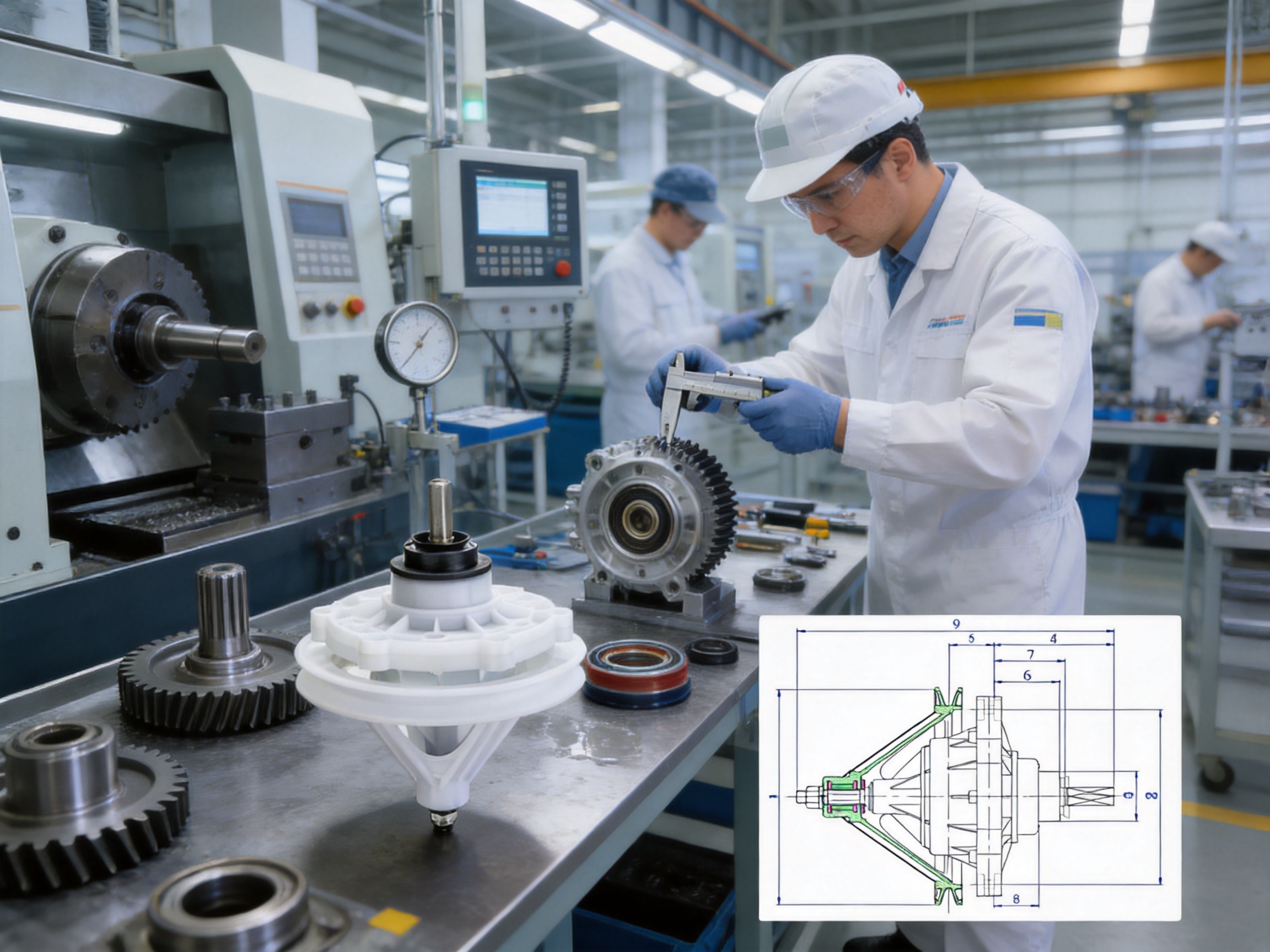
The performance of a washing machine transmission depends not only on its design but also on how consistently it is manufactured. Small variations in gear dimensions, shaft alignment, sealing position, or housing geometry can influence the performance of the finished product.
The manufacturer behind this product operates a modern production base of approximately 10,000 square meters. The company has developed manufacturing experience in washing machine components, gear reducers, synchronizers, transmissions, and related mechanical parts.
Approximately 90 percent of core materials are produced in-house. This level of internal production helps improve control over material quality, production scheduling, component compatibility, and supply stability. It can also reduce dependence on outside suppliers for critical parts and shorten the response time for technical adjustments.
6.1 Material Preparation
Material quality is the foundation of reliable transmission production. Metals and other materials used for gears, shafts, housings, fasteners, and sealing-related components must be selected according to their mechanical and environmental requirements.
Material preparation may include incoming inspection, dimensional verification, surface evaluation, and traceability management. Maintaining clear material control helps prevent unsuitable components from entering subsequent processes.
In-house production of a large proportion of core materials provides greater visibility into the manufacturing process. It enables closer coordination between design requirements and production capabilities, which is especially useful for customized OEM and ODM projects.
6.2 Precision Machining
Machining processes establish the dimensions and surface characteristics of shafts, housings, gear-related components, and mounting interfaces. Precision machining helps achieve the accuracy required for smooth assembly and stable operation.
Important machining considerations include concentricity, perpendicularity, shaft diameter, bore size, mounting-hole position, and surface finish. Maintaining these characteristics within controlled limits helps reduce assembly variation and supports consistent product performance.
6.3 Gear Manufacturing
Gear production requires careful control of tooth form, pitch, runout, hardness, and surface condition. The gear train must transmit torque while managing friction and repeated load changes.
Manufacturing processes may include forming, cutting, shaping, grinding, deburring, heat treatment, and finishing, depending on the component design and production requirements. The selected process should provide an appropriate balance between gear accuracy, durability, production capacity, and cost.
Deburring is also important. Excess material or sharp edges can interfere with assembly, contaminate lubricant, or create stress concentrations. Proper finishing helps the gear components engage more smoothly and reduces the risk of damage to adjacent parts.
6.4 Heat Treatment and Surface Management
Some transmission components require controlled heat treatment to improve hardness, wear resistance, or fatigue performance. The treatment must be matched to the material and component geometry so that the part gains the required mechanical properties without excessive distortion.
Surface management may include cleaning, protective coating, rust prevention, or other treatments. These processes help components withstand storage, transport, assembly, and operation in humid appliance environments.
6.5 Assembly
Transmission assembly requires a defined sequence. Gears, shafts, bearings, seals, spacers, lubricant, and housing parts must be installed in the correct order and orientation.
Controlled assembly reduces the risk of missing components, incorrect positioning, damaged seals, insufficient lubrication, or excessive preload. Assembly operators and production equipment must follow standardized procedures to maintain repeatability.
For high-volume appliance production, repeatability is essential. A transmission that performs well in a prototype but varies significantly during mass production will create problems for the appliance manufacturer. Process documentation, operator training, tooling control, and inspection checkpoints help address this risk.
6.6 Lubrication
Lubrication reduces friction between moving components and helps manage heat generated during operation. The lubricant must be appropriate for the gear materials, operating speed, expected load, temperature range, and appliance environment.
The quantity and distribution of lubricant are also important. Too little lubricant can increase wear and noise, while excessive lubricant may create leakage or unnecessary resistance. Controlled lubrication procedures help ensure that each transmission receives a consistent amount.
6.7 Final Inspection and Testing
Final inspection may include dimensional checks, visual inspection, rotation testing, noise evaluation, leakage checks, torque verification, and functional testing. The specific test program depends on the product design and customer requirements.
Testing helps identify problems before shipment. It also provides production feedback that can be used to improve tooling, assembly methods, material control, and process stability.
7. Quality Management and Certifications
The manufacturer operates under ISO 9001 Quality Management System certification and ISO 14001 Environmental Management System certification. These certifications support a structured approach to quality control, process management, customer satisfaction, environmental responsibility, and continual improvement.
ISO 9001 provides a framework for documenting processes, defining responsibilities, controlling production activities, monitoring performance, managing nonconformities, and improving the quality system. For washing machine component customers, this type of system can increase confidence in production consistency and supplier organization.
ISO 14001 focuses on environmental management. It encourages organizations to identify environmental impacts, control relevant processes, improve resource efficiency, and manage environmental responsibilities systematically.
The products also comply with RoHS requirements. Compliance with restrictions on hazardous substances is increasingly important for international appliance manufacturers and distributors. It supports responsible product development and helps customers meet applicable environmental expectations in their target markets.
Quality management is not limited to final product inspection. It begins with product design and continues through supplier management, material preparation, machining, assembly, testing, packaging, delivery, and after-sales support.
For a transmission, quality consistency is especially important because the component is integrated into a larger appliance system. A small issue in the transmission can affect washing noise, motor load, agitator movement, water circulation, and consumer satisfaction. A structured quality system helps reduce these risks.
8. Benefits for Washing Machine Manufacturers
8.1 Easier Product Integration
A transmission developed specifically for washing machine applications can simplify integration into a semi-automatic agitator platform. The manufacturer can discuss shaft interfaces, mounting points, motor compatibility, load requirements, and installation conditions during the development process.
This approach can reduce the need for late-stage modifications. It also helps the washing machine manufacturer evaluate the entire drive system rather than treating the transmission as an isolated part.
8.2 Support for Product Differentiation
OEM and ODM customization allows appliance manufacturers to develop different washing machine models using drive components adapted to their own product structures. Variations may include mechanical interfaces, mounting arrangements, output characteristics, and packaging requirements.
Product differentiation is important in markets where several washing machine brands compete for similar customers. A reliable transmission platform can provide a stable technical foundation while allowing the manufacturer to adjust other product features.
8.3 Controlled Production Costs
For value-oriented appliances, the drive system must meet performance expectations without adding unnecessary cost. The combination of specialized design, in-house material production, mature manufacturing processes, and production experience can support more controlled cost management.
Cost control also involves minimizing defects, reducing rework, improving material utilization, simplifying assembly, and maintaining reliable delivery schedules. These benefits can influence the total cost of ownership for the appliance manufacturer.
8.4 Stable Supply
Supply stability is critical for appliance production. A delay in receiving transmissions can interrupt assembly lines, postpone shipments, and increase inventory costs.
Internal production of most core materials gives the manufacturer greater control over availability and production planning. Combined with established manufacturing processes, this can support more predictable supply for regular orders and ongoing appliance programs.
8.5 Technical Communication
Effective technical communication helps avoid misunderstanding during product development. Customers can provide drawings, samples, performance requirements, installation information, and target-market expectations. The supplier can then evaluate feasibility and recommend appropriate solutions.
Clear communication is also useful when replacing an existing transmission. Measurements such as shaft diameter, mounting dimensions, output height, gear ratio, motor connection, and load requirements should be confirmed before a replacement is approved.
9. Benefits for Aftermarket Distributors and Repair Businesses
The aftermarket requires components that are practical to stock, easy to identify, and suitable for repeated replacement demand. A washing machine transmission designed for semi-automatic agitator machines can serve distributors and repair businesses seeking a dependable replacement solution.
Reliable dimensions and repeatable specifications help reduce compatibility problems. Distributors can organize products according to washing machine model, transmission type, shaft configuration, or other identification information.
Repair businesses benefit when the replacement component can be installed without extensive modification. A suitable transmission can reduce service time and help technicians restore the washing machine to normal operation more efficiently.
Long-term supplier cooperation is also valuable in the aftermarket. When a supplier can provide technical confirmation, consistent product quality, and stable replenishment, distributors can manage inventory more confidently.
Before ordering, aftermarket customers should verify the original transmission’s dimensions, mounting arrangement, output shaft structure, motor connection, and application. Product photographs alone may not always provide enough information for accurate identification.
10. Installation and Application Considerations
10.1 Confirm Mechanical Compatibility
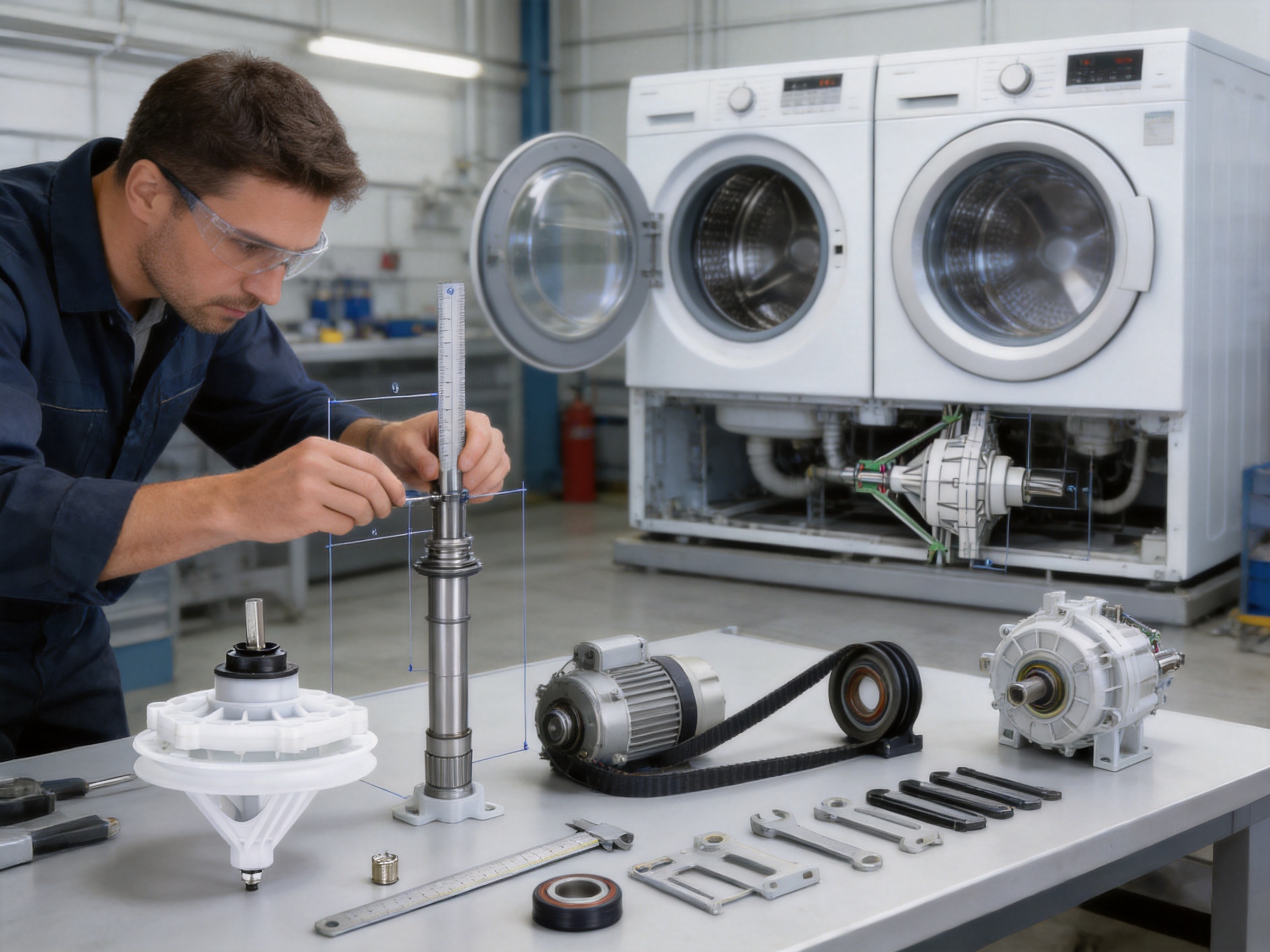
The transmission should be checked against the washing machine frame, motor, agitator, tub, belt or coupling system, and mounting structure. Important dimensions include overall height, housing width, mounting-hole position, shaft length, shaft diameter, and output connection.
Even a small dimensional difference can influence belt alignment, agitator position, sealing performance, or contact between moving parts. Technical drawings and sample verification are recommended before mass production or large-volume replacement orders.
10.2 Check Motor and Drive Matching
The motor must be compatible with the transmission’s input arrangement and operating requirements. The motor’s speed, torque, shaft structure, rotation direction, and starting characteristics may all influence transmission performance.
Where a belt drive is used, pulley dimensions and belt alignment should be checked carefully. Where a direct connection is used, the coupling and shaft interface must be correctly matched.
10.3 Confirm Agitator Requirements
The agitator design affects the required output torque and speed. Larger or more heavily loaded agitators may require different drive characteristics than smaller units.
The washing machine manufacturer should consider clothing load, water volume, wash-cycle duration, starting frequency, and expected operating environment when selecting the transmission specification.
10.4 Protect Against Incorrect Assembly
During installation, seals should not be damaged, shafts should not be forced into position, and mounting bolts should be tightened according to the appropriate procedure. Misalignment can create excessive noise and accelerate wear.
Any lubricant requirements, protective covers, spacers, or adjustment components should be handled according to the approved assembly instructions. Proper installation is essential for achieving the expected service life of the transmission.
10.5 Consider Service Conditions
Although the transmission is developed for humid washing machine environments, the appliance should still be installed and maintained properly. Excessive water leakage, damaged seals, severe vibration, or incorrect loading can shorten the life of the drive system.
Regular inspection of connected components can help identify problems before they damage the transmission. Unusual noise, slipping, agitator weakness, leakage, or repeated motor overload may indicate a problem requiring technical evaluation.
11. Why Manufacturing Experience Matters
Washing machine transmissions must operate under a combination of mechanical, environmental, and commercial requirements. They need to transmit torque, tolerate repeated cycles, fit compact appliance structures, operate near water, and remain affordable for the target market.
Manufacturing experience in washing machine gearboxes, transmissions, synchronizers, and P-shafts gives the supplier a broader understanding of appliance drive systems. This experience can help identify potential problems earlier in the design process.
A manufacturer with knowledge of related washing machine components can also coordinate product development more effectively. For example, the transmission may need to be considered together with a P-shaft, motor connection, agitator shaft, bearing arrangement, or synchronizing mechanism.
Experience also improves communication with international OEM customers. Different markets may have different appliance structures, production standards, packaging expectations, and service requirements. A supplier familiar with long-term appliance projects can provide more practical support than a company that only produces isolated mechanical parts.
Established partnerships with major appliance groups demonstrate experience in serving demanding customers and supporting long-term supply relationships. Such relationships typically require consistent quality, stable delivery, technical responsiveness, and the ability to maintain product specifications over time.
12. Application Areas
The washing machine transmission is primarily intended for semi-automatic agitator washing machines. These appliances are widely used in residential settings and remain important in markets where consumers value straightforward operation, affordable pricing, and serviceable mechanical construction.
The product can be used in new washing machine development, model updates, replacement programs, and aftermarket repair applications. It may also be considered for appliance platforms that require a customized gearbox or transmission based on a specific motor and agitator arrangement.
Potential application considerations include compact twin-tub washing machines, semi-automatic top-loading systems, replacement drive assemblies, and washing machine models designed for cost-sensitive markets.
The final suitability of the product depends on the required dimensions, speed, torque, mounting arrangement, and operating conditions. Customers should provide complete technical information so that the correct specification can be confirmed.
13. OEM and ODM Development Process
13.1 Requirement Collection
The development process begins with the customer’s technical requirements. Useful information includes washing machine drawings, existing transmission samples, motor data, agitator specifications, mounting dimensions, desired output speed, torque expectations, operating cycle, and target quantity.
13.2 Engineering Evaluation
The engineering team reviews the information to assess feasibility. This stage may identify dimensional conflicts, load concerns, sealing requirements, material considerations, or opportunities to improve the design.
13.3 Prototype or Sample Development
A prototype or sample can be prepared for evaluation. The sample is installed in the washing machine or a representative test system to confirm fit, movement, noise, load behavior, and other performance requirements.
13.4 Testing and Adjustment
Testing may reveal the need for changes to gear selection, shaft dimensions, housing features, sealing arrangements, or assembly details. Adjustments are made before formal approval.
13.5 Mass Production Preparation
After approval, production documentation, inspection standards, tooling, material planning, and assembly procedures are established. Clear specifications help ensure that mass-produced transmissions remain consistent with the approved sample.
13.6 Ongoing Quality Monitoring
Quality monitoring continues after production begins. Customer feedback, inspection data, defect analysis, and process reviews can be used to support continual improvement throughout the supply relationship.
14. Maintenance and Service Recommendations
The transmission is designed to function as a durable component, but the entire washing machine system must be used correctly. Overloading the appliance can increase torque demand and place additional stress on the transmission and motor.
Users should follow the washing machine’s recommended load capacity and avoid operating the appliance when severe vibration or unusual mechanical noise occurs. Continued operation under abnormal conditions may cause damage to the transmission or associated parts.
Water leakage should be addressed promptly. Persistent leakage can affect seals, bearings, lubricant, and internal mechanical surfaces. Early repair can prevent a relatively small problem from becoming a major transmission failure.
During service, technicians should inspect the motor, belt, pulleys, couplings, agitator, mounting bolts, and transmission together. A problem in one connected component may appear to be a transmission problem, and a complete inspection can improve diagnostic accuracy.
Replacement parts should be stored in clean and dry conditions. Proper packaging and storage help protect machined surfaces, seals, and other components before installation.
15. Frequently Asked Questions
Q1: What does a washing machine transmission do?
A washing machine transmission converts the motor’s high-speed rotation into low-speed, high-torque output for the agitator. This allows the agitator to move clothing and water effectively during the washing cycle.
Q2: Which washing machines use this type of transmission?
This product is intended primarily for semi-automatic agitator washing machines. Final compatibility depends on the machine’s dimensions, motor connection, agitator structure, mounting arrangement, and required operating characteristics.
Q3: Why is high torque important in a washing machine?
High torque helps the agitator start and continue moving when the tub contains water and wet clothing. It is especially important when washing heavy fabrics or larger loads.
Q4: Can the transmission operate in a humid environment?
The transmission is developed for washing machine applications where humidity and moisture may be present. Housing protection, sealing, material selection, and correct installation remain important for reliable operation.
Q5: Is the product suitable for OEM projects?
Yes. OEM and ODM development can be considered for customers that require specific mounting dimensions, shaft configurations, output characteristics, materials, labeling, or packaging.
Q6: What information is needed to confirm compatibility?
Useful information includes the washing machine model, transmission drawings or photographs, mounting dimensions, input and output shaft measurements, motor specifications, agitator details, gear ratio, operating load, and expected production quantity.
Q7: How does in-house production benefit customers?
In-house production of approximately 90 percent of core materials provides greater control over material quality, production scheduling, process coordination, and supply stability. It can also support more efficient customization.
Q8: Does the manufacturer have quality certifications?
The manufacturer has obtained ISO 9001 Quality Management System and ISO 14001 Environmental Management System certifications. Its products comply with RoHS requirements.
Q9: Can this transmission be used as an aftermarket replacement?
It may be suitable for aftermarket replacement applications when the dimensions and performance requirements match the original unit. Compatibility should be confirmed before ordering or installation.
Q10: What symptoms may indicate a transmission problem?
Possible symptoms include unusual grinding or knocking noise, weak agitator movement, slipping, excessive vibration, leakage, abnormal heating, or repeated motor overload. These symptoms can also be caused by other components, so a complete inspection is recommended.
Q11: Why should a specialized transmission be selected instead of a generic gearbox?
A specialized washing machine transmission is developed around appliance requirements such as compact installation, agitator torque, humid conditions, repeated cycles, acceptable noise, and cost-sensitive production. A generic gearbox may not provide the same balance of characteristics.
Q12: Does the transmission require special maintenance?
The transmission is designed for reliable service, but correct appliance loading, proper installation, protection from water leakage, and timely inspection of connected components are important for long-term performance.
16. Supplier Capability and Customer Support
The manufacturer is Cixi Gaite Electric Co., Ltd., located in Cixi City, Ningbo, Zhejiang Province, China. The company was established in 2002 and specializes in the research, development, and manufacturing of core washing machine components.
Its product range includes washing machine parts, washing machine gearboxes, transmissions, gear reducers, synchronizers, and P-shafts. These products are supplied to OEM manufacturers and aftermarket customers.
The company’s manufacturing base covers approximately 10,000 square meters. Its production capabilities, internal material control, quality systems, and experience with international appliance customers support the development of practical and reliable drive solutions.
Customers seeking technical information, OEM or ODM cooperation, replacement-part confirmation, or project quotations may contact the company through its sales and service channels. The stated contact person is Jane Lu.
Business contact information includes the telephone numbers +86-574-63256717 and +86-574-63267914, the email address gaite@gaite.cn, and the WhatsApp number 008615867503650. The production address is No. 208 Miaoshan Road, Shiyan Village, Henghe Town, Cixi City, Ningbo City, Zhejiang Province, China.
17. Conclusion
The washing machine transmission is a critical power-transfer component for semi-automatic agitator washing machines. By converting high-speed motor rotation into low-speed, high-torque output, it enables the agitator to move clothing and water effectively while helping protect the wider drive system from excessive mechanical stress.
The product offers several practical advantages: efficient speed reduction, strong torque performance, suitability for humid appliance environments, stable mechanical operation, cost-conscious design, and support for OEM and ODM customization.
Its value is strengthened by the manufacturer’s experience in washing machine components, modern production facilities, in-house control of most core materials, structured quality management, environmental management certification, RoHS compliance, and long-term cooperation with major appliance customers.
For washing machine manufacturers, the transmission can provide a stable foundation for new product development and model updates. For aftermarket distributors and repair businesses, it can serve as a reliable replacement option when the mechanical specifications are correctly matched.
Successful application depends on proper compatibility confirmation, accurate installation, suitable motor and agitator matching, and appropriate appliance operation. When these conditions are managed effectively, the washing machine transmission can deliver dependable performance, practical service life, and competitive total value for a broad range of semi-automatic washing machine programs.
References
1. ISO 9001, Quality Management Systems — Requirements.
2. ISO 14001, Environmental Management Systems — Requirements with Guidance for Use.
3. RoHS Requirements for the Restriction of Hazardous Substances in Electrical and Electronic Equipment.
4. General Principles of Gear Design, Power Transmission, and Mechanical Drive Engineering.
5. Appliance Engineering Practices for Washing Machine Drive Systems.
6. Manufacturer-provided product information for washing machine transmissions, gearboxes, P-shafts, and related components.
7. Manufacturer-provided information concerning production facilities, in-house material control, quality certifications, OEM services, and ODM development.

 English
 عربى



 +86-574-63256717 /63267914
info@gaite.cn
 gaite@gaite.cn
 No. 208 Miaoshan Road, Shiyan Village, Henghe Town, Cixi City, Ningbo City, Zhejiang Province, China
