A washing machine gear case is one of the most important transmission components in a semi-automatic agitator washing machine. Although it operates inside the appliance and is not visible to the user, it directly influences washing action, torque delivery, operating stability, service life, and overall product value. By converting the high-speed rotation of the motor into controlled, low-speed, high-torque output, the gear case enables the agitator to move clothes and water effectively throughout the wash cycle.
For washing machine manufacturers, distributors, repair companies, and aftermarket suppliers, selecting the right gear case is essential. A transmission component must deliver dependable power while tolerating repeated starting, stopping, reversing, vibration, moisture, and variable loads. It must also be manufactured with consistent dimensions so that it can be assembled efficiently and operate correctly with related parts such as the motor, agitator, shafts, seals, bearings, and housing.
The washing machine gear case supplied by Cixi Gaite Electric Co., Ltd. is designed for these demanding operating conditions. It combines practical transmission performance, durable construction, manufacturing consistency, and cost advantages. Its design is intended for semi-automatic agitator washing machines and provides a stable mechanical connection between the drive motor and the agitator system.
With experience in washing machine components, in-house material production, modern production equipment, and established quality management systems, the manufacturer is positioned to provide both standard and customized drive component solutions. These strengths make the gear case suitable for OEM projects, ODM development, equipment maintenance, replacement-part distribution, and long-term supply programs.
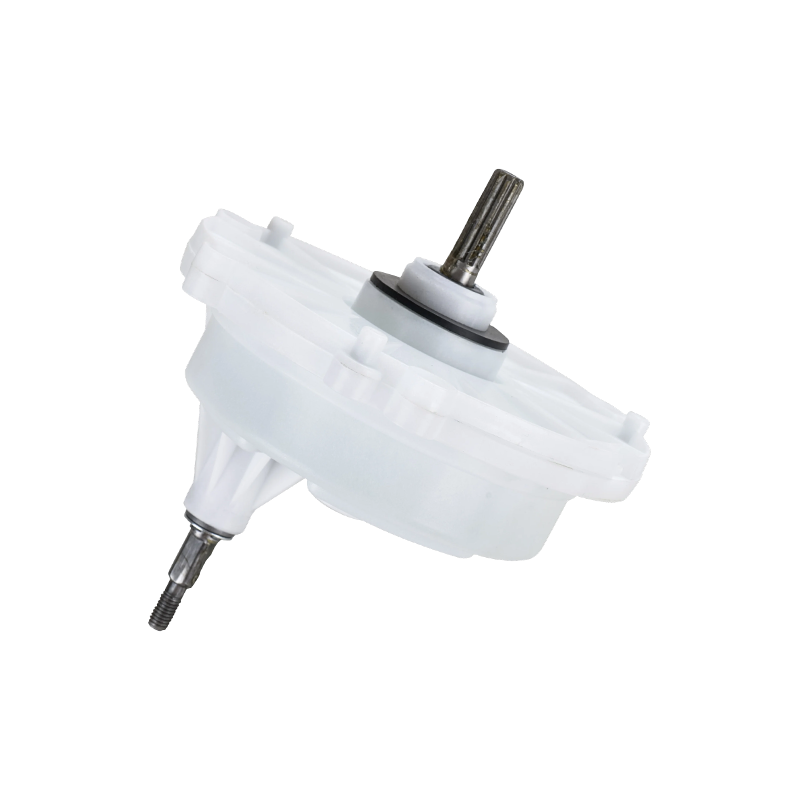
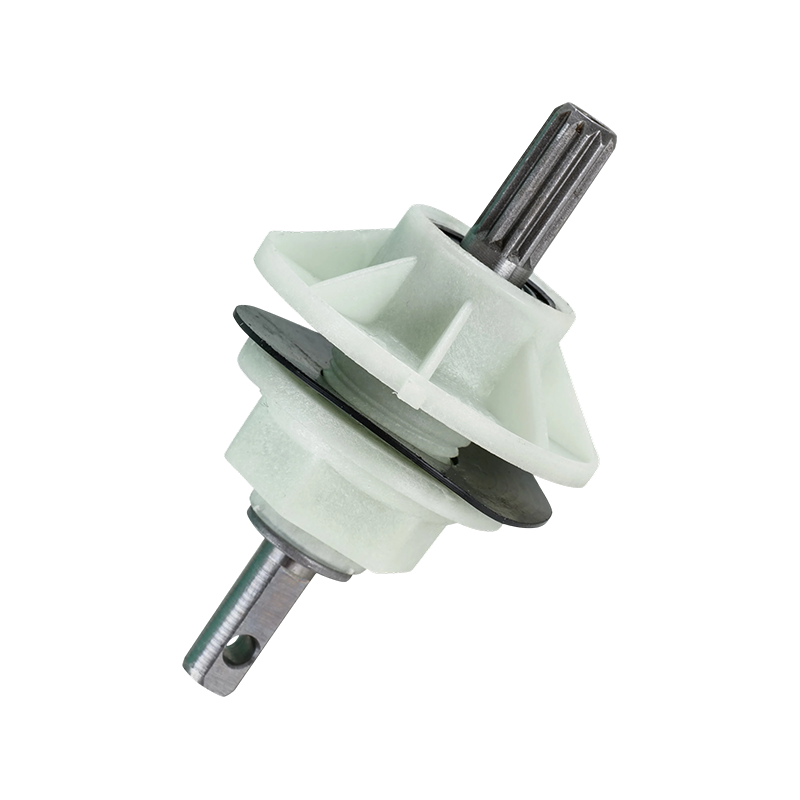
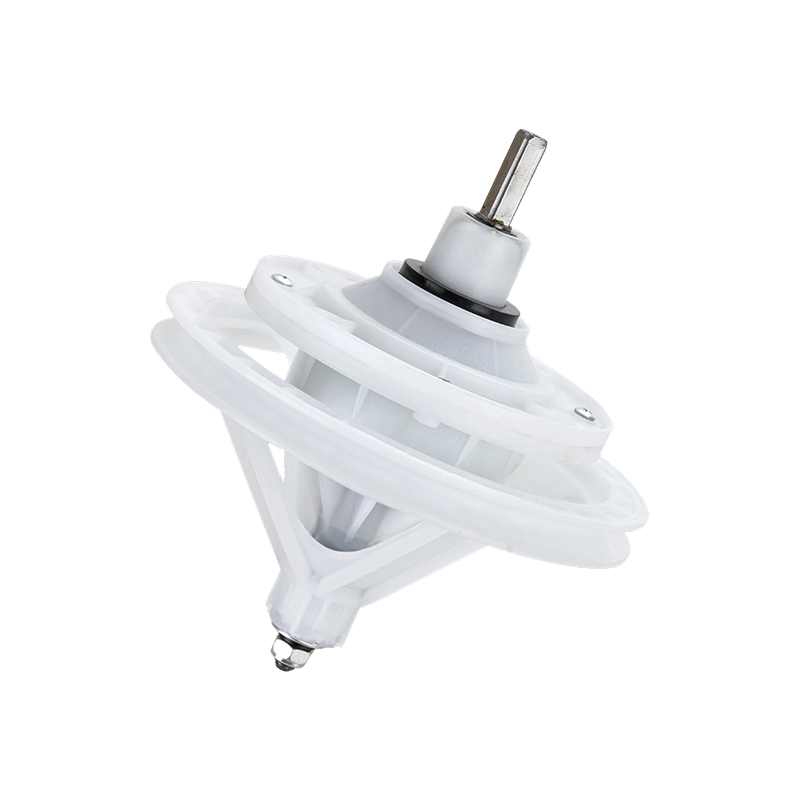
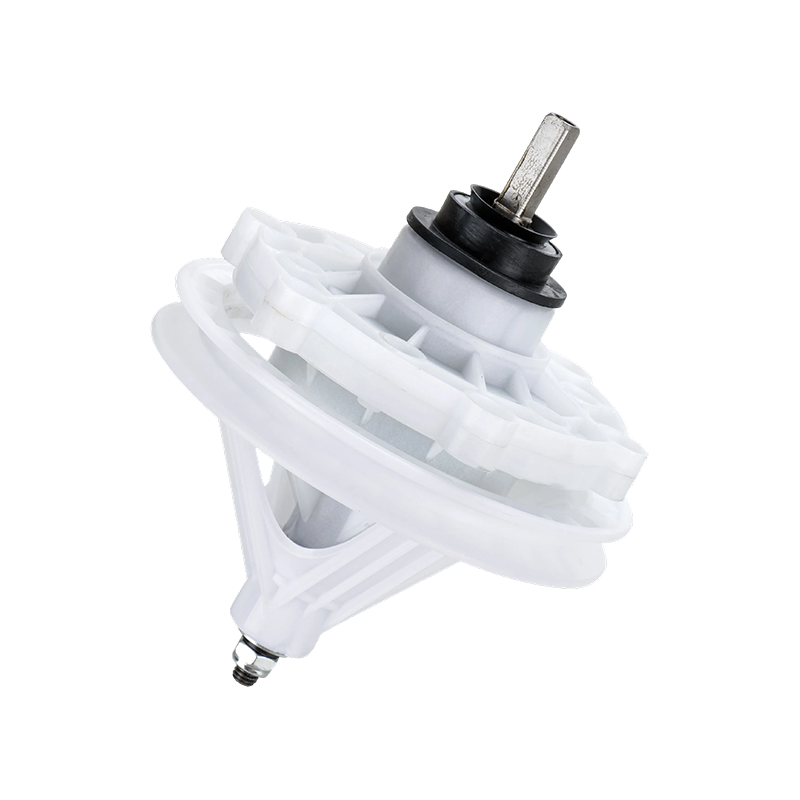
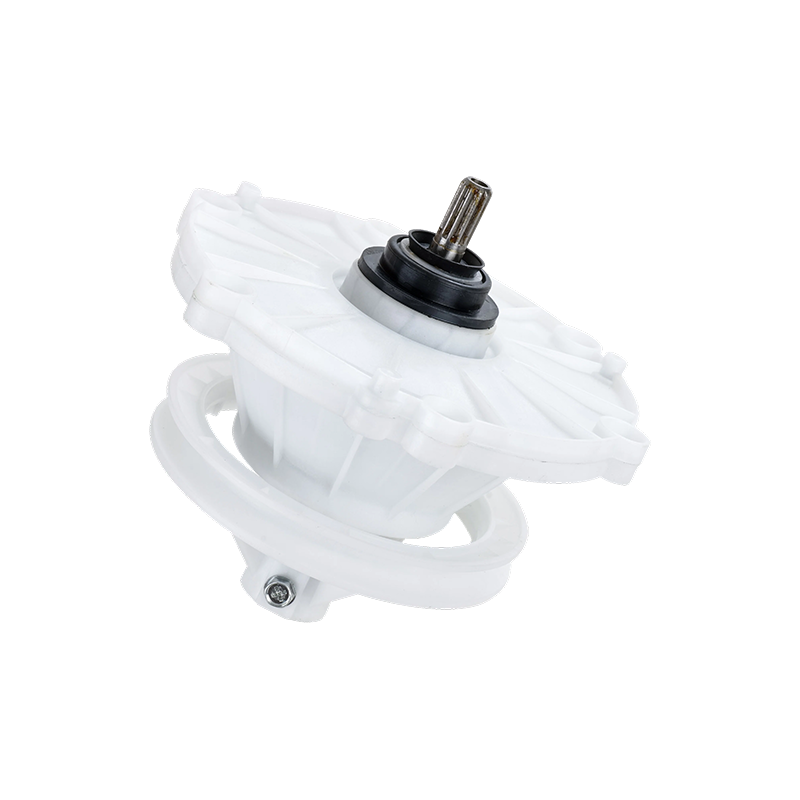
Washing Machine Gear Case
What Is a Washing Machine Gear Case?
A washing machine gear case is a mechanical transmission assembly used to transfer and modify the rotational movement produced by the motor. The motor normally operates at a relatively high speed, while the agitator requires a lower speed and significantly greater torque. The gear case performs this conversion through a coordinated system of gears, shafts, bearings, seals, and housing components.
In a semi-automatic agitator washing machine, the motor must generate enough force to move clothing, detergent solution, and water together. The load is not constant. During operation, the agitator may encounter light fabric, heavy garments, tangled clothing, or unevenly distributed loads. The gear case therefore needs to provide controlled output under changing resistance rather than simply transferring motor speed directly to the agitator.
The gear case also supports the mechanical alignment of the transmission system. Its housing protects internal components and helps maintain the correct relationship between rotating parts. Proper alignment reduces unnecessary friction, limits vibration, and helps prevent premature wear. A well-designed housing also contributes to sealing performance, which is particularly important in a washing machine environment where humidity, splashing, detergent residue, and temperature changes may occur.
In practical terms, the gear case serves several functions:
• It reduces motor speed to an appropriate agitator speed.
• It increases available output torque.
• It transfers rotational power through the transmission shaft.
• It supports stable agitator movement during washing.
• It helps protect gears, bearings, and shafts from environmental contamination.
• It contributes to the overall reliability and serviceability of the washing machine.
How the Gear Case Supports Washing Performance
The quality of washing action depends partly on how effectively the agitator moves water and fabric. If the transmission output is too fast, the machine may produce unstable movement, excessive mechanical stress, or inefficient water circulation. If the output torque is insufficient, the agitator may struggle under load and fail to generate consistent movement through the wash basket.
A correctly designed gear case balances speed and torque. It receives the motor’s rotational input and delivers a more suitable output for the agitator. This conversion enables the agitator to generate the repeated movement required to loosen soil, circulate detergent solution, and distribute water through the clothing load.
Stable torque delivery is especially important during startup. When the washing machine begins a cycle, the motor and transmission must overcome static resistance before the agitator reaches its operating movement. A reliable gear case helps the system manage this initial demand without excessive shock or noise. During reversing or repeated agitation, the internal gears and shafts must also tolerate changing loads and direction-related stress.
Consistent transmission performance can provide several practical benefits for washing machine manufacturers and users:
• More dependable agitator operation.
• Better handling of different clothing loads.
• Reduced risk of irregular movement caused by transmission instability.
• Improved compatibility with the intended motor and agitator design.
• Greater confidence in long-term appliance operation.
These benefits depend on the complete transmission system, including the motor, gear ratio, shaft structure, housing, lubrication, sealing, and assembly accuracy. For this reason, the gear case must be treated as a precision functional component rather than a simple replacement box.
Key Product Advantages
Low-Speed, High-Torque Output
The primary advantage of the washing machine gear case is its ability to convert high-speed motor rotation into low-speed, high-torque output. This is the fundamental transmission requirement of an agitator washing machine. The agitator needs controlled force rather than unrestricted motor speed, and the gear case makes this possible.
By delivering torque in a more suitable range, the gear case supports the movement of water and textiles without requiring the motor to operate at an unsuitable speed. This can improve the balance between washing action, mechanical stress, energy use, and component life within the overall appliance design.
Durability in Humid Operating Environments
Washing machines naturally operate in environments where moisture and humidity are present. Even when the gear case is protected within the appliance, condensation, splashing, detergent residue, and repeated temperature changes can place demands on materials and sealing structures.
The product is designed for long-term operation in humid environments. Durable housing materials, suitable internal component selection, and appropriate sealing arrangements help protect the transmission from external conditions. The exact performance of a complete assembly depends on the appliance structure and installation, but the gear case is developed with the operating environment of washing machines in mind.
Environmental durability is an important advantage over low-cost products that may use inconsistent materials, weak sealing designs, or insufficient surface protection. A gear case that maintains its structural integrity and internal alignment over time can reduce service interruptions and support a more dependable appliance lifecycle.
Stable Mechanical Transmission
Stable output is essential for an agitator system. The washing machine gear case is intended to provide reliable mechanical power during repeated cycles, including starting, running, stopping, and reversing operations. Consistent transmission helps reduce irregular movement and supports predictable appliance performance.
Stable operation also benefits manufacturers during product development and quality verification. When the transmission characteristics are consistent from unit to unit, engineers can design the associated motor, control system, agitator, and mounting structure with greater confidence.
Cost-Effective Component Selection
In the washing machine market, cost control must be balanced with durability and performance. A component that is inexpensive but unreliable may increase warranty costs, returns, maintenance requirements, and customer dissatisfaction. Conversely, an unnecessarily complex or over-specified component may raise product cost without creating proportional value.
This gear case design combines practical durability with cost advantages. It is intended to provide the necessary transmission function without adding unnecessary complexity. The result is a component suitable for manufacturers and distributors that need reliable performance at a competitive cost.
Cost effectiveness is supported not only by the initial purchase price but also by manufacturing consistency, supply stability, compatibility with production requirements, and expected service life. These factors are particularly important for OEM customers and aftermarket suppliers that purchase components in continuing volumes.
Suitability for OEM and ODM Applications
The washing machine gear case can be considered for original equipment production, replacement-part supply, and customized development programs. OEM customers may require a component that matches an existing washing machine structure, while ODM customers may seek support during the design of a new appliance or transmission system.
Customization may involve dimensional requirements, shaft specifications, mounting details, material selection, sealing arrangements, packaging, labeling, or other project-specific conditions. The feasibility of each modification depends on engineering review and production requirements, but the manufacturer’s experience in washing machine components provides a suitable foundation for customer cooperation.
Construction and Functional Components
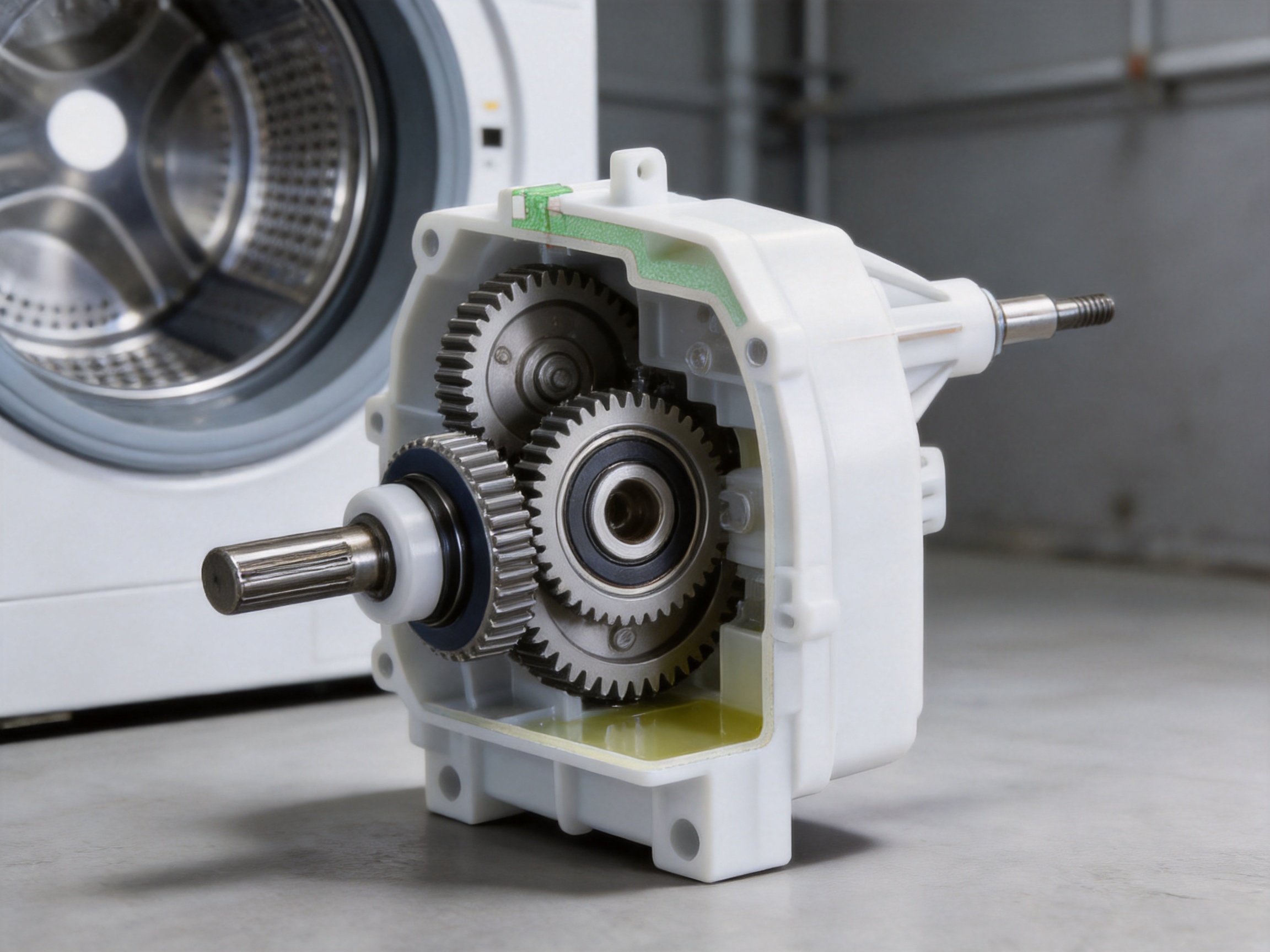
A gear case is made up of multiple parts that must work together as a complete transmission. The precise internal configuration may vary according to the washing machine model and customer requirements, but common functional elements include a housing, gear set, drive shaft, output shaft, bearings, seals, fasteners, and lubrication-related features.
Transmission Housing
The housing encloses and supports the internal transmission parts. It helps maintain the position of the gears and shafts while providing mounting points for installation in the washing machine. A rigid and accurately manufactured housing is important because distortion or dimensional inconsistency can affect gear engagement, shaft alignment, noise, and wear.
The housing also serves as a protective barrier. It limits the entry of contaminants and helps contain lubricating materials. Its external design must be compatible with the surrounding washing machine structure, including mounting brackets, motor positioning, drainage pathways, and available installation space.
Gears
The gear set is responsible for changing rotational speed and torque. Gear tooth accuracy, hardness, surface quality, and alignment all influence the efficiency and service life of the transmission. Gears that are manufactured inconsistently may cause increased noise, vibration, backlash, friction, or localized wear.
For this reason, gear production requires controlled machining and inspection. The gear materials and treatment methods should be selected according to the expected load, operating speed, lubrication conditions, and required durability. Consistent gear geometry also helps improve interchangeability between production batches.
Drive and Output Shafts
The drive shaft receives motion from the motor or associated coupling system, while the output shaft transmits the converted movement to the agitator. Shaft concentricity, surface finish, hardness, and dimensional accuracy are important to reliable operation.
A shaft that is not properly aligned can create additional radial or axial loads on bearings and seals. It may also cause vibration or uneven wear. Accurate shaft production and correct assembly therefore contribute directly to the performance of the complete gear case.
Bearings and Support Elements
Bearings support rotating shafts and help reduce friction. They must withstand the forces generated by the gear system and the agitator load. Bearing seats within the housing require suitable dimensional control so that the bearings remain correctly positioned during operation.
Support elements also help maintain gear alignment. When internal parts remain in their intended positions, the transmission can operate more smoothly and distribute loads more evenly across the gear teeth.
Sealing Structures
Seals help prevent the movement of moisture and contaminants into the transmission while retaining lubrication inside the housing. Seal selection should correspond to shaft speed, temperature, material compatibility, pressure conditions, and expected environmental exposure.
Reliable sealing is particularly valuable in washing machine applications because the appliance may be exposed to water, detergent, humidity, and vibration throughout its service life. A properly assembled seal system supports the long-term protection of internal transmission parts.
Manufacturing Strengths Behind the Product
Established Industry Experience
Cixi Gaite Electric Co., Ltd. was founded in 2002 and specializes in the research, development, and manufacturing of core washing machine components. Its product scope includes washing machine gear reducers, synchronizers, gearboxes, P-shafts, and related parts.
This specialized focus is an advantage for customers seeking a transmission supplier rather than a general-purpose manufacturer. Experience with washing machine components supports a clearer understanding of the loads, space limitations, assembly requirements, and environmental conditions associated with the appliance industry.
Long-term specialization can also improve communication between engineering, production, quality control, and customer service teams. When a supplier understands the application, it can respond more effectively to questions about dimensional compatibility, operating conditions, material options, and production feasibility.
Modern Production Base
The company operates a production base of approximately 10,000 square meters. This scale provides space for manufacturing equipment, assembly operations, inspection areas, warehousing, material handling, and engineering activities.
A suitably organized production base supports better process control. Material flow can be planned more efficiently, production stages can be monitored, and inspection activities can be integrated into the manufacturing process. These factors are important for products such as gear cases, where the final performance depends on the combined accuracy of many individual operations.
High Level of In-House Material Production
Approximately 90% of the company’s core materials are produced in-house. This is a significant manufacturing strength because internal material production can improve control over consistency, availability, and traceability.
Dependence on multiple external sources may introduce variation in material composition, hardness, dimensional stability, or delivery schedules. In-house production gives the manufacturer greater influence over critical inputs and allows production planning to respond more directly to customer demand.
Internal production does not eliminate the need for inspection or supplier management, but it can reduce supply-chain uncertainty and support more stable product quality. It also helps the manufacturer coordinate material preparation with machining, heat treatment, assembly, and final inspection requirements.
Advanced Machinery and Mature Processes
The company uses advanced machinery and mature manufacturing processes to produce washing machine components. For a gear case, manufacturing quality depends on the relationship between equipment capability, process parameters, operator training, inspection methods, and maintenance procedures.
Important process areas may include material preparation, casting or forming where applicable, machining, gear production, shaft processing, surface treatment, sealing installation, assembly, lubrication, and functional testing. Each stage has a direct or indirect effect on the performance of the finished transmission.
Modern equipment can improve repeatability and reduce variation. Mature processes can also make it easier to identify problems, establish corrective actions, and maintain stable output over continuing production runs. Together, these strengths support the requirements of OEM customers that need predictable quality at volume.
Quality Management and Product Reliability
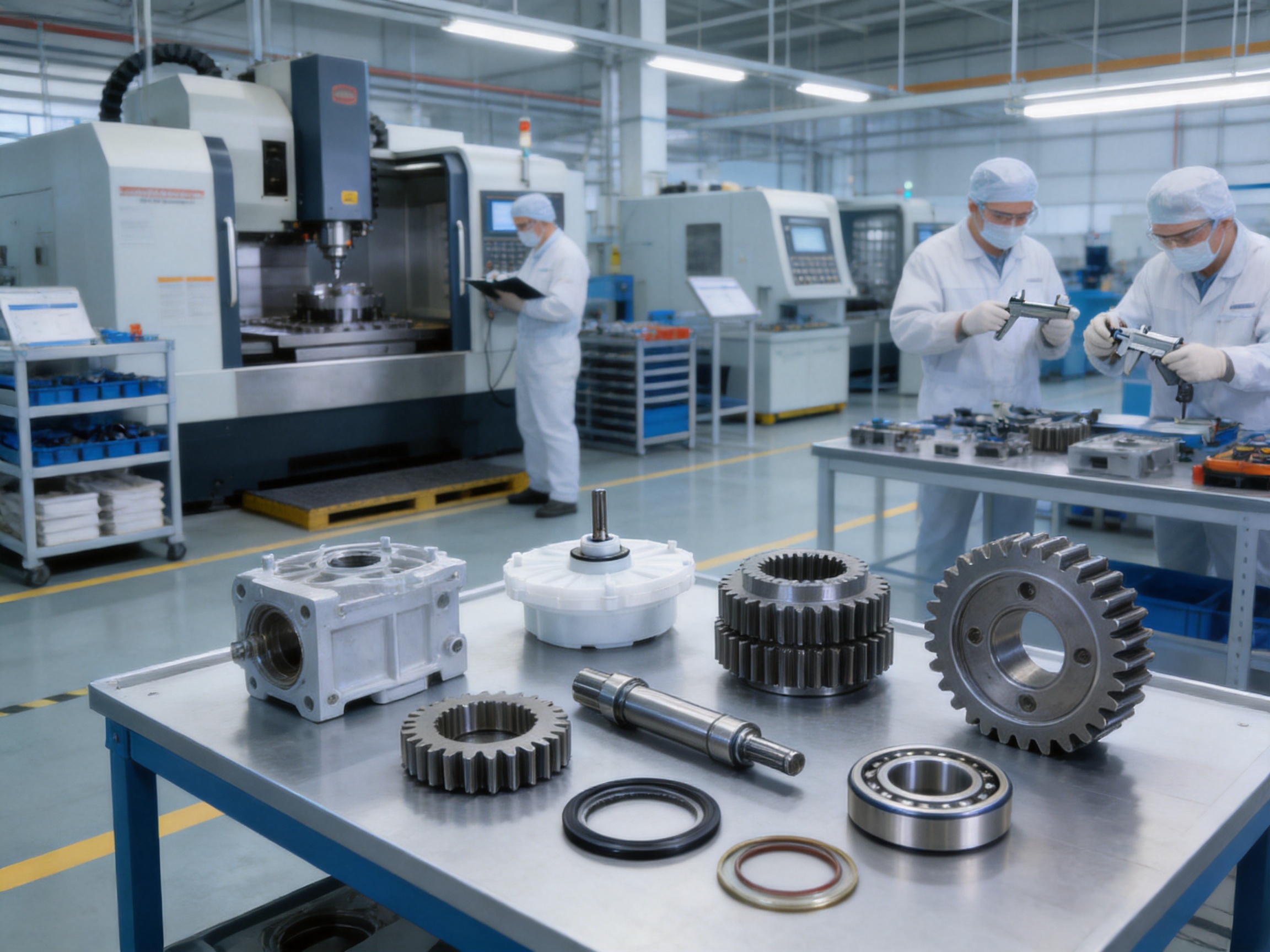
Quality management is essential for a transmission component because small dimensional or material differences can influence noise, efficiency, wear, and service life. Cixi Gaite Electric Co., Ltd. has obtained ISO 9001 Quality Management System certification, demonstrating the use of a structured approach to quality planning, process control, documentation, inspection, and continuous improvement.
The company has also obtained ISO 14001 Environmental Management System certification. Environmental management is increasingly important in the manufacturing sector, particularly for international customers that evaluate suppliers according to environmental responsibility, resource management, waste control, and process compliance.
The product complies with RoHS requirements. This supports customer expectations concerning restricted substances and responsible product manufacturing. Compliance requirements may vary by market and application, so customers should confirm the documentation and applicable standards required for their specific project.
A reliable quality program for washing machine gear cases generally involves control across several stages:
• Incoming material verification.
• Process monitoring during machining and forming.
• Dimensional inspection of housings, gears, shafts, and mounting features.
• Verification of gear engagement and rotating movement.
• Inspection of seals, fasteners, and assembly conditions.
• Functional testing of completed gear cases.
• Batch identification and production traceability.
• Corrective and preventive action when nonconformities are identified.
These procedures help ensure that quality is built into the product rather than evaluated only after production has been completed. For customers, this can reduce assembly problems, improve field reliability, and support more predictable procurement planning.
Manufacturing Process for a Washing Machine Gear Case
1. Requirement Confirmation
Production begins with a clear understanding of the customer’s technical requirements. These may include overall dimensions, mounting positions, transmission ratio, shaft specifications, operating load, appliance model, materials, sealing requirements, packaging, and expected production quantity.
Early requirement confirmation helps prevent misunderstandings and allows the engineering team to evaluate whether the proposed design can be produced consistently. For customized products, drawings, samples, three-dimensional data, or existing component references may be reviewed before tooling or production planning begins.
2. Material Preparation
Materials are selected according to the function of each part. Housing materials need appropriate strength, dimensional stability, and environmental resistance. Gear and shaft materials must be suitable for repeated mechanical loading and wear. Seal materials must be compatible with the operating environment and lubrication conditions.
Because the manufacturer produces a large proportion of its core materials in-house, it can maintain closer control over material preparation and availability. Material identification and inspection are important at this stage to ensure that the correct material is used for each component.
3. Machining and Component Production
Housings, shafts, gears, and other parts are manufactured using processes selected for their geometry and performance requirements. Machining operations may include turning, milling, drilling, grinding, broaching, gear cutting, or other specialized processes.
Process parameters must be controlled to achieve the required dimensions and surface conditions. Tool wear, machine condition, workpiece positioning, and cutting conditions can all influence accuracy. Regular inspection helps identify variation before it affects a large quantity of products.
4. Surface Treatment and Protection
Where required, components may receive surface treatment or protective processing. The purpose may be to improve wear resistance, corrosion resistance, dimensional stability, or compatibility with the operating environment.
Surface treatment must be controlled carefully because excessive coating thickness or uneven treatment can affect fit, gear engagement, bearing seats, or seal performance. Suitable inspection confirms that the processed parts remain within the applicable requirements.
5. Cleaning and Preparation
Before assembly, parts should be cleaned to remove chips, dust, processing residue, and other contaminants. Clean component surfaces are important for bearing installation, seal performance, lubrication, and gear operation.
Improper cleaning can introduce abrasive particles into the transmission and may cause premature wear. A controlled cleaning and preparation process therefore contributes to the reliability of the complete gear case.
6. Assembly
During assembly, gears, shafts, bearings, seals, housing sections, fasteners, and other components are installed in the correct sequence. Assembly accuracy is essential because the transmission depends on the precise relationship between rotating and stationary parts.
Assembly personnel may use dedicated fixtures, torque-controlled tools, measurement equipment, and process instructions. These tools help maintain repeatability and reduce the possibility of incorrect positioning or fastening.
7. Lubrication and Sealing Verification
Appropriate lubrication helps reduce friction and wear between moving parts. The type and quantity of lubricant should correspond to the transmission design, operating temperature, load, and expected service conditions.
Seals are checked during assembly to confirm correct orientation, seating, and surface condition. A damaged, displaced, or incorrectly installed seal may reduce protection against moisture and lead to leakage or contamination.
8. Functional Inspection
Completed gear cases may be checked for smooth rotation, abnormal noise, output movement, leakage, dimensional conformity, and other specified characteristics. Functional inspection provides an opportunity to identify problems that may not be visible through dimensional measurement alone.
Testing requirements vary according to the customer’s design and application. For OEM programs, the supplier and customer can define acceptance criteria that correspond to the complete washing machine system.
Comparison with Lower-Quality or Less Specialized Alternatives
Customers often compare gear cases according to price, appearance, compatibility, and delivery time. However, a meaningful comparison should also consider manufacturing control, material consistency, transmission accuracy, sealing performance, documentation, and long-term supply capability.
Less specialized alternatives may not have the same depth of experience with washing machine transmission systems. This can create challenges when a product must be adapted to a specific appliance structure or when technical problems arise during assembly and testing.
Low-cost products may also show greater variation between batches if materials and processes are not adequately controlled. Such variation can lead to differences in shaft fit, gear noise, mounting accuracy, or operating torque. The immediate purchase price may be lower, but the total cost can increase through assembly delays, returns, field repairs, and replacement requirements.
The gear case offered by GAITE is differentiated by its combination of application knowledge, in-house material production, mature processes, quality certifications, and support for OEM and ODM cooperation. These strengths are valuable for customers that prioritize reliable supply and stable performance rather than selecting solely on the lowest unit price.
| Evaluation Area | Washing Machine Gear Case | Potential Risk with Uncontrolled Alternatives |
|---|
| Application focus | Developed for semi-automatic agitator washing machine transmission requirements | Limited understanding of appliance loads, space, or mounting conditions |
| Speed and torque conversion | Designed to provide controlled low-speed, high-torque output | Unstable output or unsuitable transmission characteristics |
| Material control | Approximately 90% of core materials produced in-house | Greater dependence on variable external material sources |
| Environmental suitability | Designed for long-term operation in humid washing machine environments | Insufficient protection against moisture, residue, or corrosion |
| Manufacturing capability | Modern equipment and mature component production processes | Higher dimensional variation or inconsistent assembly |
| Quality systems | ISO 9001 and ISO 14001 certified management systems | Limited process documentation or formal improvement procedures |
| Compliance | Products comply with RoHS requirements | Unclear material declarations or market compliance documentation |
| Customization | Suitable for OEM, ODM, and aftermarket cooperation | Limited engineering support for non-standard requirements |
| Supply relationship | Long-term component manufacturing experience and established partnerships | Uncertain continuity, communication, or production planning |
Applications and Customer Segments
The washing machine gear case is primarily intended for semi-automatic agitator washing machines. It may be used in new appliance production, replacement-part programs, repair channels, and aftermarket distribution, subject to model compatibility and technical confirmation.
Washing Machine OEMs
Original equipment manufacturers require components that can be integrated into a defined product platform. The gear case must match the motor, agitator, frame, shaft arrangement, control system, and available installation space. Consistent production is particularly important because OEM assembly lines depend on predictable component dimensions and performance.
A specialized gear case supplier can support OEM customers by reviewing drawings, confirming technical specifications, coordinating samples, and planning mass production after approval. This helps reduce the risk of late-stage changes and production interruptions.
ODM and Appliance Design Companies
ODM customers may need support while developing a new washing machine model or adapting an existing transmission structure. Cooperation may begin with a concept, sample, or reference component and progress through engineering review, prototype production, testing, and volume manufacturing.
The manufacturer’s experience with gear reducers, synchronizers, P-shafts, and related washing machine parts can help customers evaluate the compatibility of the gear case with the broader drive system.
Aftermarket Distributors
Aftermarket suppliers need replacement parts that are dependable, identifiable, and suitable for the models they serve. Product consistency and clear technical communication can help distributors manage inventory and reduce incorrect orders.
Packaging, labeling, model references, and batch identification can be discussed according to the customer’s distribution requirements. Replacement-part customers should provide the original component information or washing machine model details before placing an order.
Repair and Maintenance Companies
Repair companies benefit from transmission components that can be installed with minimal adjustment and that provide dependable operation after replacement. Correct dimensional compatibility is essential, including shaft length, mounting pattern, output interface, and related assembly features.
Professional technicians should verify the condition of the motor, agitator, couplings, bearings, seals, and structural mounts before replacing a gear case. A transmission problem may sometimes be caused by another component, and replacing only the gear case may not resolve the underlying issue.
Installation and Compatibility Considerations
Before ordering a washing machine gear case, customers should confirm the technical details of the intended application. Important information may include washing machine model, motor type, agitator structure, original gear case dimensions, mounting-hole arrangement, input and output shaft dimensions, transmission direction, and operating requirements.
Compatibility should not be judged by visual appearance alone. Two gear cases may look similar but differ in shaft height, mounting position, gear ratio, seal arrangement, or output interface. Such differences can cause installation difficulty or improper operation.
The following points should be checked during technical evaluation:
• Overall gear case dimensions.
• Mounting hole positions and fastener specifications.
• Input shaft and output shaft dimensions.
• Shaft rotation direction and operating movement.
• Agitator connection method.
• Motor connection or coupling structure.
• Available clearance inside the washing machine.
• Expected load and operating cycle.
• Environmental exposure and sealing requirements.
• Lubrication and maintenance conditions.
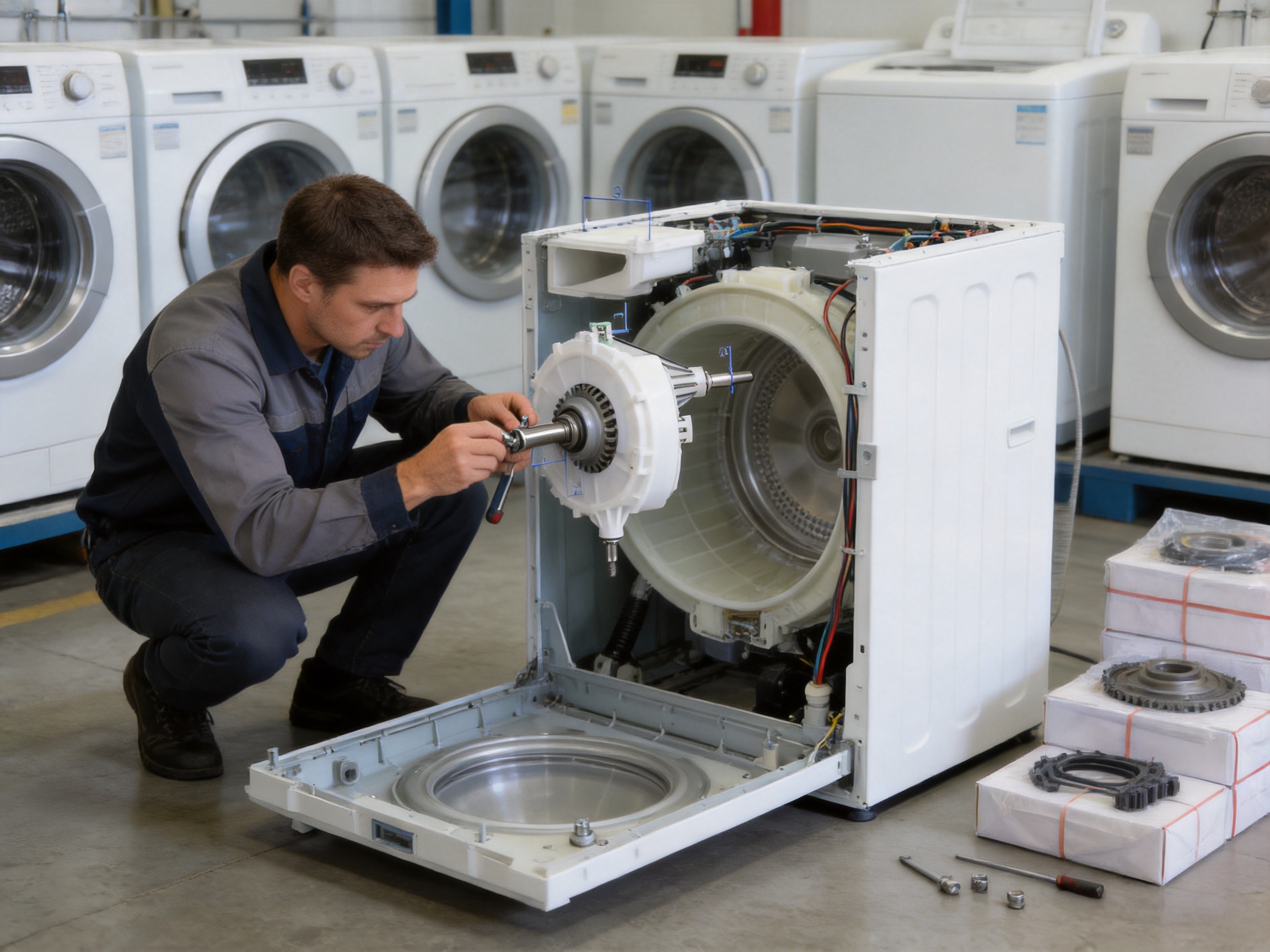
During installation, the technician should inspect the surrounding components and remove contamination from the mounting area. The gear case should be positioned accurately, fasteners should be tightened according to the applicable assembly requirements, and shafts should be aligned without forced fitting.
After installation, the washing machine should be tested under controlled conditions. Unusual noise, leakage, excessive vibration, irregular agitation, or difficulty starting may indicate a compatibility or assembly issue that requires investigation.
Purchasing and Customization Support
For efficient communication, customers should provide as much technical information as possible when requesting a quotation or product evaluation. Useful information includes drawings, photographs, samples, washing machine model numbers, annual demand, target markets, packaging requirements, and desired delivery schedule.
For a standard product, the supplier can confirm available specifications, minimum order requirements, lead time, packaging, and inspection documentation. For a customized product, engineering review may be required before price and delivery can be finalized.
Customization may be considered in areas such as:
• Housing dimensions.
• Mounting structure.
• Shaft size and length.
• Output connection design.
• Gear ratio and transmission requirements.
• Material selection.
• Sealing arrangement.
• Surface treatment.
• Product marking and packaging.
• Inspection and documentation requirements.
OEM and ODM projects typically benefit from a staged development process. This may include requirement review, technical proposal, sample or prototype production, customer testing, design adjustment, approval, pilot production, and mass production. Clear communication at each stage helps control risk and ensures that the final gear case meets the intended appliance requirements.
Company Capability and Long-Term Partnership Value
GAITE was established in 2002 in Ningbo, Zhejiang, China. The company focuses on core washing machine components and serves both OEM manufacturers and the aftermarket. Its main products include washing machine parts, washing machine gearboxes, and P-shafts.
The company has developed long-term partnerships with Sharp Corporation, Panasonic Corporation, and Midea Group. Such relationships reflect experience in supporting established appliance businesses and managing the quality, communication, and supply expectations associated with professional customers.
Its stated operating principles include customer-focused service, technological innovation, consistent quality, and continuous improvement. These principles are relevant to gear case customers because transmission components often require continuing technical support after the initial order. Product revisions, replacement requirements, quality feedback, and future appliance projects may all depend on an established supplier relationship.
The company’s approximately 10,000-square-meter production base and high level of in-house core material production provide a foundation for stable manufacturing. Advanced machinery and mature processes support efficient, precise, and cost-effective component production. ISO 9001 and ISO 14001 certifications further demonstrate the company’s commitment to systematic quality and environmental management.
Frequently Asked Questions
What is the main function of a washing machine gear case?
The main function is to convert the motor’s high-speed rotation into lower-speed, higher-torque output suitable for driving the agitator. It also supports shaft alignment, protects internal transmission components, and helps deliver stable mechanical movement during washing.
Which washing machines use this type of gear case?
The product is intended for semi-automatic agitator washing machines. Exact compatibility depends on the appliance model and the dimensions and specifications of the transmission system. Customers should confirm the model and technical details before ordering.
Why does the agitator require high torque?
The agitator must move clothing, water, and detergent solution together. The resistance changes according to the weight, type, and distribution of the clothing load. High torque helps the agitator start and continue moving under these changing conditions.
Is the gear case suitable for humid environments?
The gear case is designed for long-term operation in the humid environment associated with washing machines. Its actual service life also depends on correct installation, appliance sealing, operating conditions, maintenance, and compatibility with the complete washing machine system.
Can the gear case be customized?
OEM and ODM customization can be considered according to the project requirements. Potential customization areas include dimensions, mounting points, shaft specifications, output connections, materials, sealing arrangements, packaging, and product marking. Engineering review is required before confirming feasibility.
What information should be provided when requesting a quotation?
Customers should provide the washing machine model, original gear case information, drawings or photographs, dimensions, shaft details, mounting pattern, estimated order quantity, packaging needs, and target delivery schedule. More complete information allows the supplier to evaluate compatibility and provide a more accurate quotation.
What quality certifications does the manufacturer have?
The company has obtained ISO 9001 Quality Management System certification and ISO 14001 Environmental Management System certification. Its products comply with RoHS requirements. Additional documentation should be confirmed according to the customer’s market and project requirements.
What makes this gear case different from a generic transmission?
This product is developed specifically for washing machine drive applications and is supported by a manufacturer specializing in washing machine components. Its advantages include controlled low-speed, high-torque output, suitability for humid operating conditions, in-house production of approximately 90% of core materials, mature manufacturing processes, and OEM and ODM support.
Can the gear case be used as a replacement part?
It may be suitable for aftermarket or repair applications when the dimensions and operating specifications match the original component. Compatibility should be confirmed before installation because similar-looking gear cases may have different mounting, shaft, or transmission characteristics.
How should abnormal noise or vibration after installation be handled?
The technician should first stop operation and inspect mounting fasteners, shaft alignment, coupling condition, agitator installation, surrounding bearings, seals, and the motor. If the problem continues, the gear case specifications and installation condition should be reviewed with the supplier or qualified service personnel.
Where is the company located?
Cixi Gaite Electric Co., Ltd. is located at No. 208 Miaoshan Road, Shiyan Village, Henghe Town, Cixi City, Ningbo City, Zhejiang Province, China. Customers can contact the company for product specifications, quotations, customization discussions, and technical support.
Conclusion
The washing machine gear case is a critical component for reliable semi-automatic agitator washing machine performance. By converting high-speed motor rotation into low-speed, high-torque output, it enables the agitator to move clothing and water with controlled mechanical force. Its housing, gears, shafts, bearings, seals, and lubrication system must work together accurately to withstand repeated operation in a humid environment.
The product described here offers a practical balance of transmission performance, durability, stable operation, and cost effectiveness. Its value is strengthened by the manufacturer’s specialized experience in washing machine components, approximately 10,000-square-meter production base, advanced machinery, mature processes, and in-house production of approximately 90% of core materials.
Quality and environmental management systems certified to ISO 9001 and ISO 14001, together with RoHS compliance, provide further support for professional OEM, ODM, and aftermarket customers. The manufacturer’s experience with established appliance companies and its focus on customer service, innovation, quality, and continuous improvement make it a suitable partner for customers seeking dependable washing machine drive components.
For the best result, buyers should confirm compatibility through technical drawings, samples, model information, and operating requirements before placing an order. With accurate specification matching and proper installation, a well-manufactured gear case can provide stable transmission performance and contribute to the long-term reliability of the complete washing machine.
References
1. Cixi Gaite Electric Co., Ltd. Product Information: Washing Machine Gear Case and Washing Machine Gearbox.
2. Cixi Gaite Electric Co., Ltd. Company Profile and Manufacturing Capability Information.
3. ISO 9001, Quality Management Systems — Requirements.
4. ISO 14001, Environmental Management Systems — Requirements with Guidance for Use.
5. Restriction of Hazardous Substances Requirements for Electrical and Electronic Equipment.
6. General Mechanical Power Transmission Principles for Gear Reducers and Industrial Drive Components.
7. General Appliance Engineering Practices for Washing Machine Transmission Systems.

 English
 عربى



 +86-574-63256717 /63267914
info@gaite.cn
 gaite@gaite.cn
 No. 208 Miaoshan Road, Shiyan Village, Henghe Town, Cixi City, Ningbo City, Zhejiang Province, China
