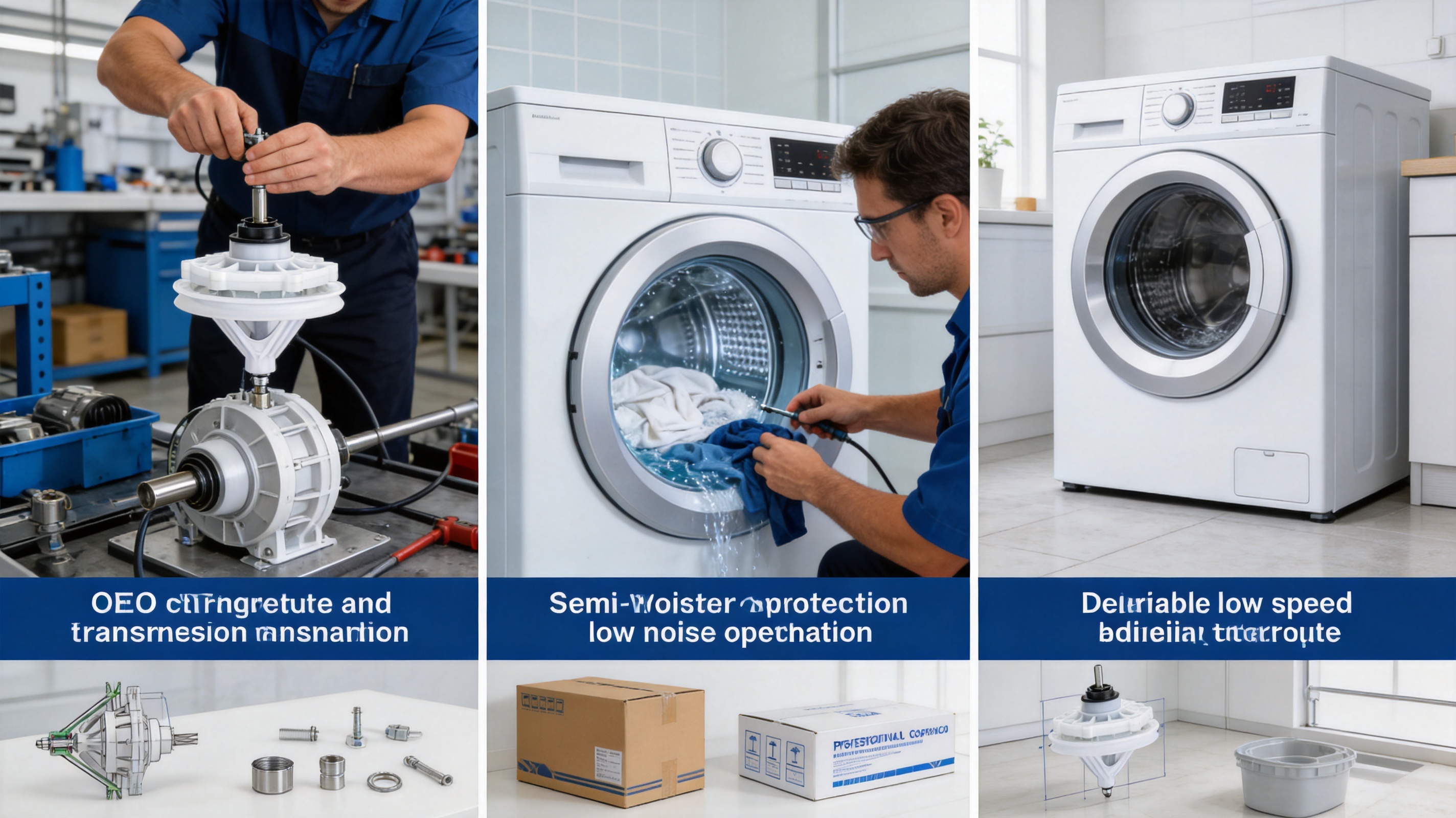
A washing machine transmission is one of the most important mechanical assemblies in a semi-automatic agitator washing machine. Positioned between the motor and the agitator mechanism, it transfers and transforms motor power so that the washing system can produce the torque, speed, and movement required for effective cleaning. Although the transmission is compact compared with the complete appliance, its performance has a direct influence on washing strength, operating noise, service life, energy use, maintenance requirements, and overall product value.
The transmission described in this article is designed to convert the high-speed rotation of a washing machine motor into lower-speed, higher-torque output suitable for an agitator. This conversion is essential because the motor generally operates at a speed that is too high for direct agitator operation. Directly connecting the motor to the agitator could result in excessive speed, insufficient usable torque, unstable movement, and accelerated wear. A properly engineered transmission solves these problems by using a controlled gear reduction system that adapts motor output to the practical requirements of washing.
For manufacturers and distributors serving price-sensitive markets, a washing machine transmission must provide more than basic power transfer. It must combine stable performance, suitable mechanical strength, resistance to humid operating conditions, repeatable manufacturing quality, and competitive production cost. The product must also be compatible with the design requirements of semi-automatic agitator washing machines, where reliable operation and ease of maintenance are often more important than unnecessary complexity.
Produced by Cixi Gaite Electric Co., Ltd., this washing machine transmission is intended for OEM, ODM, replacement, and aftermarket applications. The manufacturer specializes in washing machine gearboxes, transmissions, P-shafts, synchronizers, and other core washing machine components. With an established production base, in-house material capabilities, quality management systems, and experience serving international appliance manufacturers, the company offers a practical source for dependable washing machine drive components.
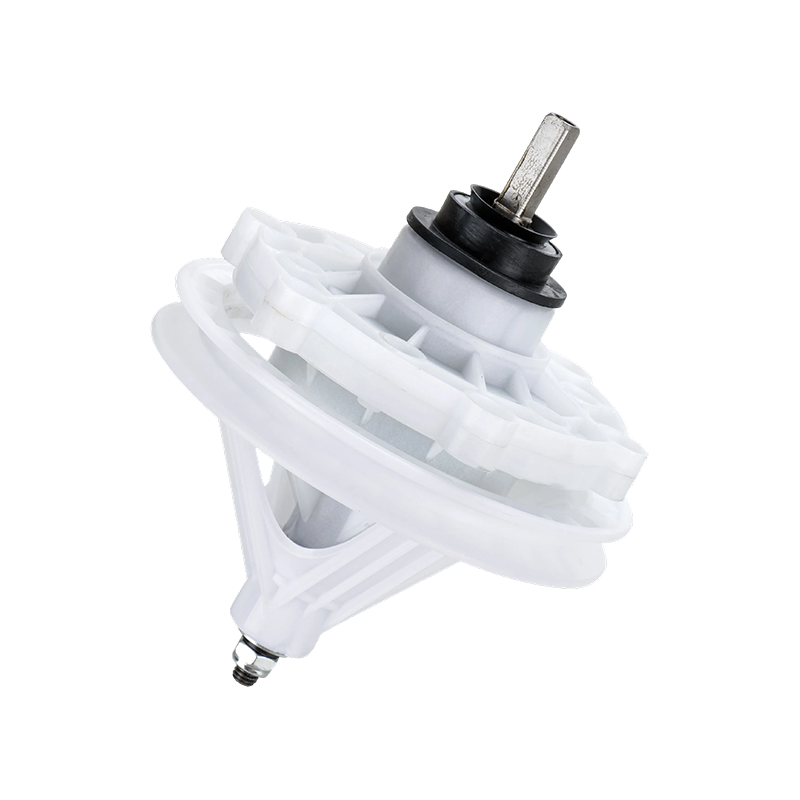
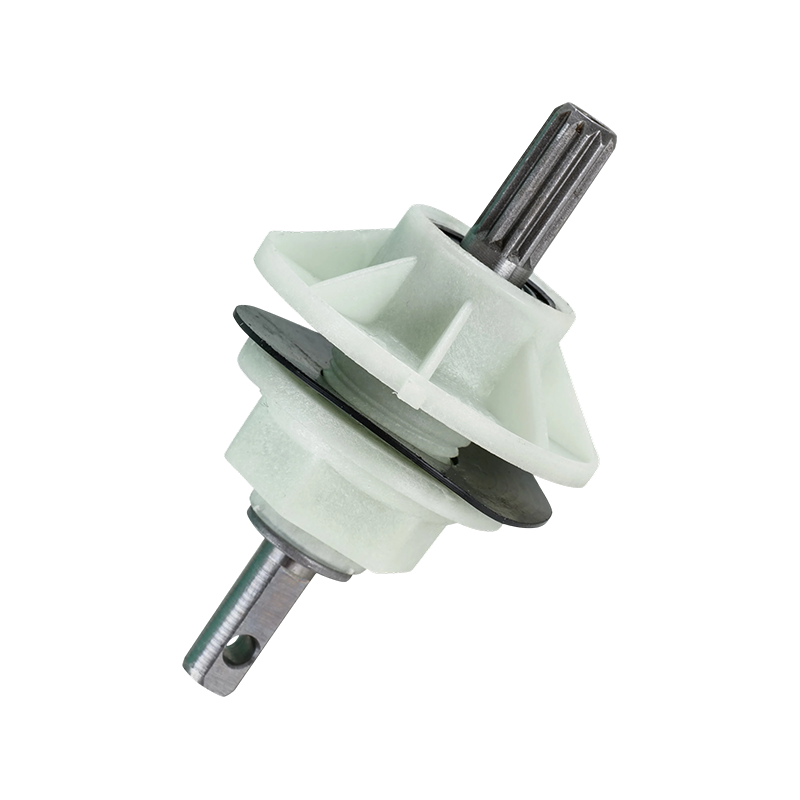
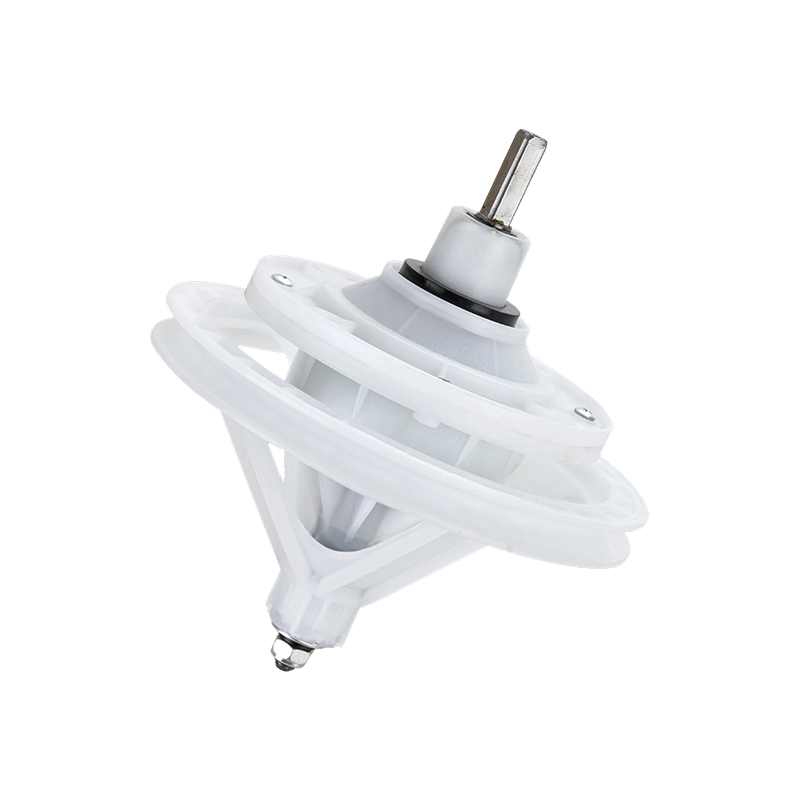
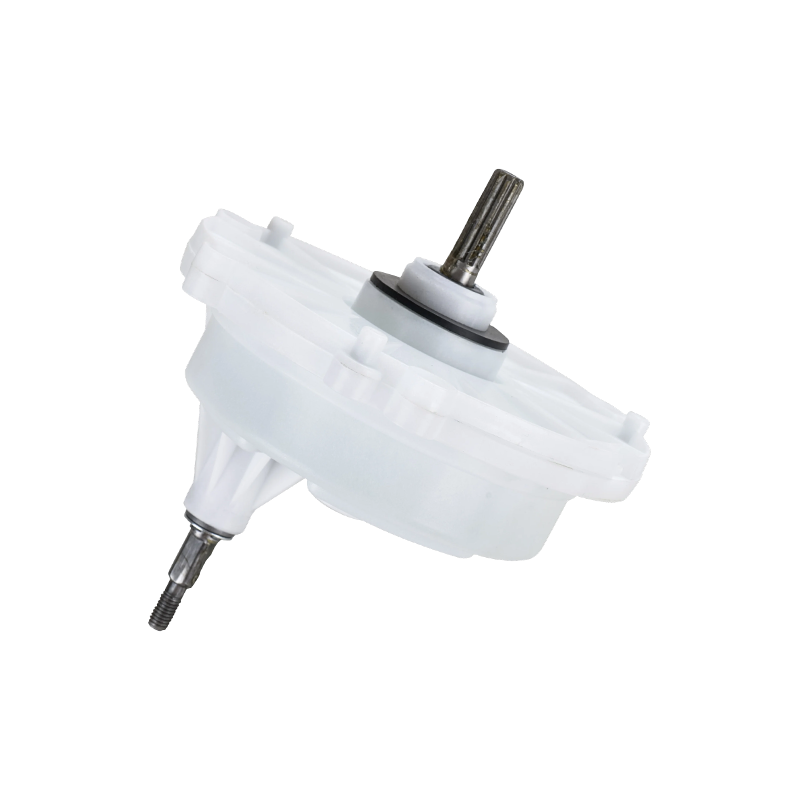
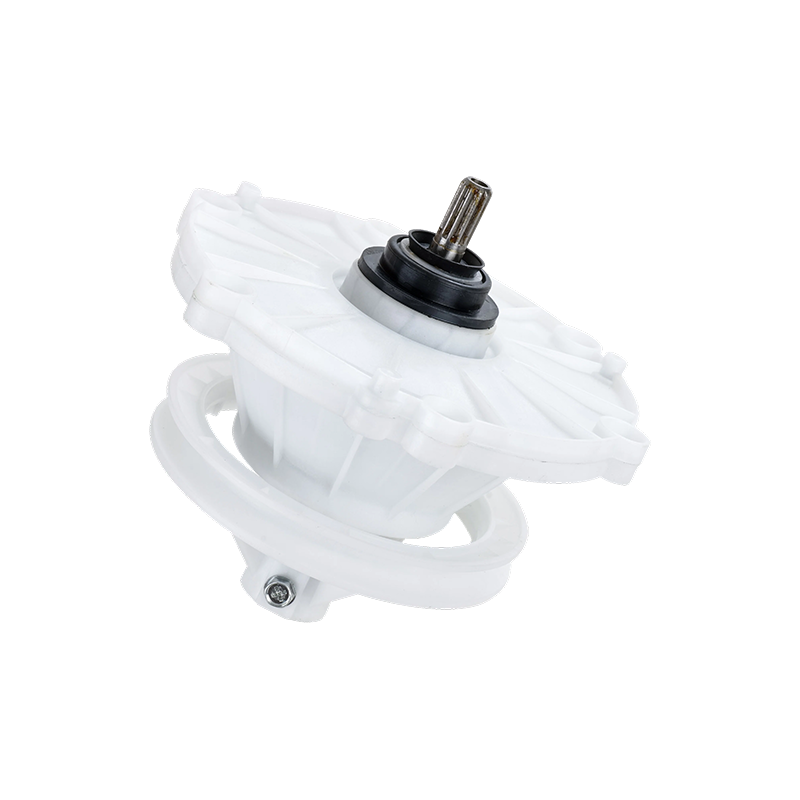
Washing Machine Transmission
1. The Role of a Transmission in a Washing Machine
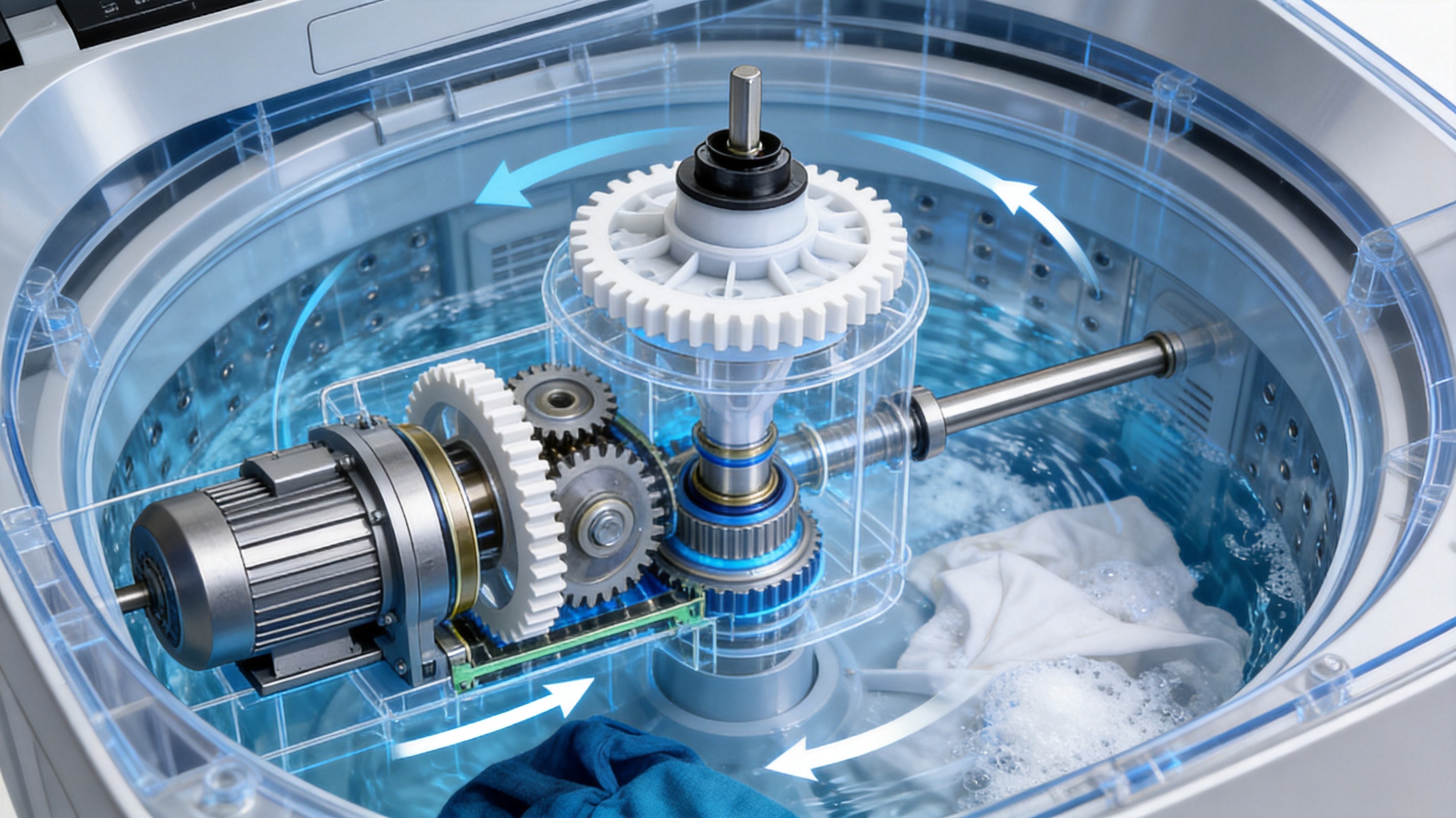
The washing machine transmission serves as the mechanical power-conversion center of a semi-automatic agitator washer. Its primary function is to receive rotational power from the electric motor and deliver it to the agitator at a more appropriate operating speed. At the same time, it increases the available torque so that the agitator can move clothing, water, and detergent through the wash chamber without placing excessive stress on the motor.
During washing, the agitator must create strong and controlled water movement. Clothes are exposed to alternating motion, friction, and circulation, allowing detergent and water to reach fabric surfaces. This process requires a balance between speed and torque. If the agitator rotates too quickly, clothing may become tangled, components may experience unnecessary stress, and water movement may become inefficient. If the agitator rotates too slowly or lacks torque, washing action may be weak, particularly when the tub contains a large load or heavily soiled garments.
The transmission establishes the required mechanical relationship between the motor and agitator. Through gear reduction and carefully designed shafts, bearings, seals, and housings, it allows the motor to operate within a practical speed range while the agitator receives the lower-speed, higher-torque output needed for washing.
1.1 High-Speed Motor Input
Electric motors are generally designed to deliver useful power at relatively high rotational speeds. Their operating characteristics can be efficient and economical when the motor is allowed to rotate at its intended speed. However, an agitator does not normally require the same speed. The transmission therefore accepts high-speed motor input and changes it into a more suitable output condition.
This adaptation helps manufacturers use compact motors while still achieving effective washing movement. Rather than requiring a much larger, slower motor, the appliance can use a motor-transmission combination that balances cost, size, power, and performance.
1.2 Low-Speed, High-Torque Output
The transmission’s reduction gears decrease rotational speed and increase torque at the output shaft. Higher torque is important because the agitator must overcome the resistance created by water, clothing, detergent, and friction within the washing system. It must also maintain movement during changes in load condition.
A strong low-speed output helps the washer start smoothly, sustain agitation, and handle normal variations in laundry volume. The transmission must therefore be designed not only for nominal running conditions but also for starting loads, intermittent operation, repeated cycles, and occasional overload conditions that may occur in everyday use.
1.3 Mechanical Stability
Stable mechanical operation depends on the interaction of gears, shafts, bearings, housing components, lubrication, and sealing structures. If any one of these elements is poorly designed or manufactured inconsistently, the transmission may develop excessive noise, vibration, friction, leakage, or premature wear.
A dependable transmission maintains alignment between rotating components and distributes loads through the gear train. Consistent tolerances and suitable materials are important because even small deviations may influence gear contact, shaft runout, bearing loading, and long-term durability.
2. Product Overview and Application Scope
The washing machine transmission is categorized as a washing machine gearbox and is primarily intended for semi-automatic agitator washing machines. These appliances remain widely used in markets where affordability, straightforward operation, repairability, and low ownership cost are important purchasing considerations.
Semi-automatic washing machines commonly separate washing and spinning functions into different compartments or operating stages. The washing side uses an agitator to generate water movement, while the spin side removes water from clothing. The transmission discussed here is designed for the washing power system and is not intended to be confused with a spin-dryer drive assembly or a fully automatic direct-drive system.
The product can support several types of customer requirements, including the following:
OEM washing machine production, where the transmission is integrated into newly manufactured appliances.
ODM development, where a customer requires a customized mechanical solution based on a specific appliance design.
Replacement-part distribution, where compatible transmissions are supplied for servicing existing washing machines.
Aftermarket maintenance, where repair companies and parts distributors require a stable source of washing machine drive components.
Regional appliance production, where manufacturers need cost-effective parts that can operate reliably under humid conditions and demanding daily use.
Because washing machine designs vary between markets and appliance brands, the exact dimensions, mounting arrangement, shaft configuration, gear ratio, and interface requirements must be confirmed before ordering. Product engineering support and technical communication are therefore important parts of a successful procurement process.
3. Core Performance Advantages
3.1 Effective Power Conversion
The primary advantage of this transmission is its ability to transform high-speed motor rotation into low-speed, high-torque agitator movement. This allows the appliance designer to match the characteristics of the motor with the mechanical requirements of washing.
Effective power conversion can improve the practical performance of the appliance in several ways. It supports stronger agitation, helps the washer start under load, reduces the need for an oversized motor, and promotes more consistent movement during the washing cycle. It also provides a controlled output that is better suited to the mechanical limits of the agitator, tub, and supporting structure.
3.2 Durable Construction
A washing machine transmission must withstand repeated mechanical loading. Each washing cycle may involve starting, stopping, acceleration, deceleration, reversing movement, or fluctuating resistance caused by uneven clothing distribution. Durable construction helps the unit maintain performance through these repeated conditions.
Durability is influenced by material selection, gear design, heat treatment where applicable, shaft strength, bearing support, housing rigidity, lubrication, and assembly accuracy. A robust transmission is not defined by one part alone. It results from the coordinated design and controlled manufacture of the complete assembly.
3.3 Suitability for Humid Environments
Washing machines operate in environments where water vapor, splashing, detergent residue, and high humidity may be present. The transmission must therefore be designed with attention to sealing, housing protection, corrosion resistance, and lubrication retention.
The product is intended to operate stably in humid washing machine environments when correctly installed and used within its specified application. Proper sealing reduces the risk of water or contaminants reaching internal moving parts. Suitable housing design supports mechanical protection, while appropriate assembly procedures help preserve the intended sealing and lubrication performance.
3.4 Cost-Effective Power Solution
In price-sensitive markets, the purchase price of the washing machine is a major factor. Appliance manufacturers must control component cost without sacrificing essential reliability. This transmission provides a practical balance between mechanical function, durability, production efficiency, and affordability.
Its value does not depend on adding unnecessary electronic complexity. Instead, it uses a proven mechanical approach to deliver the required output. This can be especially useful for semi-automatic washing machines, basic household appliances, and regional products where simple serviceable construction is a competitive advantage.
3.5 Compatibility with Replacement and Aftermarket Needs
Transmission failure can prevent a washing machine from producing effective agitation even when the motor and electrical controls remain functional. A suitable replacement transmission may extend the useful life of the appliance and reduce the cost of complete replacement.
For aftermarket customers, consistent dimensions and dependable manufacturing quality are essential. Distributors need confidence that repeated orders will maintain a stable level of fit, function, and appearance. Appliance repair businesses also benefit from a product that is practical to install and supported by clear technical communication.
4. Advantages Compared with Less Suitable Alternatives
Choosing a transmission is not simply a matter of selecting the lowest purchase price. A low-cost unit with unstable dimensions, weak gearing, poor sealing, or inconsistent assembly may create additional expenses through returns, repairs, downtime, and customer complaints. The relevant comparison should consider total operating value rather than initial cost alone.
4.1 Compared with Direct Motor-to-Agitator Drives
A direct motor-to-agitator connection may appear simple, but it does not provide the speed reduction and torque multiplication needed for many agitator washing systems. The motor may operate outside its most suitable range, while the agitator may rotate too quickly or fail to generate sufficient usable torque.
A transmission provides a controlled mechanical interface. It allows the motor and agitator to perform different functions at appropriate speeds. This separation improves design flexibility and can support a more balanced appliance structure.
4.2 Compared with Inconsistent Generic Gearboxes
Generic gearboxes may differ substantially in gear quality, shaft alignment, sealing performance, and material control. Two units with similar external dimensions may not provide the same service life or operating stability.
A manufacturer with dedicated washing machine component experience is better positioned to understand the special requirements of agitator drive systems. Experience with gear reducers, synchronizers, P-shafts, and related parts supports a more complete understanding of component interfaces and appliance-level performance.
4.3 Compared with Over-Engineered Premium Assemblies
Some washing machine applications do not require an unnecessarily complex or expensive transmission. An over-engineered assembly may increase the appliance cost without providing a proportionate benefit for the intended market.
The product described here is focused on the practical requirements of semi-automatic agitator washing machines. Its value lies in delivering reliable mechanical power conversion, suitable durability, and stable operation while remaining appropriate for cost-sensitive appliance programs.
4.4 Compared with Poorly Sealed Designs
Humidity and water exposure are common causes of mechanical deterioration in washing machine components. Poorly sealed gearboxes may allow moisture or contaminants to affect lubrication and internal surfaces. This can increase friction, corrosion, noise, and wear.
A transmission designed with appropriate sealing and housing protection offers a stronger foundation for reliable appliance operation. Correct installation remains essential, but the design must first provide the physical protection needed for the application environment.
| Evaluation Factor | Basic or Inconsistent Unit | Application-Focused Washing Machine Transmission |
|---|
| Power conversion | May not provide a stable speed and torque relationship | Designed to convert motor speed into agitator-appropriate output |
| Load handling | May experience unstable operation under changing laundry loads | Developed for repeated low-speed, high-torque washing conditions |
| Environmental suitability | Sealing and corrosion protection may vary | Designed with humid washing machine operation in mind |
| Manufacturing consistency | May vary between batches or suppliers | Supported by controlled production and quality procedures |
| Cost position | Low initial price may create higher replacement costs | Balances production cost, service life, and appliance value |
| Customization potential | Often limited to standard dimensions | Suitable for OEM and ODM communication and development |
| Supplier capability | May focus on a broad range of unrelated products | Manufacturer specializes in washing machine components |
5. Manufacturing Strength and Production Capability
The performance of a washing machine transmission depends heavily on manufacturing discipline. Gear teeth, shafts, housings, bearings, seals, and fasteners must work together within defined dimensional and functional limits. A strong design can fail to deliver its intended value if production is inconsistent.
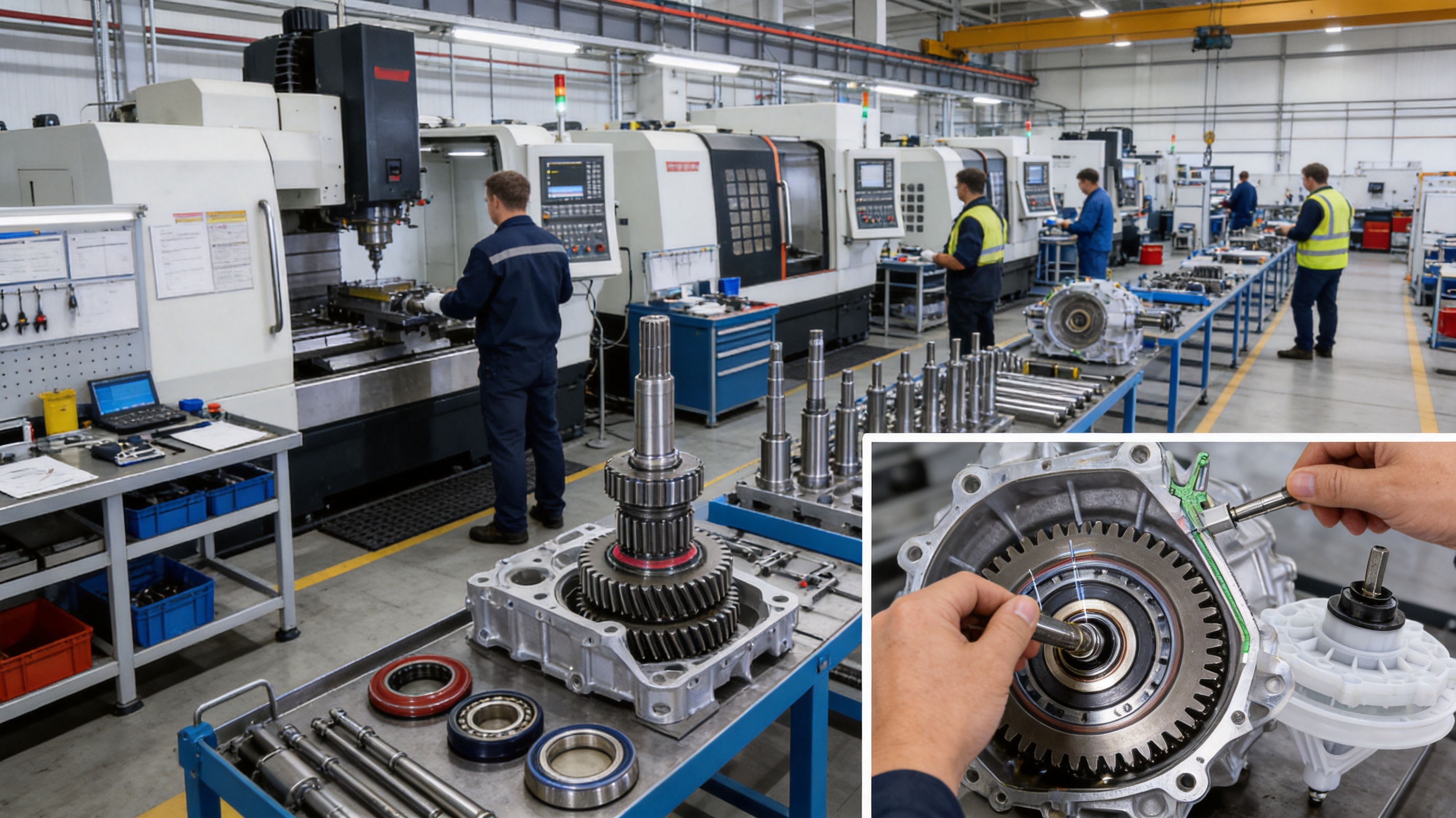
Cixi Gaite Electric Co., Ltd. was established in 2002 and is located in Ningbo, Zhejiang, China, an important manufacturing region with developed industrial supply chains and export infrastructure. The company specializes in the research, development, and manufacture of core washing machine components, including washing machine gearboxes, transmissions, gear reducers, synchronizers, and P-shafts.
The company operates a modern production base of approximately 10,000 square meters. This scale provides room for production equipment, material processing, assembly, inspection, warehousing, and engineering activities. A dedicated facility also supports better process organization and more efficient coordination between manufacturing stages.
5.1 In-House Material Production
Approximately 90 percent of core materials are produced in-house according to the supplied company information. This level of internal material production can provide important benefits for quality consistency and supply stability.
When key materials are controlled internally, the manufacturer can better monitor material specifications, processing conditions, batch consistency, and production scheduling. It can also reduce dependence on external suppliers for critical inputs. This may help shorten response time when customers require repeat orders, modifications, or urgent production planning.
In-house production does not eliminate the need for incoming inspection or process verification. Instead, it creates a stronger foundation for integrated quality management. Material preparation, machining, forming, and assembly can be coordinated under a more unified system.
5.2 Advanced Machinery and Mature Processes
The company uses advanced machinery and mature manufacturing processes to produce washing machine components. In a transmission production line, machinery may support operations such as metal forming, turning, milling, drilling, gear processing, surface treatment, assembly, and inspection. The precise process mix depends on the component design and production model.
Advanced equipment helps improve repeatability, reduce manual variation, and maintain dimensional accuracy. Mature processes are equally important because equipment alone cannot guarantee quality. Operators, engineers, inspection personnel, maintenance teams, and production planners must follow controlled procedures to achieve stable output.
For transmission manufacturing, process maturity may be reflected in controlled gear engagement, consistent shaft dimensions, stable bearing fits, accurate housing interfaces, reliable sealing assembly, and repeatable lubrication procedures. These details are directly connected to operating noise, torque transfer, friction, service life, and installation compatibility.
5.3 Integrated Manufacturing Logic
A transmission supplier with experience in related washing machine components can evaluate how individual parts interact. For example, a P-shaft, synchronizer, gearbox, and transmission may each have different functions, but their performance can influence the wider appliance drive system.
Integrated manufacturing experience helps the supplier identify potential interface issues earlier. It also makes it easier to discuss alternative materials, shaft dimensions, mounting changes, gear ratios, and production methods with OEM and ODM customers.
6. Quality Management and Compliance
Quality management is essential for a component that operates inside a household appliance and experiences repeated mechanical loads. A transmission must be evaluated not only for whether it works when new, but also for whether its important functions remain stable after repeated operation.
Cixi Gaite Electric Co., Ltd. has obtained ISO 9001 Quality Management System certification. ISO 9001 supports a structured approach to quality planning, process control, documentation, corrective action, customer requirements, and continual improvement. Certification does not replace product testing, but it demonstrates that the company operates within a recognized quality management framework.
The company has also obtained ISO 14001 Environmental Management System certification. Environmental management is increasingly important in international supply chains. It addresses the organization’s approach to environmental responsibilities, resource use, waste control, process impact, and continual environmental improvement.
The products comply with RoHS requirements according to the supplied company information. RoHS compliance helps address restrictions on certain hazardous substances in electrical and electronic products and related components. Customers should confirm the latest compliance documentation and market-specific requirements for their particular application before placing a production order.
6.1 Quality from Material to Assembly
Transmission quality begins with material selection. Gear materials must provide suitable strength and wear resistance. Shafts must withstand torque and maintain dimensional stability. Housing materials must support structural rigidity and protection. Seals must remain compatible with the intended lubricant and operating environment.
Manufacturing quality continues through machining and forming. Gear geometry must be controlled to support proper meshing. Shaft surfaces and diameters must be suitable for bearings and seals. Mounting holes and external interfaces must remain within the customer’s required tolerances.
Assembly quality determines whether the manufactured parts perform correctly as one unit. Bearings must be seated correctly, gears must be positioned accurately, lubricant must be applied appropriately, and sealing components must not be damaged during installation. Fasteners and retaining structures must also be assembled consistently.
6.2 Inspection and Functional Verification
Depending on customer requirements, transmission inspection may include dimensional checks, visual inspection, gear engagement checks, shaft rotation checks, sealing verification, noise evaluation, torque testing, and endurance testing. The exact inspection plan should be defined according to the product drawing, appliance design, order quantity, and intended market.
Functional verification is particularly valuable because a component may meet individual dimensional requirements while still producing abnormal noise or unstable operation when assembled. Testing the completed transmission helps identify issues related to gear meshing, bearing friction, lubrication, shaft alignment, or housing deformation.
7. Engineering Design Considerations
A washing machine transmission must be designed as a complete mechanical system. The following considerations are important when evaluating a product for an OEM, ODM, or replacement application.
7.1 Gear Ratio
The gear ratio determines the relationship between motor speed and agitator output speed. A suitable ratio provides the output movement required by the washing system while keeping the motor within a practical operating range.
Gear ratio selection can influence washing strength, operating noise, motor loading, heat generation, and cycle performance. The correct value depends on motor characteristics, agitator geometry, tub design, load capacity, and control strategy. Customers should provide the relevant appliance information when requesting a customized solution.
7.2 Torque Capacity
Torque capacity must be sufficient for normal operation as well as starting and fluctuating load conditions. The transmission should be evaluated against the expected laundry capacity, water volume, agitator design, motor output, and duty cycle.
Insufficient torque capacity can lead to slow starting, stalled operation, excessive heating, accelerated gear wear, or motor overload. Excessive capacity may increase cost and size without offering a meaningful benefit. Proper engineering therefore requires a balanced selection based on actual operating conditions.
7.3 Shaft and Mounting Interfaces
The input shaft must connect properly with the motor or intermediate drive arrangement. The output shaft must match the agitator or related washing mechanism. Mounting points must align with the washing machine tub, base, or support structure.
Important interface data may include shaft diameter, shaft length, keyway or spline details, mounting hole position, housing dimensions, rotation direction, output height, and seal location. Small differences in these features can prevent installation, so technical drawings and samples should be reviewed carefully.
7.4 Bearings and Support
Bearings support rotating shafts and help control friction and alignment. The bearing arrangement must withstand radial and axial forces generated by the gear train and agitator system. Correct bearing selection also contributes to noise control and service life.
Bearing fit, lubrication, housing rigidity, and shaft surface quality are closely connected. A bearing that is individually suitable may not perform correctly if the surrounding components are outside tolerance.
7.5 Sealing and Lubrication
Sealing protects internal components from moisture and helps retain lubricant. Lubrication reduces friction between gear teeth and other moving surfaces, limits heat generation, and supports smooth operation.
The lubricant must be suitable for the transmission’s materials, operating temperature, load, and speed. The quantity must also be controlled. Too little lubricant may increase wear, while too much can create resistance, leakage, or abnormal operation. Seals must be installed without cuts, deformation, or contamination.
7.6 Noise and Vibration
Some mechanical sound is normal in a gear-driven washing system, but excessive noise or vibration may indicate incorrect gear engagement, shaft misalignment, bearing problems, housing looseness, insufficient lubrication, or damaged components.
Manufacturing consistency contributes to noise control because gear geometry, bearing fits, and assembly alignment are repeated more accurately. Appliance designers should also consider the mounting structure, tub support, motor balance, and surrounding panels when evaluating total appliance noise.
8. OEM and ODM Support
OEM and ODM customers often require more than a standard catalog part. They may need changes to the gear ratio, output shaft, mounting pattern, housing dimensions, sealing arrangement, materials, packaging, labeling, or inspection criteria.
A specialized washing machine component manufacturer can support these requirements more effectively because it understands the mechanical relationships within the appliance. The development process normally begins with technical communication. Customers may provide drawings, samples, three-dimensional models, appliance specifications, target production volume, motor data, washing capacity, and environmental requirements.
8.1 Typical Customization Information
For an efficient technical evaluation, customers should provide the following information whenever available:
Washing machine type and operating mode.
Agitator design and required output movement.
Motor rated power, speed, voltage, and direction of rotation.
Expected washing capacity and maximum laundry load.
Required gear ratio or output speed.
Input and output shaft dimensions.
Mounting dimensions and installation orientation.
Operating cycle, expected service life, and duty frequency.
Environmental conditions, including humidity and temperature.
Required certifications, compliance documents, and packaging specifications.
The more complete the technical information, the easier it is to assess compatibility and avoid unnecessary prototype revisions.
8.2 Prototype and Validation Process
A typical custom development program may include requirement review, preliminary design, drawing confirmation, prototype production, sample assembly, functional testing, customer evaluation, design adjustment, pilot production, and mass-production approval.
Prototype testing should be performed in a representative appliance or test fixture. Testing only the transmission without the actual agitator, motor, and mounting structure may not reveal all application-specific issues. The complete drive system should be observed for output movement, starting behavior, noise, temperature, leakage, and endurance.
8.3 Production Continuity
After approval, production continuity becomes a major concern. OEM customers need stable supply, repeatable quality, and clear communication when demand changes. A manufacturer with in-house material capabilities and a dedicated production base may be better prepared to coordinate repeat orders and manage component availability.
Long-term cooperation also supports continuous improvement. Feedback from field service, assembly lines, and customer testing can be used to refine processes, improve packaging, reduce variation, and strengthen product performance.
9. Installation and Handling Recommendations
Correct installation is necessary to obtain the intended performance of any washing machine transmission. Even a well-manufactured unit can experience premature failure if it is installed with incorrect alignment, unsuitable fasteners, damaged seals, or excessive external loading.
Before installation, technicians should verify the part number, external dimensions, shaft configuration, rotation direction, mounting pattern, and application compatibility. The mating motor, agitator, shaft, and support structure should be inspected for wear or damage. Replacing only the transmission may not solve a problem caused by a bent shaft, worn bearing seat, misaligned motor, or damaged agitator.
The transmission should be handled carefully to prevent impact damage. Shafts and sealing surfaces should not be used as lifting points if this could cause bending or scratching. Dirt, metal particles, and moisture should be kept away from open interfaces during installation.
Mounting fasteners should be tightened according to the appliance manufacturer’s specification. Excessive tightening may distort the housing or damage threaded areas, while insufficient tightening may cause vibration and movement. The motor and transmission should be aligned correctly to prevent side loading on the input shaft.
After installation, the system should be checked before full-load operation. A preliminary run can confirm rotation direction, abnormal sound, vibration, leakage, and agitator movement. Any irregular condition should be investigated before the appliance is returned to service.
10. Maintenance and Service Life
The transmission is designed to support reliable operation, but service life also depends on the washing machine’s operating conditions and maintenance. Overloading the appliance, using a damaged agitator, allowing foreign objects into the mechanism, or operating with excessive vibration may increase stress on the transmission.
Users and service technicians should follow the washing machine manufacturer’s loading recommendations. Clothing should be distributed appropriately, and the appliance should be installed on a stable, level surface. Excessive imbalance can transfer abnormal forces through the drive system.
Visible oil leakage, grinding noise, repeated stalling, unusual vibration, failure to agitate, or a burning smell may indicate a transmission or related drive problem. Continued operation under these conditions can increase damage. Early inspection may prevent secondary failure of the motor, agitator, shaft, or mounting structure.
Where the transmission is supplied as a sealed factory assembly, unauthorized disassembly may affect sealing, lubrication, and warranty conditions. Repairs should be performed by qualified personnel using appropriate tools and replacement parts. The correct replacement model should always be confirmed before installation.
11. Supply and Commercial Value
For appliance manufacturers, the value of a washing machine transmission includes more than its unit price. Supply continuity, technical response, production capacity, quality documentation, delivery performance, and customization capability can all influence the total cost of ownership.
A supplier that specializes in washing machine components can offer more focused technical communication than a general industrial parts supplier. This specialization may help reduce misunderstandings concerning gear reduction, shaft interfaces, washing loads, moisture exposure, and appliance integration.
The company’s experience with OEM manufacturers and the aftermarket provides exposure to different purchasing requirements. OEM customers may prioritize engineering validation and batch consistency, while aftermarket customers may focus on compatibility, packaging, availability, and replacement convenience. A flexible manufacturer must understand both requirements.
Established partnerships with Sharp Corporation, Panasonic Corporation, and Midea Group, as provided in the company information, indicate experience in cooperation with recognized appliance organizations. Customers should request current product documentation, quality records, and application references relevant to their specific project.
| Customer Requirement | Relevant Product or Supplier Strength | Practical Benefit |
|---|
| Stable agitator power | Low-speed, high-torque transmission output | Supports effective washing movement |
| Competitive appliance cost | Cost-conscious mechanical design and established production | Helps control total product cost |
| Humid operating conditions | Application-focused housing, sealing, and lubrication considerations | Supports reliable operation in washing environments |
| OEM integration | Custom engineering and manufacturing communication | Improves fit with appliance-specific designs |
| Repeat orders | Dedicated production base and high in-house material proportion | Supports supply stability and batch consistency |
| International procurement | ISO 9001, ISO 14001, and RoHS-related compliance capabilities | Supports supplier evaluation and market requirements |
| Aftermarket replacement | Experience with washing machine parts and compatible drive components | Helps repair businesses and distributors source practical replacements |
12. Why Choose a Specialized Washing Machine Component Manufacturer
A transmission is not an isolated commodity item. It is a central part of the washing machine’s mechanical architecture. The supplier’s understanding of washing loads, agitator operation, motor matching, shaft interfaces, sealing, and appliance assembly can directly influence project success.
A specialized manufacturer can usually identify application risks more quickly than a supplier with no experience in washing machine systems. It may also maintain dedicated tooling, process knowledge, inspection methods, and component libraries for the appliance sector.
Specialization can support faster communication about questions such as whether a particular output shaft will fit an existing agitator, whether a gear ratio is appropriate for a selected motor, whether a housing can fit within a limited base structure, or whether a seal arrangement is suitable for a humid environment.
In addition, a focused product portfolio allows the manufacturer to improve related components together. Experience in gearboxes, reducers, synchronizers, and P-shafts can contribute to a more complete understanding of washing machine power transmission systems.
13. Recommended Evaluation Checklist
Before purchasing a washing machine transmission, buyers should evaluate the following points:
Application: Confirm that the product is intended for the correct type of semi-automatic agitator washing machine.
Motor compatibility: Verify motor speed, power, shaft arrangement, rotation direction, and mounting relationship.
Agitator compatibility: Confirm output shaft dimensions, connection method, output speed, and torque requirements.
Mechanical dimensions: Compare housing size, mounting holes, shaft height, and available installation space.
Environmental conditions: Review humidity, temperature, water exposure, detergent exposure, and expected operating frequency.
Quality requirements: Request available inspection procedures, testing records, material information, and compliance documentation.
Sample approval: Test a production-representative sample in the intended washing machine or an equivalent fixture.
Supply capability: Discuss annual demand, minimum order quantity, lead time, packaging, shipping method, and forecast planning.
Customization: Determine whether changes to shafts, gear ratios, housings, seals, labels, or packaging are required.
After-sales support: Confirm how technical questions, quality concerns, replacement requests, and improvement feedback will be handled.
This checklist helps buyers compare suppliers based on complete project value rather than only the initial quotation.
14. Frequently Asked Questions
Q1: What does a washing machine transmission do?
A washing machine transmission transfers power from the motor to the agitator while reducing rotational speed and increasing usable torque. This allows the agitator to create effective washing movement without requiring the motor to operate at the agitator’s lower speed.
Q2: Which washing machines use this type of transmission?
The product is primarily intended for semi-automatic agitator washing machines. Compatibility depends on the appliance design, motor, agitator, mounting structure, shaft configuration, and required output characteristics.
Q3: Why is low-speed, high-torque output important?
An agitator must move water and clothing, which creates resistance. Low-speed, high-torque output helps the agitator start, maintain movement, and handle changing load conditions more effectively than a direct high-speed motor connection.
Q4: Can the transmission be used as an aftermarket replacement?
It may be suitable for replacement and aftermarket applications when the dimensions, shaft interfaces, gear ratio, mounting arrangement, and operating specifications match the original or approved design. Buyers should confirm compatibility before ordering.
Q5: Is the transmission suitable for humid environments?
The transmission is designed for stable operation in the humid environment associated with washing machines. Correct installation, intact sealing, appropriate lubrication, and proper appliance maintenance remain important for long-term performance.
Q6: Can the product be customized for OEM projects?
OEM and ODM customization can be discussed according to the customer’s requirements. Potential customization areas may include gear ratio, shaft dimensions, housing design, mounting points, sealing arrangement, materials, packaging, and inspection standards.
Q7: What information should be provided for a quotation?
Customers should provide the appliance type, motor specifications, agitator information, drawings or samples, shaft dimensions, mounting details, expected order quantity, environmental conditions, and any required certifications or packaging specifications.
Q8: How does in-house production benefit customers?
A high proportion of in-house core material production can support material consistency, production coordination, supply stability, and control over key manufacturing stages. It may also help the supplier respond more efficiently to repeat orders and engineering changes.
Q9: What quality certifications are available?
The company has obtained ISO 9001 Quality Management System and ISO 14001 Environmental Management System certifications. Its products are also stated to comply with RoHS requirements. Customers should request current documents applicable to their specific order and destination market.
Q10: What problems may indicate transmission failure?
Possible warning signs include failure to agitate, abnormal grinding or knocking sounds, repeated stalling, excessive vibration, visible leakage, unusual heat, or a burning odor. These symptoms may also originate from the motor, agitator, bearings, or mounting structure, so professional diagnosis is recommended.
Q11: Can a transmission improve washing performance by itself?
A transmission provides the required power conversion, but total washing performance also depends on the motor, agitator shape, tub design, water level, detergent, cycle timing, laundry load, and appliance control system. The transmission must be matched correctly with the complete washing system.
Q12: Why should buyers work with a specialized supplier?
A specialized supplier understands washing machine drive requirements and related components. This can improve technical communication, product matching, customization, quality control, and long-term supply support.
15. Conclusion
The washing machine transmission is the mechanical foundation of effective agitation in many semi-automatic washing machines. By converting high-speed motor rotation into low-speed, high-torque output, it enables the agitator to deliver the controlled movement needed for household washing. Its performance affects washing strength, motor loading, noise, durability, maintenance, and overall appliance value.
The product described in this article combines practical power conversion with durability, humid-environment suitability, and cost-conscious design. These qualities make it appropriate for price-sensitive markets, OEM appliance production, replacement-part distribution, and aftermarket service applications.
Its competitive value is further supported by the manufacturer’s specialization in washing machine components, approximately 10,000-square-meter production base, high proportion of in-house core material production, advanced machinery, mature processes, and experience with international appliance customers. ISO 9001 and ISO 14001 certifications, together with stated RoHS compliance, provide additional support for structured quality and environmental management.
For the best results, customers should evaluate the transmission as part of a complete washing machine drive system. Motor data, agitator design, shaft interfaces, mounting dimensions, load requirements, sealing conditions, and expected duty cycle should all be considered before final selection. With accurate technical communication and appropriate validation, the transmission can provide a reliable and economical power solution for semi-automatic agitator washing machines.
References
1. Manufacturer-provided product information for washing machine transmission and washing machine gearbox applications.
2. Manufacturer-provided company profile, production capability, certifications, and washing machine component portfolio.
3. ISO 9001, Quality Management Systems—Requirements.
4. ISO 14001, Environmental Management Systems—Requirements with Guidance for Use.
5. Restriction of Hazardous Substances requirements for electrical and electronic equipment.
6. General mechanical engineering principles for gear reduction, torque transmission, shaft alignment, bearing support, lubrication, and sealing.
7. General appliance engineering practices for washing machine drive systems, agitator mechanisms, installation, maintenance, and functional testing.
Contact Information
Company: Cixi Gaite Electric Co., Ltd.
Contact: Jane Lu
Telephone: +86-574-63256717 / 63267914
Email: gaite@gaite.cn
Additional email: info@gaite.cn
WhatsApp: 008615867503650
Address: No. 208 Miaoshan Road, Shiyan Village, Henghe Town, Cixi City, Ningbo City, Zhejiang Province, China

 English
 عربى



 +86-574-63256717 /63267914
info@gaite.cn
 gaite@gaite.cn
 No. 208 Miaoshan Road, Shiyan Village, Henghe Town, Cixi City, Ningbo City, Zhejiang Province, China
