Semi-automatic twin-tub washing machines continue to serve millions of households and commercial users that value simple operation, affordable ownership, straightforward maintenance, and dependable washing performance. Unlike fully automatic washing machines, twin-tub models generally use separate washing and spin-drying tubs. The washing tub and spin tub may operate through different drive systems, allowing the appliance to maintain a relatively simple mechanical and electrical structure.
At the center of the washing function is the washing-machine gearbox or transmission assembly. This component transfers motor power to the pulsator, supports the rotating shaft, controls the movement of the washing mechanism, and helps prevent water from escaping through the shaft opening. For older-style semi-automatic twin-tub washing machines, a straight-through pulsator shaft assembly can provide a practical alternative to more complicated internal gearboxes.
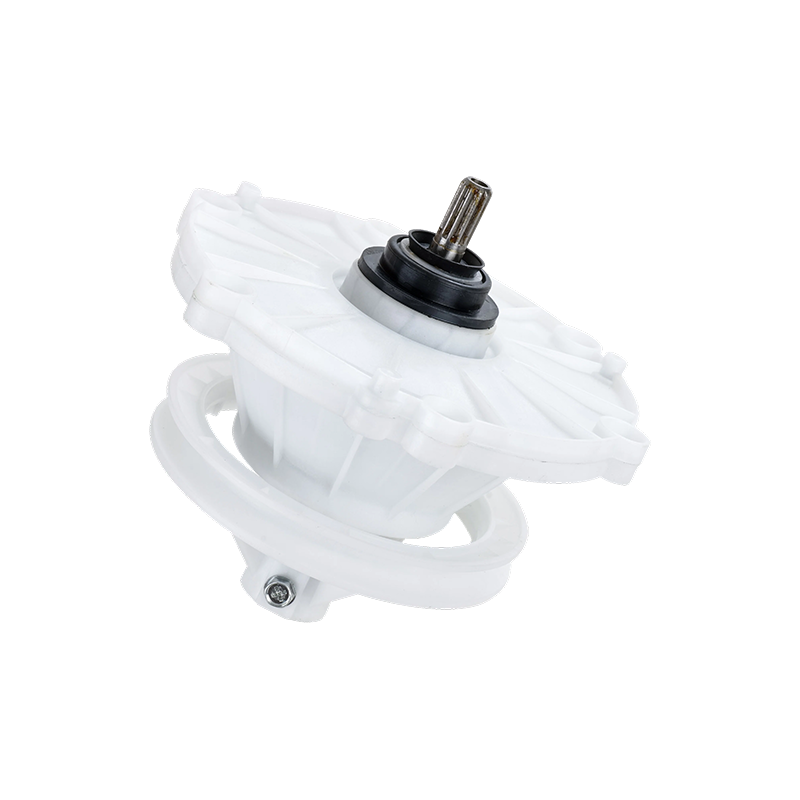
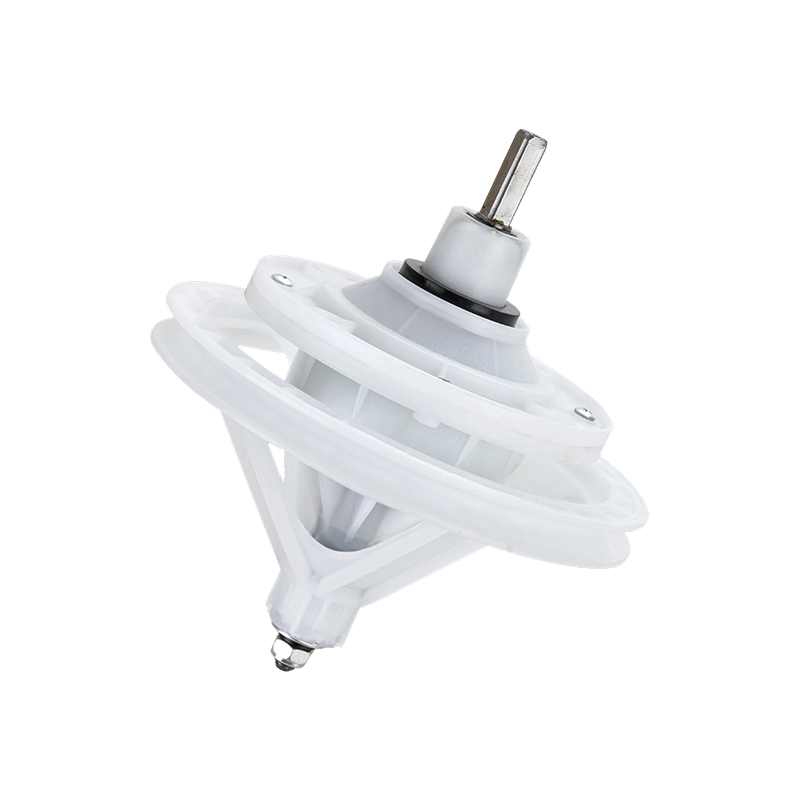
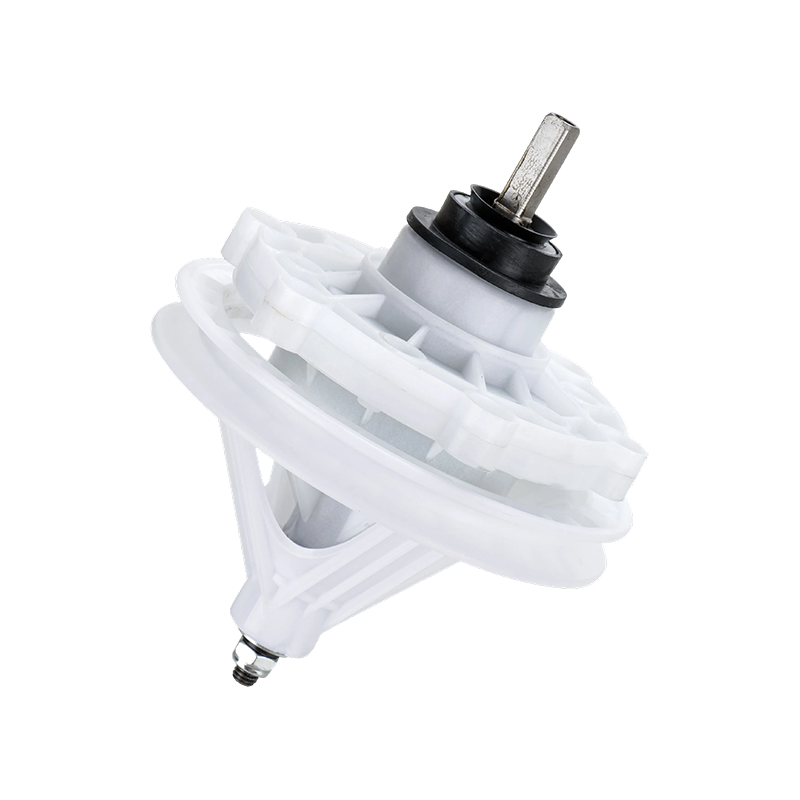
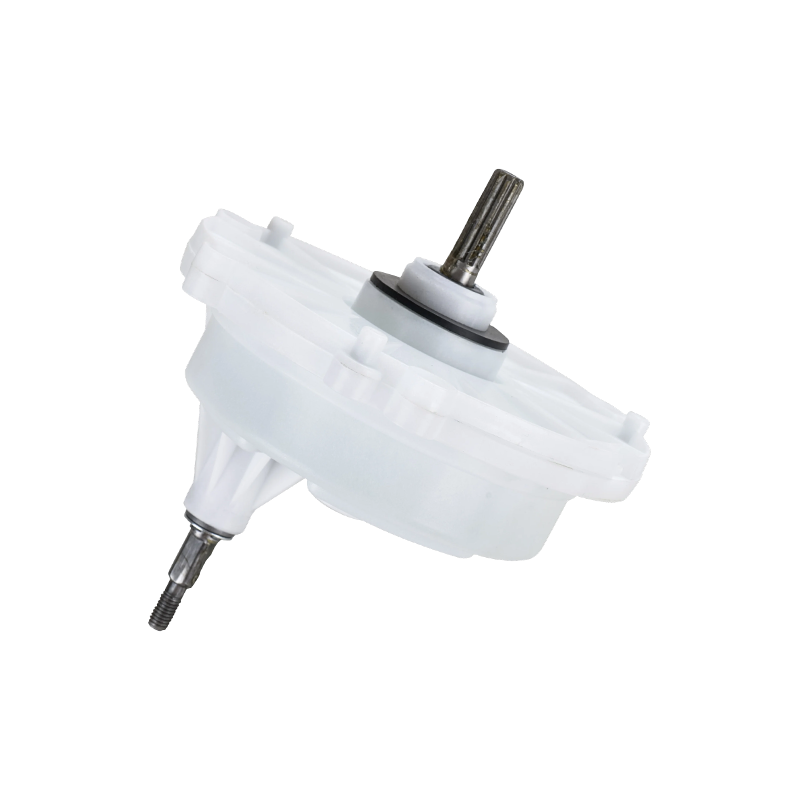
The semi-automatic twin-tub washing machine gearbox described in this article is a P-shaft transmission component designed for washing tubs without internal gears. It uses an integrated solid shaft, built-in bearings, and a waterproof mechanical seal. Speed reduction is achieved externally by the difference between the small motor pulley and the larger driven pulley. The transmission shaft, driven pulley, and pulsator rotate synchronously, producing a direct and efficient transfer of power.
This design is particularly suitable for old-style semi-automatic twin-tub washing machines in which the washing tub is driven by one motor and the spin tub is operated separately. Its simple architecture reduces the number of internal moving parts and avoids common gearbox-related problems such as broken gears and internal oil leakage. At the same time, the assembly remains serviceable because the principal wear points can be identified and inspected during maintenance.
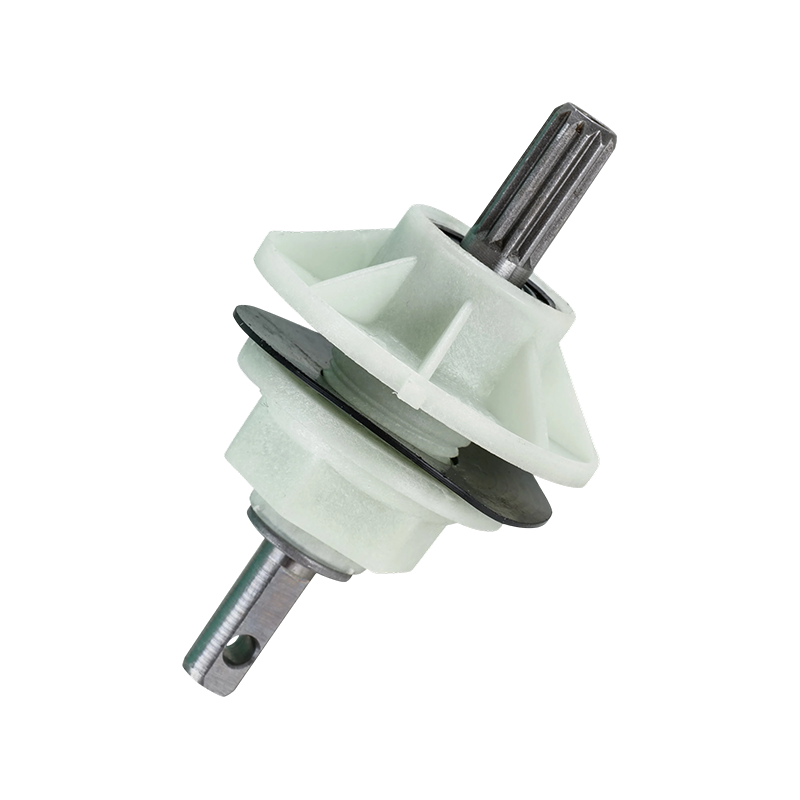
Semi-Automatic Twin-Tub Washing Machine Gearbox
1. Understanding the Role of a Washing Machine P-Shaft
A P-shaft, or pulsator shaft assembly, is the mechanical connection between the washing-machine drive system and the pulsator located inside the washing tub. The motor generates rotational power, the belt and pulley system transfer that power, and the P-shaft carries the rotation into the tub so that the pulsator can move the laundry and water.
In a semi-automatic twin-tub washing machine, the pulsator does not normally rotate at the same speed as the motor. The motor operates at a relatively high speed, while the pulsator requires a lower operating speed with sufficient torque for moving wet clothing, water, and detergent. In this product design, the reduction ratio is created by the pulley sizes rather than by a set of internal reduction gears.
The smaller motor pulley rotates the belt at a higher speed, while the larger driven pulley turns at a lower speed. Because the transmission shaft is integrated with the driven pulley and pulsator connection, the reduced-speed movement is transferred directly into the washing tub. This arrangement is mechanically understandable, easy to inspect, and well matched with traditional twin-tub washing-machine layouts.
The P-shaft has several functions at the same time. It transmits torque, supports the pulsator, maintains shaft alignment, withstands radial and axial forces, and helps isolate the internal washing space from the external drive area. These requirements mean that shaft accuracy, bearing quality, sealing performance, and material consistency are all important to the final performance of the washing machine.
A poorly manufactured shaft assembly may create excessive noise, pulsator wobbling, belt misalignment, water leakage, or premature bearing failure. A properly produced assembly can support stable rotation, reduce mechanical losses, protect the washing-machine structure, and extend service life. The design therefore deserves attention not only as a replacement part but also as a major functional component of the appliance.
2. Product Construction and Operating Principle
The straight-through twin-tub washing-machine P-shaft is based on a solid integrated shaft rather than a multi-stage internal gear train. The shaft provides the central path for power transmission. Its connection to the external pulley and internal pulsator allows the washing force to pass through the assembly with fewer intermediate components.
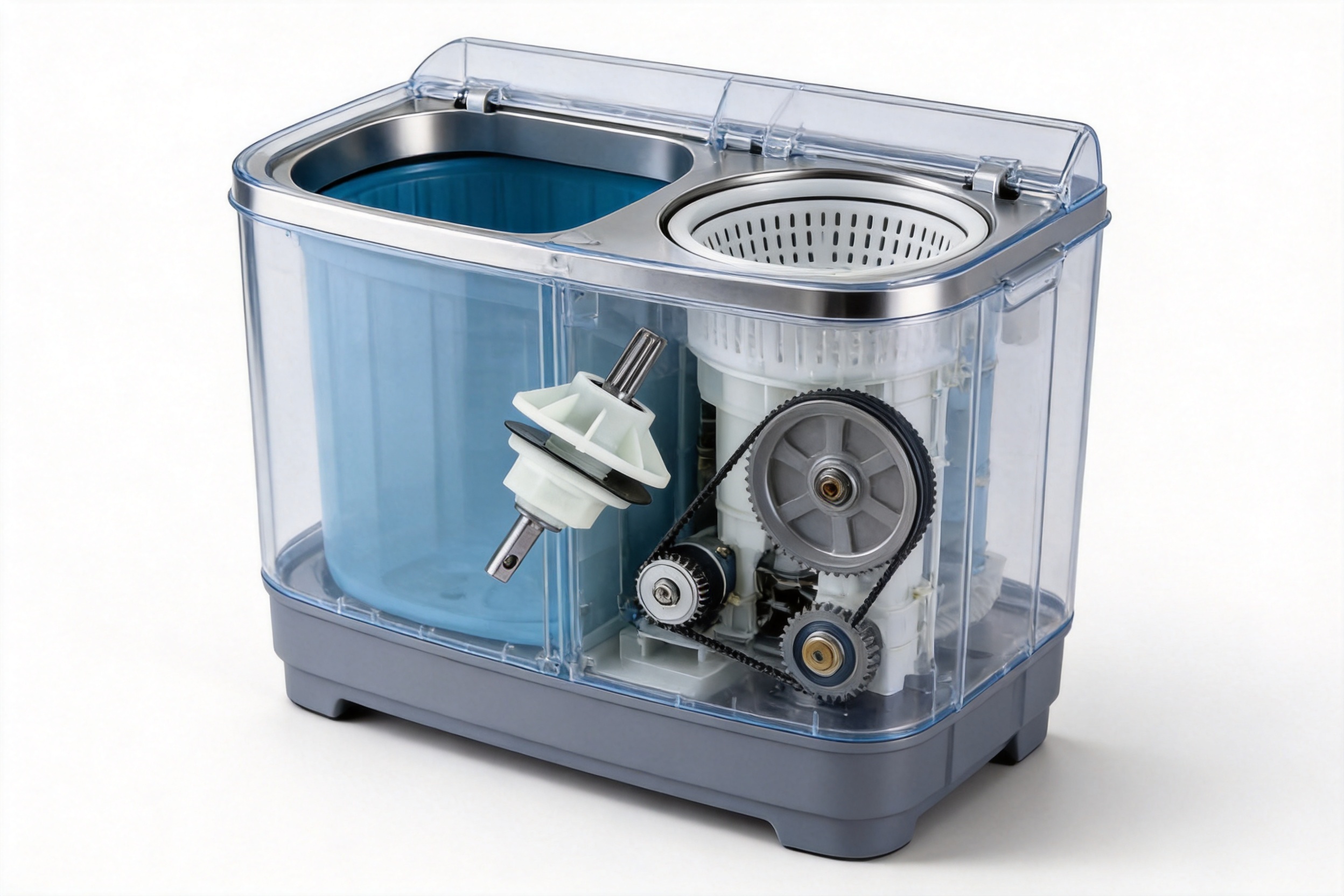
During operation, the washing-machine motor rotates the small pulley. A belt connects the small motor pulley to the larger driven pulley mounted on the P-shaft assembly. Since the driven pulley has a larger diameter, it rotates more slowly than the motor pulley. The lower speed produces a more suitable operating condition for the pulsator.
The pulsator then moves the water and clothing in the washing tub. Depending on the washing-machine control system, the pulsator may rotate in alternating directions or through repeated reversing movements. The P-shaft must therefore tolerate repeated starting, stopping, reversing, and torque changes. This is different from a component designed only for continuous one-direction rotation.
Bearings positioned within the assembly support the shaft and maintain its alignment. They help control radial movement and reduce friction as the shaft rotates. When the bearings are correctly installed and properly matched to the shaft, they also help reduce pulsator vibration and operating noise.
A waterproof mechanical seal is installed around the shaft passage. Its purpose is to prevent washing water and wastewater from traveling along the shaft into the bearing or pulley area. The seal also protects the internal support components from moisture, detergent residue, and corrosion-producing contamination.
Because the design does not contain an internal gear set, it does not require internal gear oil for its power-reduction function. The absence of internal gears simplifies the transmission structure and eliminates a class of failures associated with gear tooth breakage, gear wear, and oil leakage from a sealed gearbox housing.
2.1 Direct Power Transmission
Direct transmission does not mean that the motor and pulsator necessarily rotate at identical speeds. In this assembly, the pulley ratio provides the necessary speed reduction externally. The term direct refers to the relatively direct mechanical path from the driven pulley through the solid shaft to the pulsator.
Fewer internal transmission stages can reduce mechanical power loss. Every gear mesh, additional shaft, and unnecessary contact surface can introduce friction and wear. A straight-through assembly removes many of these potential loss points. As a result, the motor’s available power can be transferred efficiently to the washing action, provided that the belt is correctly tensioned and the pulleys are properly aligned.
2.2 Separate Washing and Spin Functions
The product is intended to transmit power for the washing tub only. The spin tub is driven independently by a separate motor and drive system. This division reflects the traditional design of semi-automatic twin-tub washing machines.
Separating the washing and spin functions offers practical advantages. A failure in the washing-tub P-shaft does not necessarily affect the spin-tub motor, and a spin-tub problem does not automatically require replacement of the washing-tub transmission. For manufacturers and service technicians, this separation can simplify diagnosis, stock management, and replacement procedures.
3. Key Product Advantages
3.1 Simple and Reliable Mechanical Structure
The most important advantage of this P-shaft assembly is its uncomplicated construction. It uses an integrated solid shaft, external pulley reduction, built-in bearings, and a waterproof mechanical seal. Compared with an internal geared transmission, the product has fewer internal power-transfer parts and fewer surfaces that require lubrication or precise meshing.
A simple structure can improve reliability when it is matched to the correct application. Traditional twin-tub washing machines usually do not require a complex electronic transmission system or a multi-speed internal gearbox. A robust shaft-and-pulley solution can meet the required washing performance while keeping the mechanical system accessible and economical.
Reduced component complexity may also improve production consistency. Gearboxes with several internal gears, shafts, washers, and oil-sealing interfaces require numerous assembly steps and strict control of gear alignment. A straight-through P-shaft assembly concentrates quality control on the shaft, bearing seats, seal position, pulley connection, and overall dimensional accuracy.
3.2 Lower Risk of Gear Breakage
Internal gear damage is a familiar failure mode in many mechanical transmissions. Excessive loading, impact, material defects, poor lubrication, foreign particles, and repeated reversing can eventually damage gear teeth. Once a gear is broken or severely worn, the transmission may produce clicking, grinding, irregular pulsator motion, or complete loss of washing power.
This P-shaft design does not depend on an internal gear train. Consequently, it avoids gear-tooth breakage as a product-specific failure mode. This does not mean that the assembly is immune to all mechanical problems. Bearings, seals, splines, belts, and pulley connections still require proper design and maintenance. However, removing internal gears eliminates one of the more complicated failure categories found in geared transmissions.
3.3 No Internal Gear-Oil Leakage
Traditional gearboxes may contain lubricating oil inside a housing. If a housing seal deteriorates, if the case is damaged, or if an assembly joint is not properly sealed, oil leakage may occur. Oil can contaminate surrounding components and create additional maintenance difficulties.
The straight-through P-shaft does not rely on an internal oil-filled gear chamber for speed reduction. Its external pulley arrangement reduces the need for internal gear oil. The waterproof mechanical seal still remains essential because its role is to prevent washing water from entering the support area, but the design avoids the specific problem of internal gearbox oil leakage.
3.4 Efficient Power Transfer
The integrated shaft provides a short and direct route for transmitting torque from the driven pulley to the pulsator. A shorter mechanical path can help reduce friction and power loss, especially when compared with systems that use several gears or multiple transmission stages.
Efficient power transfer benefits the washing-machine manufacturer and the end user. The motor can use its output more effectively, the pulsator can maintain a stable washing motion, and the system may produce less unnecessary heat. Actual energy performance depends on the motor, belt, pulley ratio, load, water level, and control pattern, but the P-shaft structure supports an efficient mechanical design.
3.5 Quiet Operating Potential
Gear contact is a common source of mechanical noise. Even well-designed gears can generate meshing noise, especially if tooth profiles, center distances, lubrication, or assembly tolerances are not properly controlled. By using an external pulley and a straight-through shaft, this product avoids internal gear-mesh noise.
Bearings and seals still influence sound levels. A damaged bearing, excessive radial play, belt misalignment, or dry seal can create noise. When the assembly is correctly manufactured and installed, however, the lack of internal gears can support quiet operation and reduce the range of possible mechanical noise sources.
3.6 Built-In Bearing Support
Bearings are integrated into the assembly to support and position the shaft. This improves the convenience of replacement because the critical shaft-support relationship is supplied as a matched component rather than requiring a technician to assemble several separate parts under field conditions.
Built-in bearings also help maintain the position of the pulsator. If the shaft is not properly supported, the pulsator may move vertically, wobble, or rub against surrounding parts. Such movement can increase noise, disturb washing performance, damage the tub, and accelerate seal wear. Stable bearing support helps prevent these problems.
3.7 Waterproof Mechanical Seal
The mechanical seal is another major functional feature. Washing water contains detergent, suspended fibers, soil, and other contaminants. If these materials reach the bearing area, they can accelerate corrosion, remove lubrication, or create abrasive wear.
A properly fitted seal forms a protective barrier around the rotating shaft. It helps prevent leakage from the washing tub and protects the external drive components. The seal must be compatible with the shaft surface, correctly positioned, and compressed according to the design requirements. Installation errors can cause leakage even when the seal itself is of good quality.
3.8 Suitability for Older Twin-Tub Machines
Many older semi-automatic washing machines remain in use because they are easy to operate and relatively inexpensive to repair. Their owners often prefer a replacement part that preserves the original mechanical layout rather than requiring a complete appliance upgrade.
This P-shaft assembly is matched to old-style semi-automatic twin-tub washing machines with a washing-tub motor, belt-driven pulley arrangement, and separately driven spin tub. Its application-specific design can help repair distributors, appliance service centers, and original-equipment manufacturers maintain compatible product lines.
4. Comparison with More Complex Gearbox Designs
Different washing-machine transmissions are suitable for different appliance architectures. A fully automatic washing machine may require a specialized clutch, planetary gearbox, direct-drive motor, or variable-speed drive. A semi-automatic twin-tub machine generally has simpler operating requirements and may benefit from a straightforward pulley-based transmission.
An internal gear gearbox can provide a controlled reduction ratio within a compact housing. It may be useful where space, torque multiplication, or integrated mechanical functions are critical. However, it also introduces additional parts, lubrication requirements, gear-mesh tolerances, and sealing interfaces.
The straight-through P-shaft offers a different set of priorities. It emphasizes a simple power path, external speed reduction, serviceability, and reduced internal complexity. It is not intended to replace every type of washing-machine transmission. Instead, it is designed to provide an appropriate solution for a specific family of semi-automatic twin-tub applications.
| Evaluation Item | Straight-Through P-Shaft Assembly | Internal Geared Transmission |
|---|
| Speed reduction method | External pulley diameter difference | Internal gear stages |
| Internal moving parts | Relatively few | Multiple gears and supporting parts |
| Gear-tooth failure risk | Not applicable to the shaft transmission design | Possible under overload, wear, or impact |
| Internal gear-oil requirement | Not required for speed reduction | Commonly required by the design |
| Main sealing concern | Waterproof shaft seal | Water and oil sealing interfaces |
| Service focus | Bearings, seal, spline, pulley, and belt | Gears, bearings, oil, seals, and housing |
| Typical application | Older semi-automatic twin-tub washing machines | Machines requiring integrated gear reduction |
The table demonstrates that the product’s competitive advantage is based on application fit rather than a universal claim that one transmission style is better in every situation. For the intended twin-tub washing-machine platform, the P-shaft can deliver the required washing-tub power transmission with fewer internal complications.
5. Manufacturing Strengths and Production Capabilities
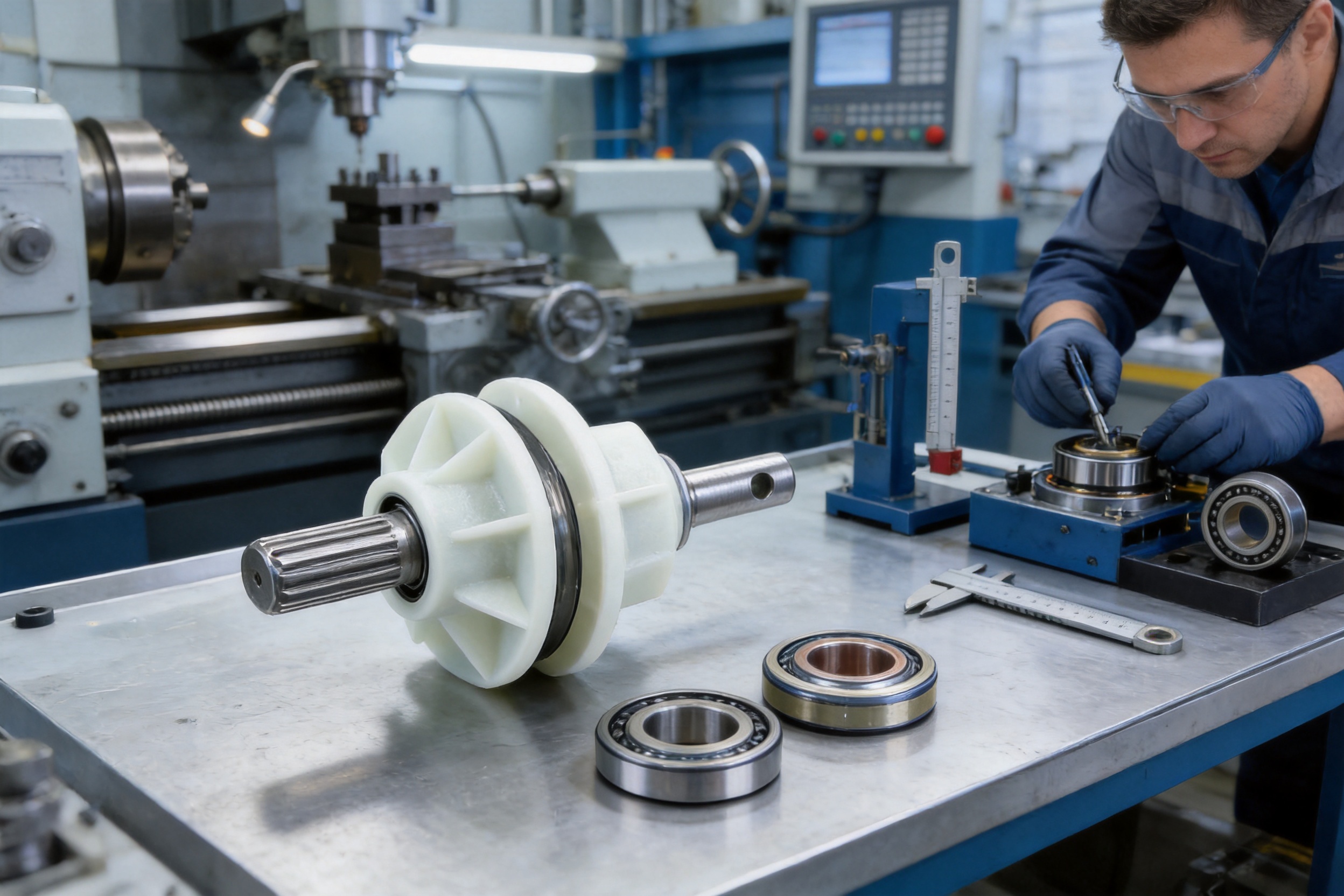
The quality of a washing-machine drive component depends on more than its basic design. Shaft straightness, bearing-seat accuracy, seal positioning, spline geometry, surface finish, material consistency, and assembly control all influence field performance. A manufacturer with integrated production capability can manage these factors more effectively than a supplier that relies entirely on disconnected outside processes.
Cixi Gaite Electric Co., Ltd. was founded in 2002 and is located in Ningbo, Zhejiang, China. The company specializes in the research, development, and manufacture of core washing-machine components, including gear reducers, synchronizers, washing-machine gearboxes, and P-shafts.
The company operates a production base of approximately 10,000 square meters. Around 90 percent of its core materials are produced in-house. This level of internal production can support better control over material consistency, production scheduling, process coordination, and quality traceability.
5.1 In-House Material and Component Control
Producing a high proportion of core materials internally can reduce dependence on changing external supply conditions. It can also help the manufacturer establish consistent requirements for shaft materials, bearing seats, sealing surfaces, pulley interfaces, and other critical features.
In-house control does not eliminate the need for supplier management or incoming inspection. Bearings, seals, belts, and other purchased elements must still be evaluated. However, greater control over core materials gives the manufacturer a stronger foundation for maintaining repeatable dimensions and mechanical performance across production batches.
5.2 Precision Machining
A P-shaft requires precision machining at several locations. The shaft must remain sufficiently straight so that it rotates smoothly. Bearing journals must be manufactured to suitable dimensions so that bearings are neither excessively loose nor improperly forced into position. The seal-running surface must be smooth enough to support reliable sealing without rapidly damaging the seal lip.
Spline or keyed areas also require careful machining. The connection must transmit torque without excessive backlash. If the spline is too loose, the pulsator may move irregularly and generate impact noise. If it is too tight or poorly finished, assembly may become difficult and stress may concentrate at the connection.
Modern machinery and mature manufacturing processes help maintain these dimensional requirements. Process stability is especially important for replacement components because service technicians and distributors expect each new unit to fit the same washing-machine platform without extensive modification.
5.3 Bearing and Seal Assembly
Bearing and seal installation should be performed with controlled procedures. Bearings must be pressed using appropriate force paths so that load is applied to the correct ring. Improper installation can create internal damage that may not be visible immediately but later results in noise or premature failure.
The mechanical seal must also be installed without twisting, cutting, contamination, or incorrect compression. The shaft surface should be inspected for burrs and sharp edges before the seal is fitted. A controlled assembly environment can reduce the possibility of particles entering the seal interface or bearing cavity.
5.4 Process Inspection
Quality inspection for a P-shaft assembly may include visual inspection, dimensional measurement, shaft runout checking, bearing rotation inspection, seal installation verification, pulley alignment inspection, and functional rotation testing. Depending on the customer’s requirements, additional tests may be applied to leakage resistance, noise, torque transmission, or endurance.
Inspection is most effective when it is connected to process control. If a shaft is found to have excessive runout, the manufacturer should not only reject the individual part but also investigate machining tools, fixtures, material handling, and assembly conditions. This approach supports continuous improvement and reduces repeated defects.
5.5 Research and Development
Washing-machine components must respond to practical field requirements. Product development may involve improving shaft geometry, adjusting seal structures, optimizing bearing support, adapting pulley connections, or modifying dimensions for a specific appliance platform.
GAITE’s specialization in washing-machine components allows its engineering work to remain focused on the actual operating conditions of washing appliances. This application knowledge can help shorten communication cycles with OEM customers and aftermarket distributors because the supplier understands the relationship between the shaft assembly, motor, belt, pulsator, washing tub, and user operating pattern.
6. Quality Systems and Compliance
Cixi Gaite Electric Co., Ltd. has obtained ISO 9001 Quality Management System certification and ISO 14001 Environmental Management System certification. ISO 9001 supports structured quality-management practices, including documented processes, corrective action, customer-focused control, and continual improvement.
ISO 14001 reflects an organized approach to environmental management. For a manufacturing company, this may include control of production impacts, resource use, waste handling, environmental objectives, and compliance responsibilities. Environmental management is increasingly important for appliance-component suppliers serving international customers.
The company’s products comply with RoHS requirements. Restriction of hazardous substances is relevant to global appliance supply chains because component materials and finishes must meet applicable environmental and market-entry expectations.
Certifications do not replace product-specific testing, and buyers should still confirm the exact inspection plan for each order. Nevertheless, documented management systems provide a useful framework for consistent manufacturing, traceability, customer communication, and corrective action.
7. Reliability in Real Washing-Machine Operation
A washing-machine transmission experiences repeated mechanical stress. Each cycle may include motor starting, belt acceleration, pulsator movement, reversing action, stopping, and restarting. Loads vary according to garment quantity, water level, fabric type, detergent, and user habits.
The P-shaft assembly must therefore balance strength and smooth rotation. The solid shaft needs sufficient torque capacity, while the bearings must support the rotating assembly without excessive friction. The seal must maintain its barrier function during repeated shaft movement and exposure to washing water.
Overloading the washing tub can increase belt force, shaft torque, bearing load, and pulsator resistance. If clothing becomes heavily unbalanced or tangled, impact forces may also increase. Correct appliance operation is therefore important even when the replacement component is manufactured to a high standard.
Belt tension is another important factor. A belt that is too loose may slip, reduce pulsator speed, generate heat, and produce a smell of rubber wear. A belt that is too tight can overload the motor shaft, driven pulley, bearings, and P-shaft. The correct tension should follow the washing-machine manufacturer’s service instructions.
Pulley alignment should also be checked. If the motor pulley and driven pulley are not in the same plane, the belt may run toward one side, wear unevenly, or jump from the pulley. Misalignment can create additional radial force on the P-shaft bearing and reduce the life of the seal.
8. Common Failure Modes and Maintenance Guidance
8.1 Bearing Wear
Worn bearings may produce humming, grinding, rumbling, or increased shaft movement. The pulsator may wobble, or the shaft may show excessive radial play when inspected. Bearing wear can be caused by age, overload, water contamination, misalignment, improper installation, or insufficient protection from the seal.
If bearing noise is present, continued operation may damage the shaft journal, seal, pulley alignment, or washing tub. Replacing the complete P-shaft assembly can be more practical than attempting an uncertain field repair, particularly when the shaft and bearing seats are supplied as a matched unit.
8.2 Mechanical Seal Leakage
Seal leakage may appear as water beneath the washing tub, moisture near the pulley, or corrosion around the bearing area. Possible causes include a worn seal lip, a scratched shaft surface, incorrect installation, excessive shaft movement, or contamination at the sealing interface.
When replacing a leaking assembly, the technician should inspect the surrounding tub opening, shaft connection, bearing support, and drain path. A new seal may not solve the problem if the shaft is bent or if the bearing has excessive play.
8.3 Spline or Shaft-Connection Wear
The pulsator connection may wear over time, especially if the pulsator is loose or if the shaft connection is subjected to repeated impact. Symptoms can include delayed pulsator movement, clicking sounds, irregular washing action, or visible movement between the shaft and pulsator.
Correct tightening and compatibility are important. A replacement P-shaft should match the pulsator connection, shaft dimensions, driven pulley arrangement, and washing-machine model. Attempting to force an incompatible pulsator onto the shaft can create premature wear or damage.
8.4 Belt Slipping
Belt slipping is not necessarily a gearbox defect, but it directly affects the performance of the P-shaft system. A worn, stretched, oily, or incorrectly tensioned belt may prevent the driven pulley from receiving sufficient torque.
Technicians should inspect belt condition, pulley grooves, motor adjustment, and alignment. A belt replacement should use the correct size and profile. Removing oil and detergent residue from the pulley area can also help restore proper friction.
8.5 Pulsator Vertical Shaking
Vertical pulsator movement may indicate bearing wear, loose mounting, shaft deformation, or an incorrect connection between the pulsator and shaft. Excessive movement can lead to water leakage, noise, uneven washing, and contact with the tub.
The built-in bearing support and sealed structure of the P-shaft are intended to prevent this problem under normal conditions. However, inspection remains necessary if the appliance has been overloaded, impacted, or operated for a long period.
9. Installation and Replacement Considerations
Before ordering a replacement P-shaft assembly, the buyer should confirm the washing-machine type, tub function, shaft length, pulley arrangement, bearing configuration, seal position, pulsator connection, and mounting dimensions. Product photographs are useful, but dimensional confirmation is more reliable.
The assembly is intended for the washing tub of a semi-automatic twin-tub washing machine. It should not be assumed to fit the spin tub or a fully automatic appliance with a different transmission architecture. The spin tub uses a separate drive system, and its components may have completely different dimensions and operating requirements.
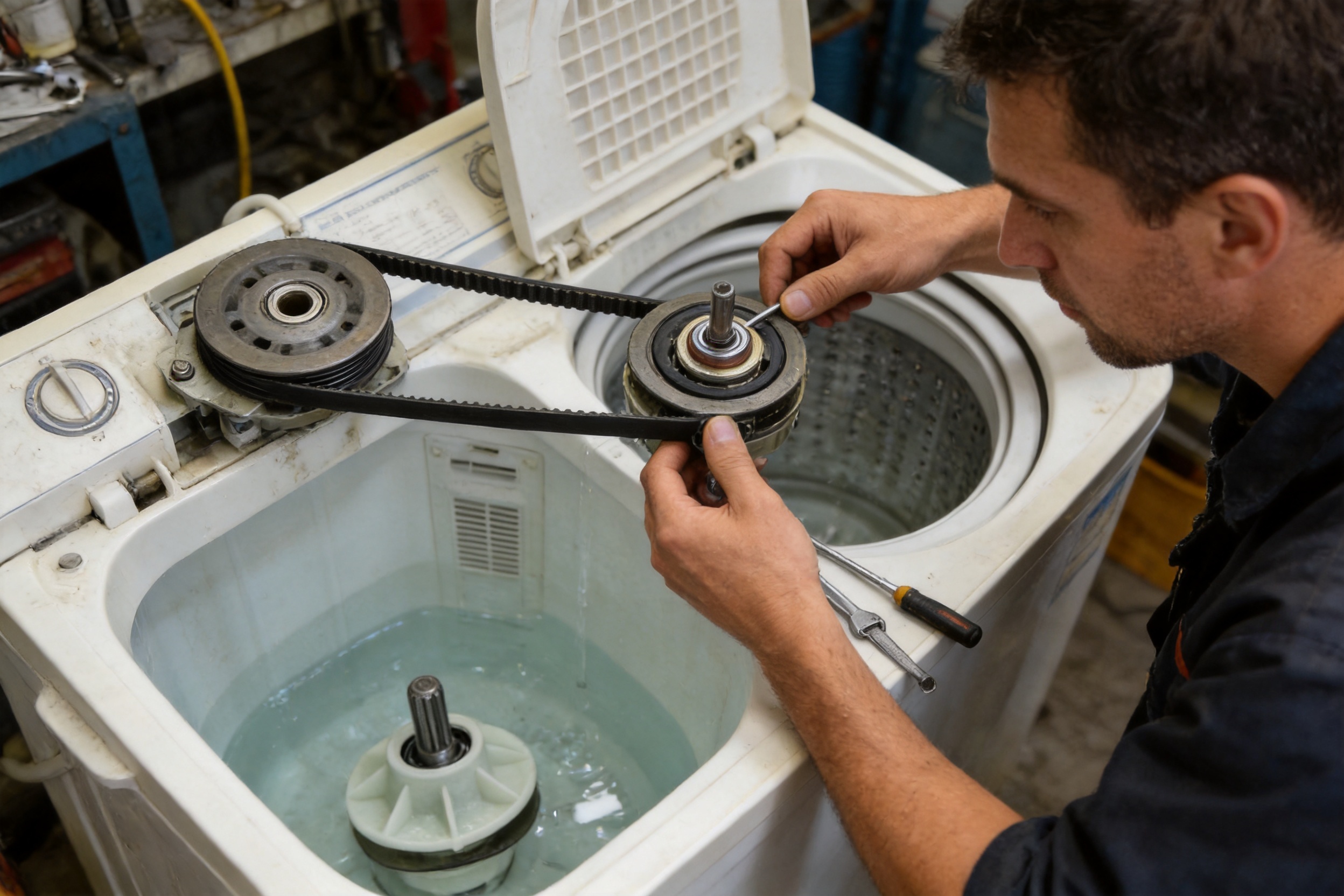
During removal, the appliance should be disconnected from electrical power and drained of water. The belt should be removed without damaging the pulley. The old shaft assembly should be examined for signs of leakage, bearing wear, bent components, corroded fasteners, and tub damage.
Before installation, the mounting surfaces should be cleaned. Dirt, old sealant, detergent residue, or corrosion can prevent correct seating. The new seal should not be struck directly with a hard tool. If pressing is necessary, force should be applied evenly and through a suitable installation tool.
After installation, the driven pulley should rotate smoothly by hand. The belt should run in a straight line between the motor pulley and the driven pulley. The pulsator should be checked for secure attachment and excessive vertical movement. A controlled test with water should then be performed to verify washing action and leakage resistance.
10. OEM, ODM, and Aftermarket Value
The P-shaft assembly can serve several customer groups. Original-equipment manufacturers may require a stable component supplier for new twin-tub washing-machine platforms. Appliance brands may need customized dimensions or connection features for a particular model. Aftermarket distributors may require replacement components with consistent fit and reliable packaging.
OEM and ODM cooperation can involve drawings, samples, technical specifications, material requirements, inspection standards, packaging design, labeling, and production scheduling. A manufacturer experienced in washing-machine components can contribute engineering feedback during the development process rather than simply producing a part from a drawing.
For aftermarket customers, consistency is especially important. A distributor may sell the same component over an extended period and must avoid frequent changes in dimensions or fit. Stable process control, core-material production, and documented inspection can help maintain continuity across repeat orders.
GAITE has developed long-term partnerships with Sharp Corporation, Panasonic Corporation, and Midea Group. Such relationships indicate experience in serving established appliance organizations with demanding requirements. Specific project conditions should still be confirmed with the supplier, but this background supports the company’s position as a specialized washing-machine component partner.
11. Why Application Matching Matters
A washing-machine gearbox should not be selected solely by appearance or general shaft length. Two components may look similar while differing in bearing spacing, pulley offset, spline form, seal dimensions, mounting holes, or operating direction.
Application matching ensures that the pulley ratio provides suitable pulsator speed, the shaft reaches the correct position inside the tub, and the seal sits at the intended water boundary. It also ensures that the motor and belt system operate within reasonable load conditions.
Buyers should provide photographs, drawings, old-part measurements, appliance model information, estimated order quantity, and intended market when requesting a quotation. These details help the manufacturer determine whether a standard component is suitable or whether an OEM modification is necessary.
12. Sustainability and Lifecycle Benefits
Replacing a failed P-shaft can extend the useful life of a washing machine. For households and service businesses, repair may be more economical than replacing an entire appliance. Extending product life also reduces the need for new appliance materials, packaging, transportation, and disposal.
The simple structure of this assembly can support maintenance-oriented product design. Bearings, seals, belts, and shaft connections can be recognized as the principal service points. When a product is easy to diagnose and replace, technicians can restore appliance function without discarding unrelated components.
Environmental performance also depends on manufacturing practices. ISO 14001 certification provides a framework for managing environmental responsibilities, while RoHS compliance addresses restricted substances in relevant product materials. Customers with additional environmental or recycling requirements can request project-specific documentation from the supplier.
13. Selecting a Reliable Component Supplier
A suitable supplier should be evaluated on product fit, manufacturing capability, quality systems, communication, delivery reliability, and technical support. Low purchase price alone does not guarantee lower total cost. A poorly matched or inconsistent transmission can create warranty claims, installation delays, returns, and customer dissatisfaction.
Important supplier-evaluation questions include whether the company specializes in washing-machine components, whether it can support custom OEM or ODM requirements, whether critical materials are controlled internally, whether inspection records are available, and whether replacement parts can be supplied consistently over time.
Production scale is also relevant. A modern production base of approximately 10,000 square meters and substantial in-house core-material manufacturing capacity can support organized production and stable supply. However, the buyer should still review actual lead times, minimum order quantities, sample procedures, packaging, and quality agreements.
Technical communication should cover the complete operating environment. The supplier needs to know the motor type, pulley ratio, pulsator design, washing-tub dimensions, expected load, operating cycle, and market requirements. Better information at the quotation stage reduces the risk of late-stage redesign.
14. Frequently Asked Questions
Q1: What type of washing machine uses this P-shaft assembly?
This assembly is designed for semi-automatic twin-tub washing machines, especially older-style models in which the washing tub and spin tub have separate drive systems. It is intended to transmit power to the washing-tub pulsator, not to the independently driven spin tub.
Q2: Does the assembly contain internal gears?
No. The described product uses a straight-through solid shaft and does not rely on internal gears for speed reduction. Reduction is achieved externally through the diameter difference between the small motor pulley and the larger driven pulley.
Q3: How is the pulsator speed reduced?
The motor drives a smaller pulley, which transfers motion through a belt to a larger driven pulley. Because the driven pulley has a larger diameter, it rotates more slowly. The driven pulley and transmission shaft then transfer the reduced-speed movement to the pulsator.
Q4: What are the main advantages over an internal geared gearbox?
The main advantages include a simpler internal structure, fewer gear-related failure points, no internal gear-oil leakage issue, direct power transmission, potentially lower mechanical noise, and convenient focus on serviceable parts such as bearings, seals, splines, and belts.
Q5: Can this component drive the spin tub?
No. The product is designed for the washing tub. In a traditional semi-automatic twin-tub washing machine, the spin tub is driven separately by an independent motor and drive system.
Q6: What are the main wear parts?
The main possible wear points are the built-in bearings, waterproof mechanical seal, splined shaft connection, belt, and pulley interface. Their service life depends on load, operating frequency, installation quality, water contamination, belt tension, and maintenance conditions.
Q7: What symptoms may indicate bearing failure?
Common symptoms include grinding or humming noise, excessive pulsator movement, shaft looseness, increased vibration, and possible water leakage if bearing play damages the seal. A complete inspection should be performed before ordering replacement parts.
Q8: Can a leaking seal be replaced without replacing the entire assembly?
That depends on the specific component design, available service parts, and condition of the shaft and bearing seats. If the shaft is worn or the bearing has excessive play, replacing only the seal may provide a temporary solution. A complete matched assembly may offer more dependable repair results.
Q9: What information should be supplied when requesting a quotation?
Useful information includes the washing-machine model, photographs of the original component, shaft and mounting dimensions, pulley size, pulsator connection, bearing details, required quantity, packaging needs, and destination market. These details help confirm compatibility and customization requirements.
Q10: Is the product suitable for OEM and ODM projects?
Yes. The manufacturer offers OEM and ODM solutions for washing-machine gearboxes, transmissions, P-shafts, and related drive components. Custom projects should be discussed through drawings, samples, technical specifications, inspection criteria, and production requirements.
Q11: Does the component require internal oil?
The straight-through P-shaft does not use an internal gear set requiring gear oil for speed reduction. Its critical sealing function is to prevent washing water from entering the bearing and external drive area.
Q12: How can premature failure be prevented after installation?
Use the correct compatible part, install the bearings and seal carefully, align the motor and driven pulleys, set the belt tension correctly, avoid washing-machine overload, confirm secure pulsator attachment, and test for leakage and abnormal noise before returning the appliance to service.
15. Conclusion
The semi-automatic twin-tub washing machine gearbox described here is a practical straight-through P-shaft assembly for washing tubs that use external pulley reduction. Its integrated solid shaft, built-in bearings, and waterproof mechanical seal create a simple transmission solution for older-style twin-tub washing machines.
Its key advantages include direct power transfer, low internal complexity, reduced risk of gear breakage, avoidance of internal gear-oil leakage, quiet operating potential, and convenient compatibility with separate washing and spin drive systems. The design does not attempt to replace every type of modern washing-machine transmission; instead, it provides a focused and reliable solution for the application it was designed to serve.
Product performance depends on more than the concept of the design. Shaft accuracy, bearing quality, seal installation, pulley alignment, belt tension, and application matching are all essential. This is why manufacturing capability and quality management are central to the value of the component.
Cixi Gaite Electric Co., Ltd. brings experience in washing-machine drive components, a production base of approximately 10,000 square meters, substantial in-house control of core materials, OEM and ODM capability, ISO 9001 and ISO 14001 certifications, and RoHS-compliant products. These strengths support its role as a specialized supplier for washing-machine manufacturers, repair distributors, and aftermarket customers.
For buyers seeking a dependable replacement or a custom washing-machine drive component, the most effective approach is to match the P-shaft carefully to the appliance structure, confirm all critical dimensions, define quality requirements in advance, and work with a manufacturer that understands the complete washing-machine transmission system.
References
1. International Organization for Standardization, ISO 9001 Quality Management Systems: Requirements.
2. International Organization for Standardization, ISO 14001 Environmental Management Systems: Requirements with Guidance for Use.
3. Restriction of Hazardous Substances principles and compliance guidance for electrical and electronic equipment.
4. General mechanical power-transmission engineering principles for belt drives, pulleys, bearings, shafts, and seals.
5. General appliance-service practices for semi-automatic twin-tub washing machines.
6. Manufacturer-provided technical information for straight-through washing-machine P-shaft assemblies, washing-machine gearboxes, and related drive components.

 English
 عربى



 +86-574-63256717 /63267914
info@gaite.cn
 gaite@gaite.cn
 No. 208 Miaoshan Road, Shiyan Village, Henghe Town, Cixi City, Ningbo City, Zhejiang Province, China
