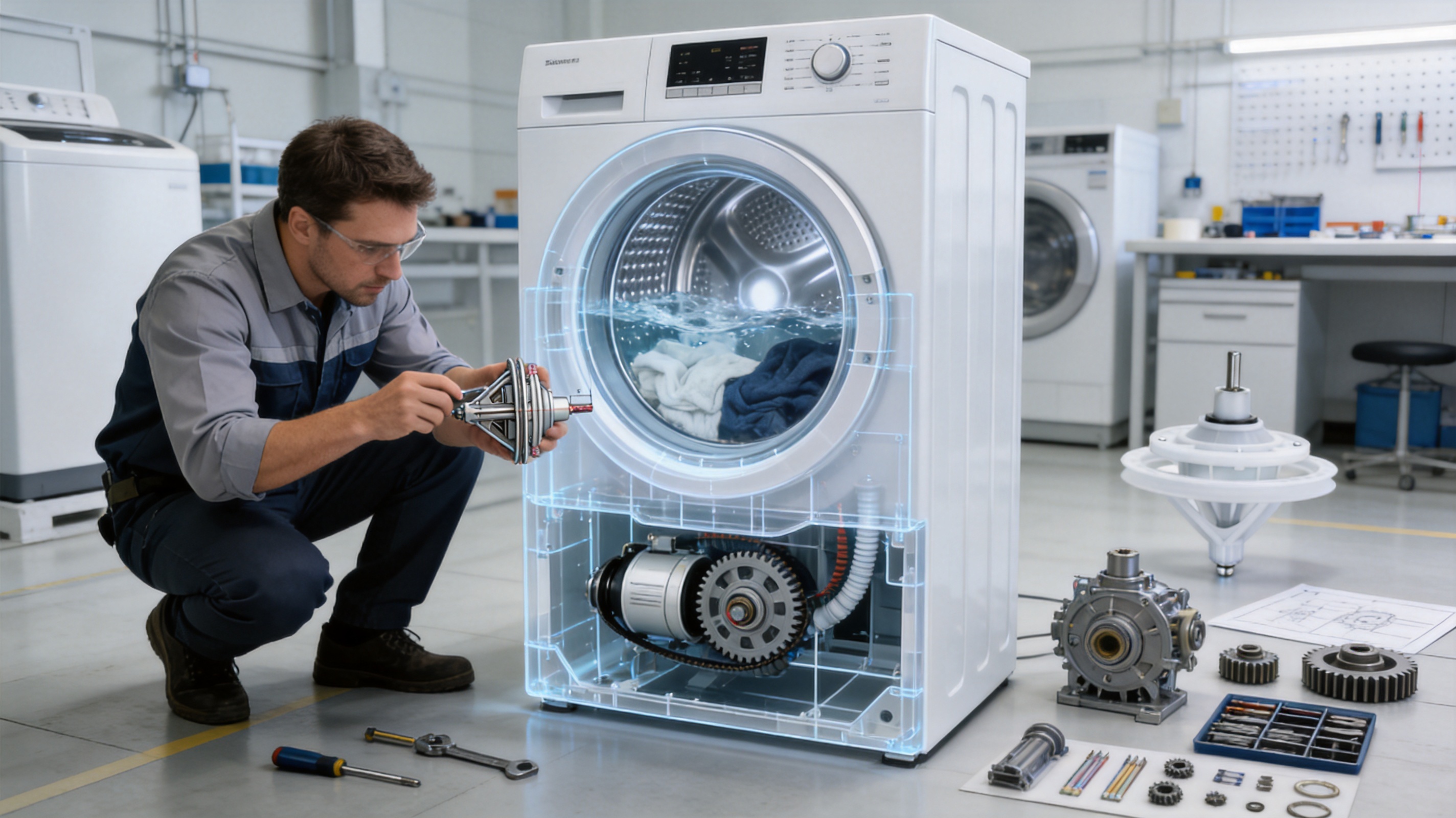
A semi-automatic washing machine gearbox is a critical transmission component that determines how effectively a washing machine converts motor power into useful washing action. Although compact and often hidden inside the appliance, the gearbox has a direct influence on washing performance, operating noise, energy transfer, service life, maintenance requirements, and overall product cost.
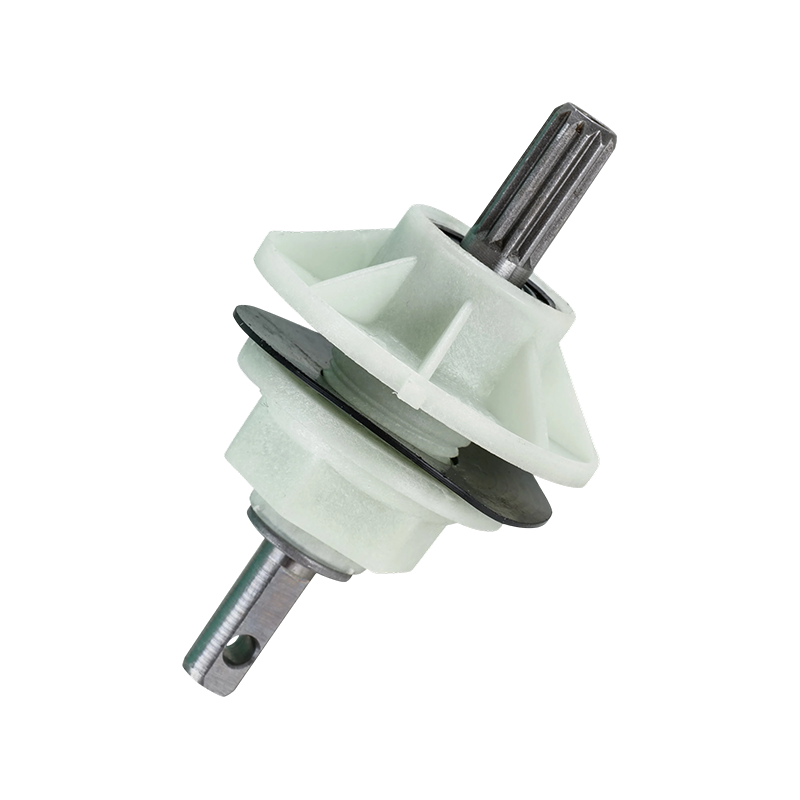
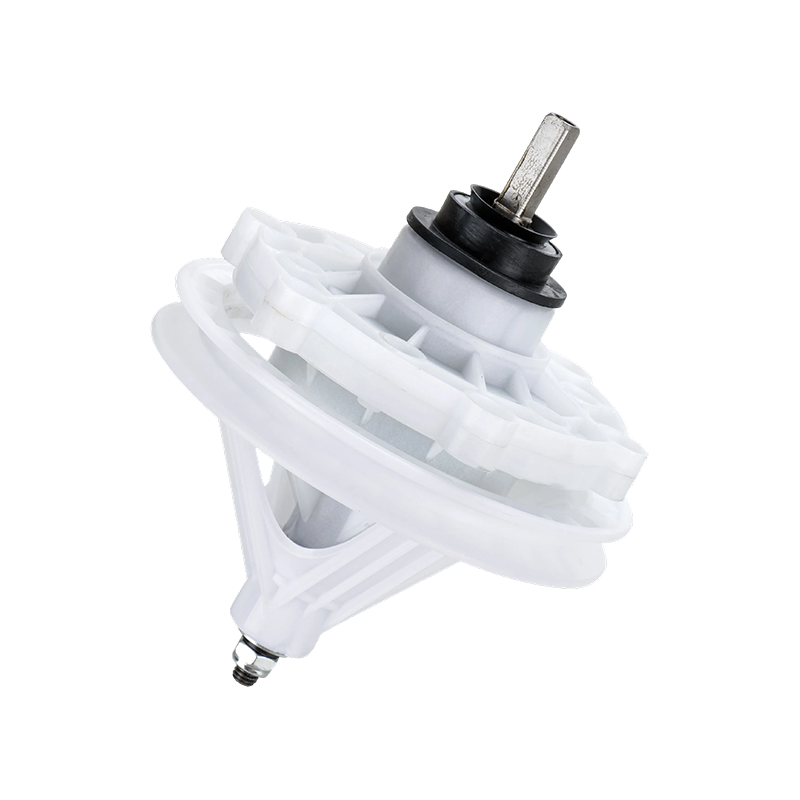
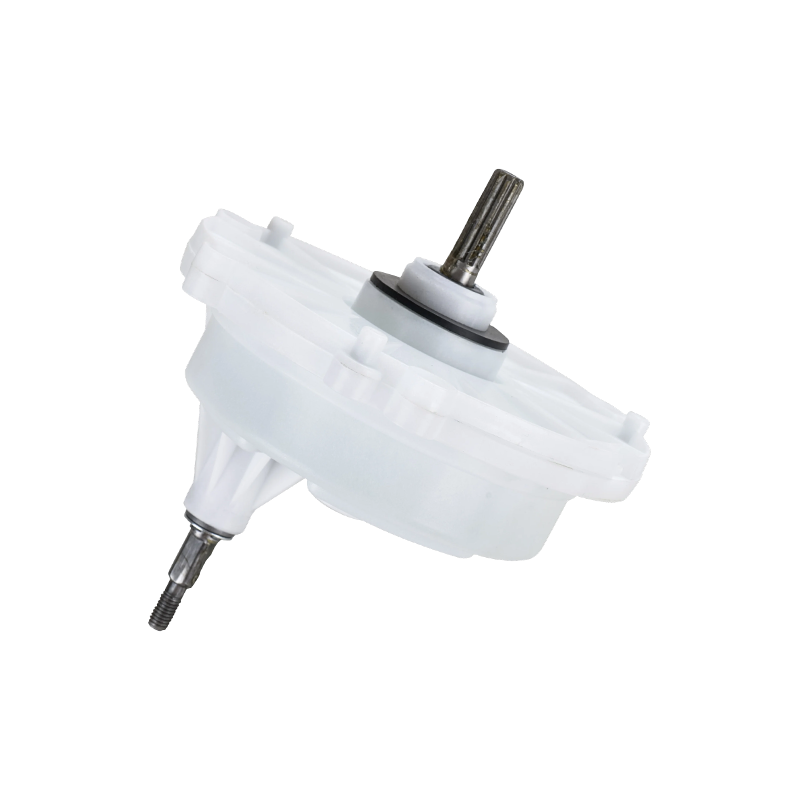
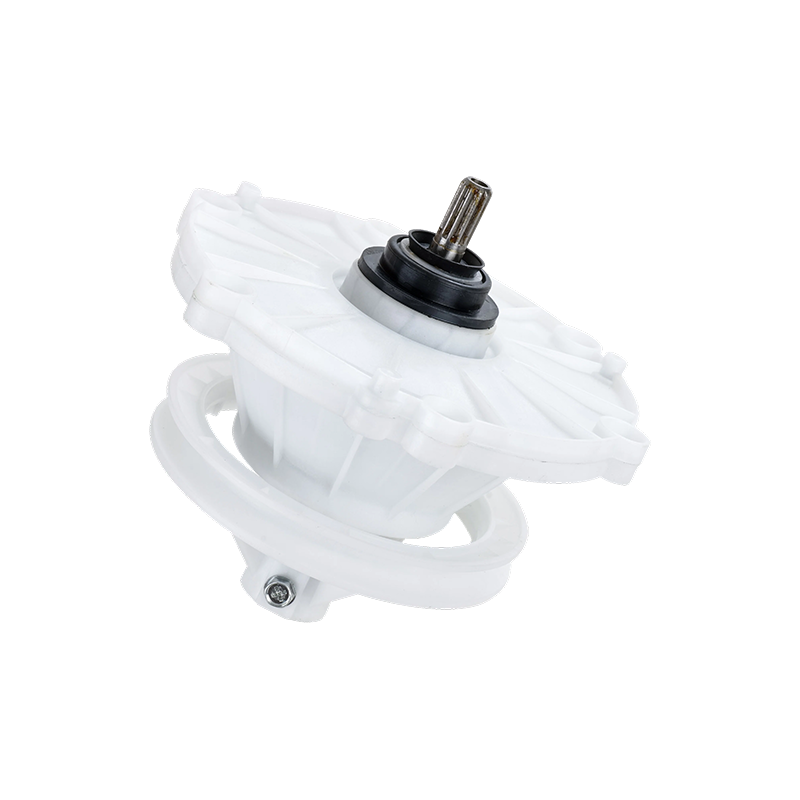
The Semi-auto Washing Machine Gear Box is designed for semi-automatic agitator washing machines that require dependable transmission in demanding household and commercial environments. Its primary task is to convert the motor’s high-speed rotation into a controlled, low-speed, high-torque output. This output drives the agitator, allowing it to move clothes and water through a consistent washing motion.
For manufacturers, distributors, repair professionals, and appliance brands, selecting the correct gearbox is more than a matter of choosing a replacement part. The component must match the washing machine’s mechanical structure, operating conditions, load requirements, and target market. It must also provide a practical balance between durability, manufacturing cost, availability, and ease of integration.
Produced by Cixi Gaite Electric Co., Ltd., this gearbox is part of a broader range of washing machine drive components developed for original equipment manufacturers and the aftermarket. The supplier combines in-house material production, established manufacturing processes, quality management systems, and customization capabilities to provide a stable solution for semi-automatic washing machine applications.
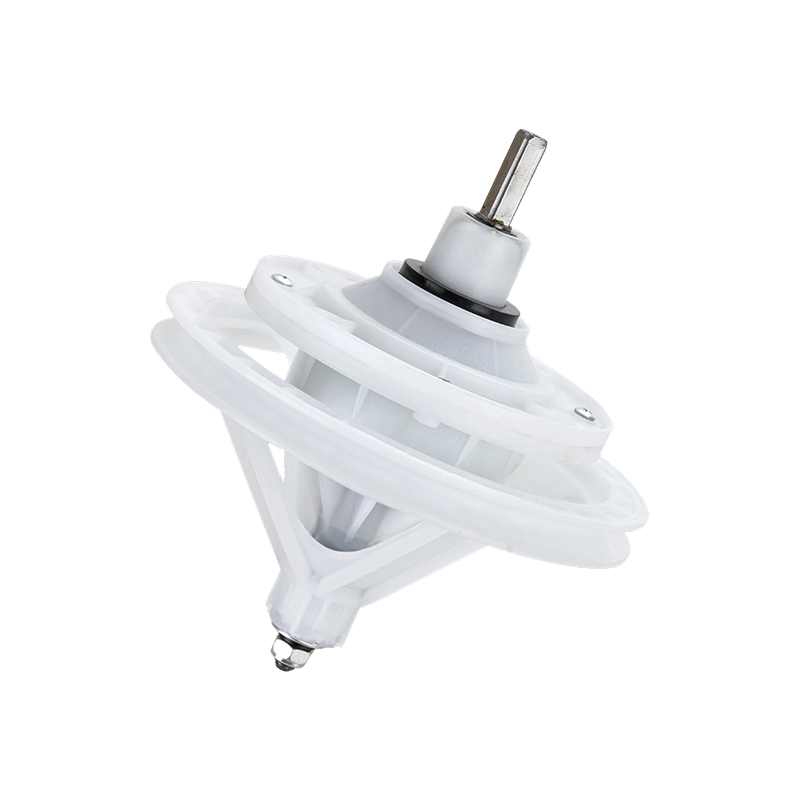
Semi-auto Washing Machine Gear Box
1. The Role of a Gearbox in a Semi-Automatic Washing Machine
A semi-automatic washing machine commonly uses an agitator or pulsator to create movement in the wash tub. The motor rotates at a speed that is generally unsuitable for directly driving the agitator. Direct motor output can be too fast, provide an unsuitable torque profile, and create excessive mechanical stress. The gearbox solves this problem by modifying the motor’s rotational characteristics before power reaches the agitator.
The transmission process involves several important functions. First, the gearbox reduces rotational speed. Second, it increases usable torque at the output shaft. Third, it transfers motion through a controlled mechanical arrangement that supports the required washing pattern. Finally, it helps maintain a stable relationship between the motor and agitator during repeated operating cycles.
In practical operation, the gearbox must withstand frequent starting and stopping, changes in load caused by wet clothing, water resistance, and long periods of exposure to a humid environment. It may also experience vibration, temperature fluctuations, assembly stress, and occasional overload caused by unbalanced or excessive loads.
A well-designed gearbox therefore contributes to more than simple motion transmission. It supports consistent washing action, reduces unnecessary stress on the motor, helps protect connected components, and improves the reliability of the complete washing machine.
1.1 Speed Reduction
The motor in a semi-automatic washing machine is designed to operate at a relatively high rotational speed. The agitator, however, requires slower movement to generate effective water circulation and fabric movement. The gearbox reduces the input speed to a more suitable output speed.
This reduction allows the agitator to move clothing through the water instead of simply spinning at excessive speed. Controlled low-speed movement helps improve contact between water, detergent, and fabric. It also supports a washing action that is more appropriate for household garments and common textile loads.
1.2 Torque Multiplication
When rotational speed is reduced through a transmission system, output torque can be increased. This is important because a loaded agitator must overcome water resistance, fabric drag, and friction in the washing mechanism. The gearbox provides the mechanical advantage required to move the load effectively.
Stable torque transmission is particularly important during startup. At the beginning of a cycle, the agitator must overcome static resistance and begin moving a combination of water and clothing. A gearbox with suitable mechanical strength helps the motor deliver this starting force without excessive slip, vibration, or power loss.
1.3 Motion Stability
The washing action must remain reasonably stable throughout the operating cycle. Irregular transmission, excessive shaft movement, or poorly controlled gear engagement can create noise and vibration. These problems may reduce user comfort and accelerate wear on the gearbox, agitator, tub, motor coupling, and mounting structure.
A properly manufactured gearbox supports consistent rotation and predictable mechanical behavior. This stability is valuable for both appliance manufacturers and service providers because it reduces the likelihood of secondary failures caused by abnormal transmission behavior.
2. Product Design Priorities
The Semi-auto Washing Machine Gear Box is developed around the practical requirements of semi-automatic agitator washing machines. Its design emphasizes durability, cost control, dependable power transmission, and suitability for operation in high-humidity environments.
These priorities are especially relevant in price-sensitive markets, where washing machines must deliver reliable daily performance while remaining affordable. A gearbox that is unnecessarily complex may increase the appliance price, complicate assembly, and make repairs more difficult. Conversely, a gearbox that is under-designed may create early failures, warranty costs, and dissatisfaction in the field.
The most effective approach is a balanced design that provides sufficient strength and durability for the intended application without adding unnecessary structural or manufacturing expense.
2.1 Durability in High-Humidity Conditions
Washing machines operate around water, detergent, wet textiles, and changing humidity levels. Even when the transmission is housed inside the appliance, the surrounding environment can create long-term challenges for metal parts, seals, bearings, fasteners, and lubricated surfaces.
The gearbox must therefore be produced with attention to material selection, surface condition, sealing, lubrication, assembly accuracy, and corrosion resistance. These factors work together. Strong materials alone cannot compensate for poor sealing, inaccurate assembly, or unsuitable lubrication practices.
By focusing on reliable manufacturing processes and controlled component production, the gearbox is intended to support stable operation over repeated washing cycles. The objective is not only to withstand a single high-load event, but also to maintain useful performance throughout long-term routine use.
2.2 Cost-Conscious Engineering
Many semi-automatic washing machines are sold in markets where purchase price is a major consideration. For these products, the transmission system must meet performance expectations without creating an excessive bill of materials or assembly burden.
Cost-conscious engineering does not mean removing essential quality controls. Instead, it involves selecting suitable materials, simplifying production where possible, controlling dimensional consistency, improving manufacturing efficiency, and using established component designs that can be produced at scale.
The result is a gearbox solution that can support competitive appliance pricing while still providing the mechanical reliability expected from a core drive component.
2.3 Compatibility with Semi-Automatic Agitator Systems
The gearbox is intended for semi-automatic agitator washing machines and should be evaluated according to the specific design of the appliance. Important compatibility factors may include input and output shaft dimensions, mounting geometry, center distances, rotation requirements, pulley or coupling arrangements, tub structure, and agitator connection details.
Because washing machine platforms vary by market and manufacturer, a technical review should be completed before production or replacement orders are finalized. Product drawings, samples, installation conditions, and operating requirements can be used to confirm suitability.
This compatibility-focused approach helps prevent problems such as misalignment, difficult installation, excessive belt tension, improper agitator movement, or interference with the appliance housing.
3. Key Advantages Compared with Generic or Poorly Matched Alternatives
Not every gearbox marketed for a semi-automatic washing machine provides the same level of practical value. Differences in material quality, dimensional control, manufacturing discipline, sealing, lubrication, inspection, and supplier support can significantly affect the performance of the finished appliance.
The following advantages describe the value of a purpose-oriented gearbox supplied through an established washing machine component manufacturer. They should be considered in comparison with generic products that may have limited documentation, inconsistent production, or uncertain compatibility.
3.1 Purpose-Oriented Transmission Design
A gearbox developed specifically for semi-automatic agitator washing machines is more likely to reflect the actual requirements of the application. Its output characteristics, structural arrangement, and installation concept can be evaluated in relation to washing-machine loads rather than general-purpose machinery.
This application focus helps manufacturers reduce the risk of selecting a transmission that technically rotates but does not provide the required torque, speed, durability, or fit. A purpose-oriented design also makes technical communication easier when discussing performance expectations and integration requirements.
3.2 Consistent Power Transfer
The gearbox is intended to transfer motor power to the agitator with controlled speed and increased torque. Consistent power transfer supports repeatable washing action and helps reduce sudden mechanical stress during starting and changing load conditions.
Compared with low-quality alternatives, a more carefully manufactured gearbox can provide better control of gear engagement, shaft alignment, bearing support, and rotating balance. These details may not be visible to the end user, but they strongly influence operating sound, vibration, component wear, and service life.
3.3 Structural Reliability
The gearbox housing and internal components must work together as a stable transmission unit. The housing supports the rotating parts, maintains alignment, contains lubricant, and provides attachment points for installation. Internal gears, shafts, bearings, and related components must maintain their intended relationship under load.
A structurally reliable gearbox is less likely to suffer from premature deformation, excessive clearance, or alignment-related wear. This can help protect the wider washing machine assembly and lower the chance of repeated service visits.
3.4 Better Supply Stability
For appliance manufacturers, a technically suitable component is valuable only when it can be supplied consistently. Production interruptions caused by material shortages, unstable subcontracting, or inconsistent quality can affect assembly schedules and customer delivery commitments.
Cixi Gaite Electric Co., Ltd. operates a production base of approximately 10,000 square meters and produces around 90 percent of its core materials in-house. This level of internal production can support better control over material availability, process coordination, and product consistency.
In-house production does not eliminate every supply risk, but it can reduce dependence on external sources and make it easier to coordinate quality and delivery requirements across the manufacturing process.
3.5 OEM and ODM Support
Different appliance brands may require different shaft configurations, mounting arrangements, performance targets, or packaging methods. A supplier with OEM and ODM experience can participate earlier in the product development process and help convert application requirements into a practical component solution.
OEM support may involve producing according to customer drawings or approved samples. ODM support may involve assisting with design selection, structural optimization, prototyping, validation, and production preparation. These capabilities are useful when a washing machine manufacturer is developing a new platform or adapting an existing platform for a different market.
3.6 Suitability for Aftermarket Replacement
The gearbox can also serve the replacement-parts market. Semi-automatic washing machines remain widely used in many regions, and aging appliances may require transmission replacement rather than complete replacement of the machine.
A suitable replacement gearbox can help repair businesses restore washing performance efficiently. For aftermarket applications, correct dimensions, installation compatibility, reliable operation, and clear technical communication are especially important because the installer may be working with an existing appliance whose condition varies.
| Evaluation Area | Value of a Purpose-Oriented Gearbox | Importance for Manufacturers and Repairers |
|---|
| Speed reduction | Converts high-speed motor rotation into suitable agitator movement | Supports effective washing action |
| Torque output | Provides mechanical force for loaded agitator operation | Improves startup and load-handling capability |
| Dimensional consistency | Supports repeatable installation and assembly | Reduces fitting problems and production delays |
| Humidity resistance | Addresses the wet operating environment of washing machines | Helps improve long-term reliability |
| Manufacturing control | Coordinates materials, machining, assembly, and inspection | Supports stable quality and supply |
| Customization | Allows adaptation to customer platforms and requirements | Enables OEM, ODM, and aftermarket applications |
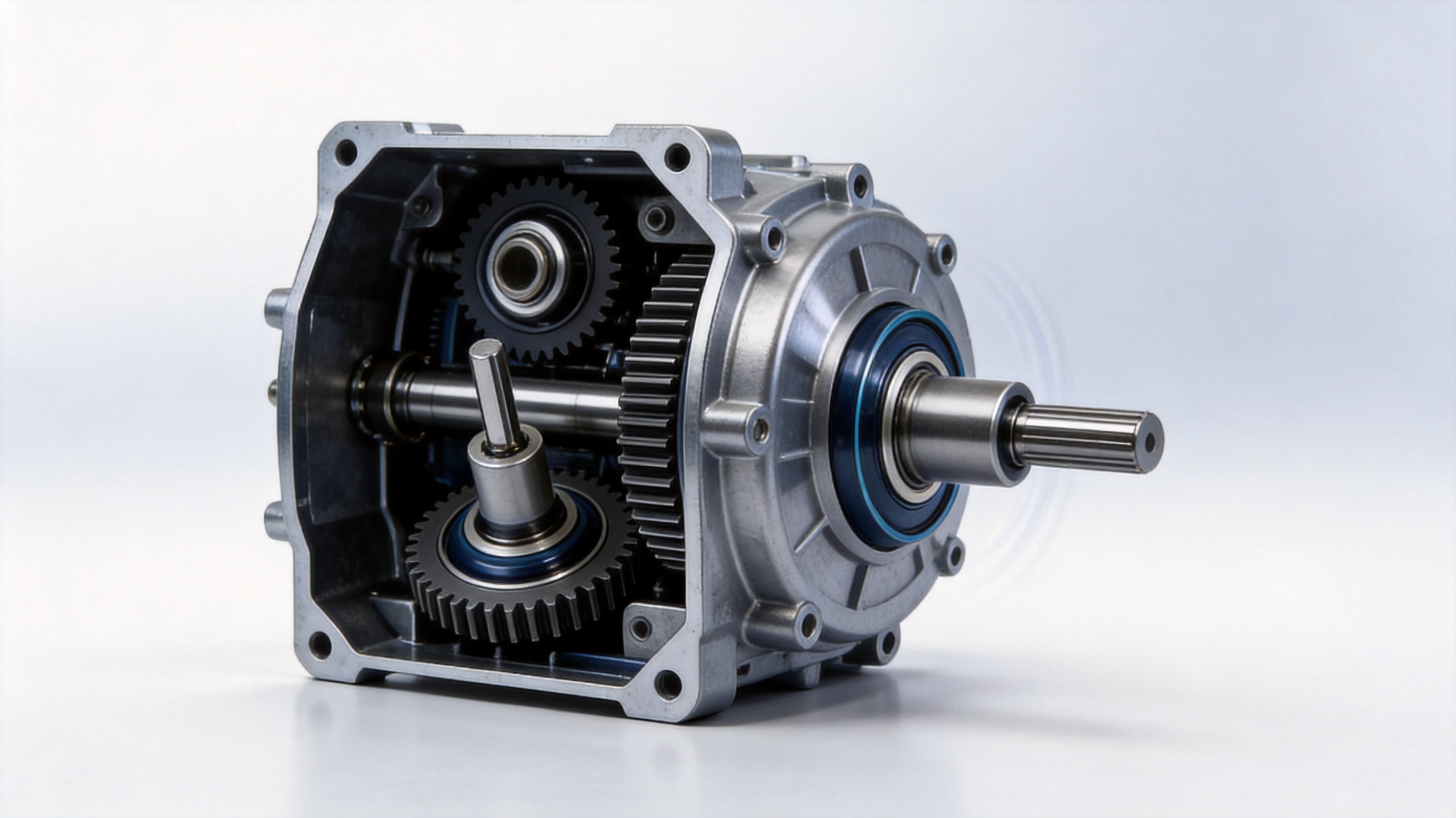
4. Manufacturing Strengths Behind the Product
The quality of a gearbox depends on more than its basic design. Manufacturing capability determines whether the intended design is reproduced accurately and consistently. Cixi Gaite Electric Co., Ltd. has specialized in washing machine components since 2002, with a focus on gear reducers, synchronizers, washing machine gearboxes, P-shafts, and related drive components.
This specialized product focus creates practical advantages. A manufacturer that works continuously with washing machine transmissions can develop deeper knowledge of common load conditions, installation requirements, failure modes, customer expectations, and production challenges. Such experience supports continuous improvement across design, processing, assembly, inspection, and technical service.
4.1 Integrated Production Base
The company’s production base covers approximately 10,000 square meters. A dedicated manufacturing site provides space for material handling, machining, component processing, assembly, testing, storage, packaging, and quality management activities.
Production integration can improve coordination between different stages. When machining, assembly, and inspection are managed within a connected manufacturing system, process feedback can be communicated more efficiently. Issues identified during assembly or testing may be traced back to earlier production steps, supporting corrective action and process refinement.
A well-organized production base also helps maintain a clearer production flow. This is important for a product such as a gearbox, where many parts must work together with appropriate dimensional and functional relationships.
4.2 In-House Core Material Production
Approximately 90 percent of the company’s core materials are produced in-house. This internal production ratio is a significant manufacturing strength because material consistency affects every subsequent process.
In-house production can support control over material specifications, processing parameters, intermediate inspection, and production scheduling. It may also reduce the variation that can occur when critical parts are sourced from multiple external suppliers with different equipment, procedures, and quality standards.
For customers, this can create greater confidence in repeat orders. A stable source of core materials helps reduce the possibility that a product will change unexpectedly because of an uncontrolled supplier substitution or inconsistent batch condition.
4.3 Precision-Oriented Processing
Gearbox components require appropriate dimensional accuracy and surface quality. Shafts, gears, housings, bearing seats, seals, and connecting parts must be manufactured within suitable tolerances for the intended design.
Precision-oriented processing helps maintain alignment between rotating components. It can also support proper engagement between gear teeth, reduce unnecessary friction, limit vibration, and improve the effectiveness of lubrication. The required tolerance depends on the specific design, but the general principle remains the same: consistent machining contributes directly to reliable transmission performance.
Manufacturing equipment and process parameters must be selected according to the material and function of each component. Cutting, forming, drilling, turning, grinding, finishing, and related processes may be applied as appropriate to the product structure.
4.4 Controlled Assembly
Gearbox assembly requires careful attention to part orientation, shaft positioning, bearing installation, sealing, lubrication, fastener control, and housing closure. An assembly error can undermine the quality of otherwise well-produced components.
Controlled assembly procedures help ensure that each gearbox is built according to the intended configuration. Standardized work instructions, suitable tooling, trained operators, and in-process checks all contribute to repeatable assembly quality.
Assembly control is particularly important when a supplier produces several related models. Clear identification and process separation help reduce the risk of mixing components or applying the wrong assembly procedure to a particular product version.
4.5 Testing and Inspection
Inspection and testing provide evidence that the gearbox meets defined requirements. Depending on the customer’s specification and product design, evaluations may include dimensional checks, visual inspection, shaft rotation, noise, vibration, leakage, torque behavior, load performance, and endurance testing.
Testing can be performed at different stages. Incoming material inspection verifies that supplied materials or purchased components meet requirements. In-process inspection identifies deviations before they are built into a completed gearbox. Final inspection confirms that the assembled unit is ready for shipment.
For OEM programs, customers may also define additional validation procedures, sampling plans, traceability requirements, or approval standards. A capable supplier should be prepared to coordinate these requirements during product development and mass production.
4.6 Quality and Environmental Management
Cixi Gaite Electric Co., Ltd. has obtained ISO 9001 Quality Management System certification and ISO 14001 Environmental Management System certification. These certifications reflect the company’s formal approach to quality management and environmental responsibility.
ISO 9001 provides a framework for consistent processes, documented procedures, customer requirements, corrective action, and continual improvement. For gearbox customers, this can support more reliable order execution and quality communication.
ISO 14001 addresses environmental management practices. Manufacturing companies must consider energy use, waste, emissions, material handling, and legal or regulatory responsibilities. Environmental management is increasingly important for appliance supply chains, particularly when customers evaluate suppliers according to broader sustainability objectives.
The company’s products comply with RoHS requirements. This supports customer needs related to restricted substances and responsible product manufacturing. Compliance documentation should be confirmed according to the specific order, market, and customer requirements.
5. How the Gearbox Supports Washing Machine Performance
The transmission system affects several aspects of the finished washing machine. While it is not the only factor controlling performance, it has an important influence on how efficiently mechanical power is delivered to the agitator.
5.1 Effective Water and Fabric Movement
The agitator must create movement that carries water and clothing through the wash zone. If the output speed is too high, the machine may generate excessive turbulence or unnecessary mechanical stress. If the output torque is insufficient, the agitator may struggle under load.
A suitable gearbox provides a controlled combination of speed and torque. This allows the agitator to move clothing and water more effectively, supporting the basic washing function of a semi-automatic appliance.
5.2 Reduced Mechanical Stress
Directly connecting a high-speed motor to an agitator would place unsuitable mechanical demands on the washing system. The gearbox acts as an intermediary that adapts motor behavior to the needs of the washing mechanism.
By managing speed and torque, it can help reduce stress on the agitator shaft, coupling system, mounting structure, and motor. This may contribute to improved durability throughout the appliance, provided that the machine is correctly assembled and operated within its intended load range.
5.3 Improved User Experience
Users generally expect a washing machine to operate with reasonable stability and without excessive noise. Transmission quality can affect sound and vibration, especially during startup and under heavy loads.
A gearbox with accurate alignment, suitable component fit, and controlled assembly can help the appliance produce a more consistent operating experience. It cannot eliminate all washing-machine noise because motor, belt, tub, pump, and cabinet design also contribute, but it is an important part of the overall mechanical system.
5.4 Serviceability and Replacement Value
When a gearbox is available as an individual component, manufacturers and service providers can repair a machine without replacing the entire appliance. This approach may reduce material waste and lower repair costs for users.
For distributors, a dependable gearbox can be a useful addition to a washing machine parts portfolio. For repair companies, consistent availability and technical support can improve job completion rates and reduce the need to adapt unsuitable components.
6. Application and Selection Considerations
Before ordering a semi-automatic washing machine gearbox, buyers should confirm the mechanical and commercial requirements of the application. Even when two gearboxes appear similar, small differences in dimensions or output behavior may affect installation and operation.
6.1 Mechanical Compatibility
Important mechanical parameters may include the input shaft, output shaft, mounting holes, housing dimensions, shaft height, rotational direction, pulley or coupling interface, and connection to the agitator. These details should be compared with the washing machine drawing or an approved sample.
Where an existing gearbox is being replaced, the original component should be inspected for identification marks, dimensions, mounting pattern, and connection details. Photographs can support an initial review, but drawings or physical samples are usually more reliable for final confirmation.
6.2 Operating Requirements
The supplier should understand the motor characteristics, expected washing load, operating cycle, voltage and frequency environment, duty pattern, and target service life. The gearbox should be selected according to the complete drive system rather than as an isolated part.
Customers should also identify whether the gearbox will be used in a new appliance platform, a replacement program, or a general aftermarket application. Each situation may require a different level of testing, documentation, packaging, and traceability.
6.3 Installation Conditions
Correct installation is essential for gearbox performance. The gearbox must be properly aligned, securely mounted, and connected to the motor and agitator according to the approved design. Excessive belt tension, incorrect coupling, shaft misalignment, loose fasteners, or interference with surrounding parts can cause premature problems.
Installers should follow the relevant appliance assembly instructions and verify that the transmission rotates freely before operating the machine under load.
6.4 Lubrication and Sealing
Lubrication reduces friction and supports the service life of moving components. Sealing helps retain lubricant and limit the entry of water, detergent residue, and contaminants. The correct lubricant type and quantity should be determined by the gearbox design and supplier instructions.
Improper lubricant selection or excessive lubricant can be as problematic as insufficient lubrication. For this reason, customers should request the applicable maintenance and handling requirements when placing an OEM or aftermarket order.
6.5 Packaging and Transportation
Gearboxes contain precision interfaces and rotating parts that should be protected during transportation. Appropriate packaging helps prevent shaft damage, housing impact, moisture exposure, contamination, and mixed-model shipments.
For international supply, packaging may need to accommodate extended transport, multiple handling stages, warehouse storage, and different climate conditions. Labeling should clearly identify the model, quantity, batch information, and customer order reference where required.
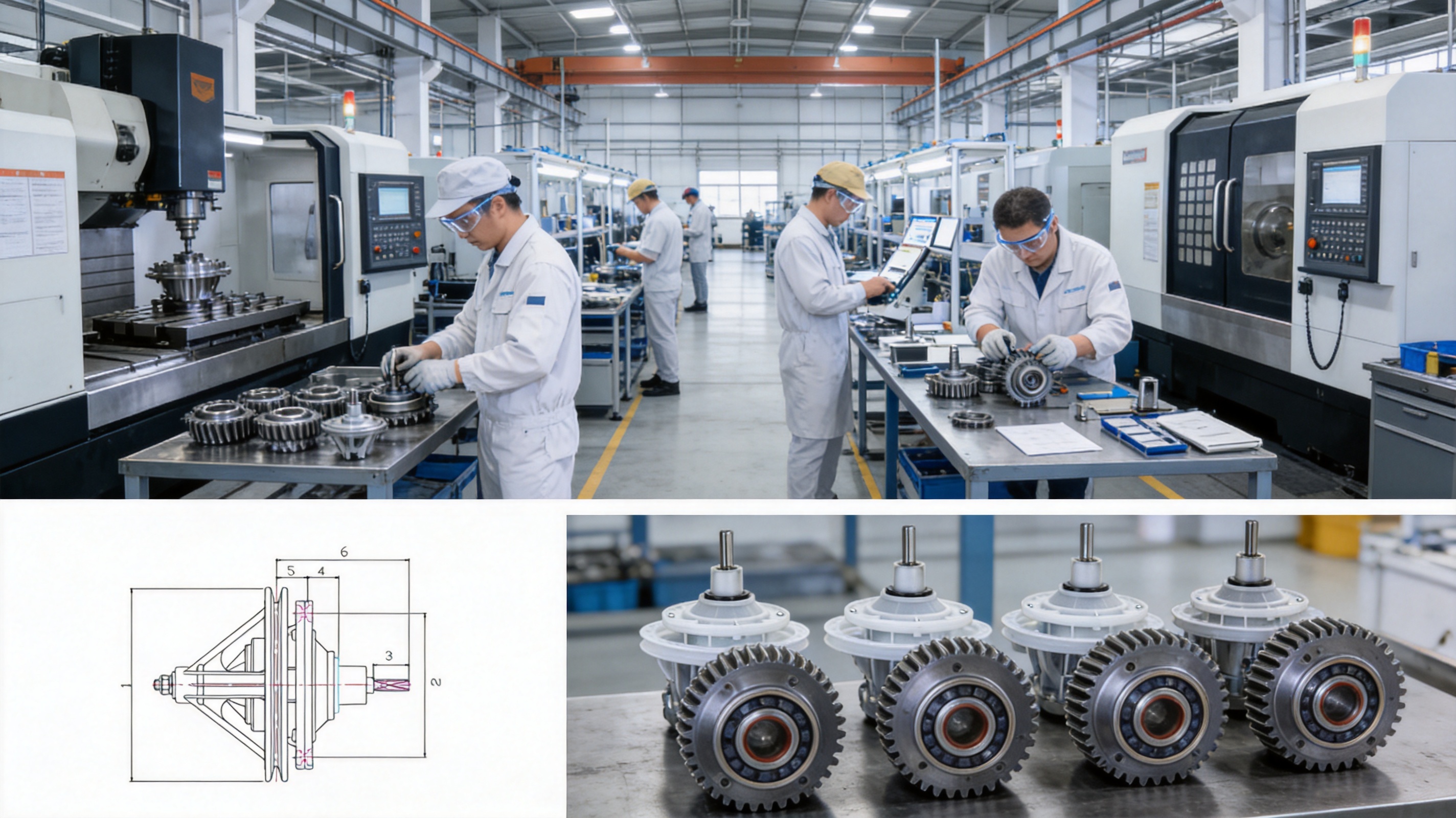
7. OEM and ODM Cooperation Process
A structured cooperation process helps ensure that the gearbox meets the technical and commercial needs of the washing machine manufacturer. Cixi Gaite Electric Co., Ltd. provides OEM and ODM solutions for washing machine gearboxes, transmissions, P-shafts, and other drive components.
7.1 Requirement Review
The process normally begins with a review of the customer’s application. The customer may provide drawings, samples, photographs, performance targets, assembly conditions, or information about an existing gearbox.
At this stage, both parties should clarify the intended machine type, load range, motor arrangement, agitator connection, operating environment, annual demand, target cost, and required approval documents.
7.2 Technical Evaluation
Engineers can then evaluate whether an existing gearbox is suitable or whether customization is required. Technical evaluation may identify differences in mounting dimensions, shaft design, output behavior, housing structure, sealing, or material requirements.
Early evaluation helps avoid expensive changes after tooling or mass production has begun. It also allows the customer to compare alternative solutions according to performance, cost, lead time, and development risk.
7.3 Prototype and Sample Approval
For a new application, samples or prototypes may be produced for dimensional inspection and functional testing. The washing machine manufacturer can install the gearbox in the intended appliance and evaluate fit, noise, vibration, washing action, and load behavior.
Sample approval should be based on documented criteria. Approved drawings, specifications, samples, and test results can establish a reference for future production.
7.4 Production Preparation
Once the design is approved, production preparation includes material planning, process development, tooling, work instructions, inspection standards, packaging confirmation, and scheduling. The objective is to make the approved sample reproducible in regular production.
Clear communication at this stage reduces the risk of misunderstanding between technical, purchasing, quality, and production teams.
7.5 Mass Production and Continuous Improvement
During mass production, quality data and customer feedback can be reviewed to identify opportunities for improvement. Process capability, defect trends, field performance, delivery results, and customer service records may all provide useful information.
Continuous improvement is especially valuable for high-volume washing machine programs. Even small improvements in assembly time, material utilization, inspection efficiency, or defect prevention can create meaningful benefits over the life of a product platform.
8. Why Specialist Experience Matters
Washing machine components operate within a specialized mechanical and environmental system. A supplier that focuses on this sector can provide more relevant knowledge than a general industrial transmission producer unfamiliar with appliance integration.
GAITE was founded in 2002 in Ningbo, Zhejiang, China, and has developed long-term partnerships with Sharp Corporation, Panasonic Corporation, and Midea Group. These relationships reflect experience in supplying major appliance manufacturers, although each new project still requires its own technical evaluation and approval.
The company’s main products include washing machine parts, washing machine gearboxes, and P-shafts. This product concentration supports a broader understanding of the drive system and allows related components to be considered together when necessary.
Specialist experience can help customers address practical questions such as how a gearbox interacts with a motor, whether a P-shaft or coupling requires adjustment, how a housing should be mounted, and which quality documents are needed for a specific market.
It can also improve communication. Customers do not need to explain every basic feature of a washing machine transmission to a supplier that already works with similar products. This can shorten the path from inquiry to technical confirmation.
9. Quality, Compliance, and Responsible Manufacturing
Modern appliance supply chains evaluate components according to performance, safety, environmental responsibility, and documentation. A gearbox supplier must therefore manage both the physical product and the systems that support its production.
ISO 9001 certification indicates that the company operates a quality management framework designed to control processes and support customer satisfaction. In practice, a quality system may include document control, supplier management, production monitoring, inspection, nonconformity handling, corrective action, and continual improvement.
ISO 14001 certification demonstrates attention to environmental management. Responsible production involves more than the final product. It includes the way materials are handled, production waste is managed, energy is consumed, and environmental risks are monitored.
RoHS compliance is relevant to customers selling washing machines and replacement parts in markets where restrictions on hazardous substances apply. Buyers should confirm the applicable compliance documents and product scope for each project, especially when a custom material or surface treatment is introduced.
These certifications and compliance practices do not replace product-specific validation. Instead, they provide a management foundation that supports consistent manufacturing and responsible supply-chain cooperation.
10. Maintenance and Service Recommendations
Although a gearbox is designed for long-term operation, its service life depends on the full washing machine system. Correct loading, proper installation, suitable operating conditions, and timely repair all contribute to transmission durability.
10.1 Avoid Overloading
Excessive clothing loads increase resistance on the agitator and transmission. Repeated operation beyond the intended capacity can raise torque demand and accelerate wear on gears, shafts, bearings, couplings, and motor components.
Users should follow the washing machine’s recommended capacity and distribute clothing appropriately in the tub.
10.2 Check for Abnormal Noise
New or increasing noise may indicate a problem with the gearbox, belt, motor, agitator, mounting structure, or surrounding components. Early inspection can prevent a minor issue from developing into a larger failure.
Grinding, knocking, repeated clicking, excessive vibration, or irregular output movement should not be ignored. Service personnel should identify the source before replacing components.
10.3 Inspect Mounting and Connections
Loose fasteners, misaligned shafts, damaged couplings, or incorrect belt tension can place additional stress on the gearbox. During service, technicians should inspect the mounting arrangement and confirm that all connected parts are properly installed.
10.4 Protect Against Water Intrusion
Water or detergent entering the transmission can damage lubricant and accelerate corrosion or wear. Seals and surrounding structures should be inspected when leakage or unusual operating conditions are observed.
10.5 Use Correct Replacement Parts
A replacement gearbox should match the original application in dimensions, output characteristics, mounting arrangement, and operating requirements. Installing a visually similar but technically unsuitable component may lead to poor washing performance or early failure.
11. Commercial Value for Different Customer Groups
11.1 Appliance Manufacturers
For washing machine manufacturers, the gearbox is a core component that affects product reliability and customer satisfaction. A stable supplier can help reduce production interruptions, simplify quality management, and support the development of new appliance models.
OEM and ODM capabilities are particularly valuable when a manufacturer requires a customized transmission or wants to optimize an existing design for cost, performance, or local market requirements.
11.2 Importers and Distributors
Importers and distributors need products that are technically credible, commercially competitive, and available in consistent quantities. A supplier with a dedicated production base and in-house core material capability may offer stronger supply continuity than an informal trading source.
Distributors can also benefit from product support, packaging coordination, technical documentation, and the ability to combine different washing machine components within one supplier relationship.
11.3 Repair Businesses
Repair businesses require replacement parts that can be installed efficiently and perform reliably in existing machines. A suitable semi-automatic washing machine gearbox can help extend the service life of appliances and reduce the cost of complete replacement.
For repair professionals, accurate model identification and compatibility confirmation remain essential. Technical support before ordering can help avoid returns and installation problems.
11.4 Appliance Brand Owners
Brand owners often need to protect product reputation over many years. A gearbox supplier that supports quality consistency, documentation, compliance, and continuous improvement can contribute to the brand’s long-term reliability objectives.
Supplier evaluation should consider not only unit price but also defect risk, delivery stability, development support, communication quality, and after-sales response.
12. Frequently Asked Questions
Q1: What is the main function of a semi-automatic washing machine gearbox?
The main function is to convert the motor’s high-speed rotation into a lower-speed, higher-torque output suitable for driving the washing machine agitator. This allows the agitator to move clothing and water effectively during the wash cycle.
Q2: Why is a gearbox necessary instead of connecting the motor directly to the agitator?
A washing machine motor generally operates at a speed and torque profile that is not suitable for direct agitator operation. The gearbox adapts the motor output, reducing speed and increasing usable torque while supporting controlled washing movement.
Q3: Is this gearbox suitable for every semi-automatic washing machine?
Suitability depends on the specific washing machine design. Mounting dimensions, shaft configuration, rotation requirements, coupling structure, agitator connection, and performance conditions should be confirmed before ordering. Technical drawings or samples are recommended for final validation.
Q4: Can the gearbox be customized?
OEM and ODM cooperation is available for washing machine gearboxes and related drive components. Customization may involve dimensions, mounting features, shaft arrangements, materials, packaging, or other customer-defined requirements, subject to technical evaluation.
Q5: What makes this product suitable for price-sensitive markets?
The design emphasizes reliable transmission, durability, and cost control. Manufacturing integration and in-house production of approximately 90 percent of core materials can also support efficient production and stable supply while maintaining attention to quality.
Q6: Is the gearbox suitable for aftermarket replacement?
It may be suitable for aftermarket applications when the dimensions and operating requirements match the original washing machine. Installers should compare the original component with the replacement gearbox and confirm compatibility before installation.
Q7: What certifications and compliance measures are associated with the manufacturer?
Cixi Gaite Electric Co., Ltd. has obtained ISO 9001 Quality Management System and ISO 14001 Environmental Management System certifications. Its products comply with RoHS requirements. Specific documentation should be confirmed for the relevant order and market.
Q8: How can customers begin an OEM or ODM project?
Customers can provide product drawings, physical samples, photographs, application details, target quantities, and performance requirements. The supplier can then review compatibility, recommend a solution, prepare samples where necessary, and coordinate approval before mass production.
Q9: What information should be included in a gearbox inquiry?
An inquiry should ideally include the washing machine type, original gearbox model, motor information, mounting dimensions, shaft dimensions, agitator connection, required quantity, target market, packaging requirements, and any available drawings or samples.
Q10: How does manufacturing control affect gearbox reliability?
Material consistency, machining accuracy, assembly control, lubrication, sealing, and inspection all affect transmission performance. Strong manufacturing control helps ensure that gearboxes produced in different batches maintain consistent dimensions and operating behavior.
Q11: What should be checked if a replacement gearbox produces unusual noise?
Technicians should check mounting fasteners, alignment, belt or coupling condition, agitator connection, surrounding interference, lubrication, and the condition of the motor and tub assembly. The gearbox should not be assumed to be the only possible source of noise.
Q12: Why is supplier experience in washing machine components important?
Specialist experience helps the supplier understand appliance-specific loads, installation requirements, moisture exposure, customer validation procedures, and common transmission problems. This can improve technical communication and reduce development risk.
13. Conclusion
The Semi-auto Washing Machine Gear Box is an essential component for converting motor power into effective agitator movement. By reducing speed and increasing torque, it helps semi-automatic washing machines deliver stable washing action under practical household operating conditions.
Its value is based on a balanced combination of transmission performance, durability, humidity suitability, cost-conscious engineering, and compatibility with OEM and aftermarket requirements. Compared with generic or poorly matched alternatives, a purpose-oriented gearbox can provide more reliable power transfer, better installation confidence, stronger supply support, and a clearer path to customization.
Cixi Gaite Electric Co., Ltd. brings specialized experience in washing machine components, a production base of approximately 10,000 square meters, and in-house production of around 90 percent of core materials. Its capabilities include washing machine gearboxes, gear reducers, synchronizers, P-shafts, and other drive components for appliance manufacturers and the aftermarket.
The company’s ISO 9001 and ISO 14001 certifications, RoHS compliance, established manufacturing processes, OEM and ODM support, and experience with international appliance customers provide a practical foundation for long-term cooperation. For buyers evaluating a semi-automatic washing machine gearbox, the most important steps are to confirm compatibility, define operating requirements, review quality documentation, and validate the component within the intended washing machine platform.
When these steps are completed carefully, the gearbox can contribute to dependable appliance performance, lower maintenance risk, efficient manufacturing, and longer useful life for semi-automatic washing machines.
References
1. Product information for the Semi-auto Washing Machine Gear Box, supplied in the customer-provided product materials.
2. Company information for Cixi Gaite Electric Co., Ltd., including manufacturing capabilities, product range, certifications, and company history, supplied in the customer-provided materials.
3. ISO 9001, Quality Management Systems — Requirements.
4. ISO 14001, Environmental Management Systems — Requirements with Guidance for Use.
5. Restriction of Hazardous Substances requirements and related product compliance principles.
6. General engineering principles for mechanical power transmission, gear reduction, torque conversion, lubrication, sealing, and rotating component alignment.
7. General appliance manufacturing and maintenance practices for semi-automatic washing machines and agitator drive systems.

 English
 عربى



 +86-574-63256717 /63267914
info@gaite.cn
 gaite@gaite.cn
 No. 208 Miaoshan Road, Shiyan Village, Henghe Town, Cixi City, Ningbo City, Zhejiang Province, China
